Propositional equality, identity types, and direct computational paths
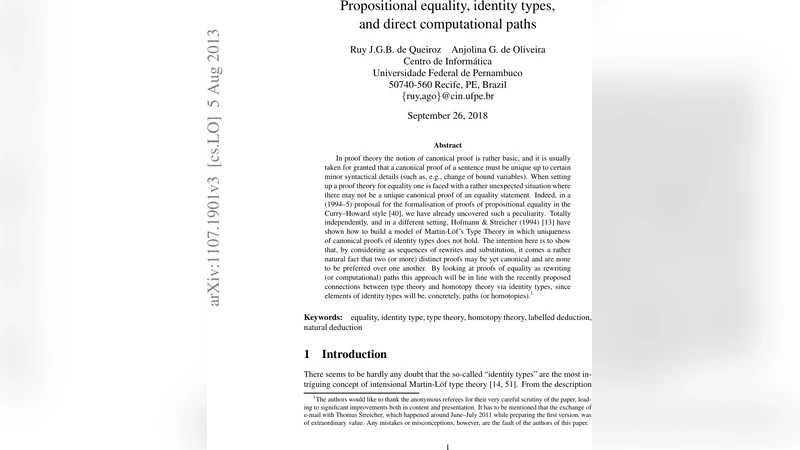
In proof theory the notion of canonical proof is rather basic, and it is usually taken for granted that a canonical proof of a sentence must be unique up to certain minor syntactical details (such as, e.g., change of bound variables). When setting up a proof theory for equality one is faced with a rather unexpected situation where there may not be a unique canonical proof of an equality statement. Indeed, in a (1994–5) proposal for the formalisation of proofs of propositional equality in the Curry–Howard style, we have already uncovered such a peculiarity. Totally independently, and in a different setting, Hofmann & Streicher (1994) have shown how to build a model of Martin-L"of’s Type Theory in which uniqueness of canonical proofs of identity types does not hold. The intention here is to show that, by considering as sequences of rewrites and substitution, it comes a rather natural fact that two (or more) distinct proofs may be yet canonical and are none to be preferred over one another. By looking at proofs of equality as rewriting (or computational) paths this approach will be in line with the recently proposed connections between type theory and homotopy theory via identity types, since elements of identity types will be, concretely, paths (or homotopies).
💡 Research Summary
The paper investigates a subtle but fundamental phenomenon in Martin‑Löf’s dependent type theory: the non‑uniqueness of canonical proofs of identity (equality) types. In ordinary proof theory a canonical proof is considered unique up to trivial syntactic variations such as renaming bound variables. When one turns to the identity type, however, this expectation fails. The authors revisit two independent lines of work—an early Curry‑Howard style formalisation of propositional equality (1994‑95) and the Hofmann‑Streicher groupoid model (1994)—and show that both exhibit multiple, distinct canonical proofs for the same equality proposition.
The central idea is to view an equality proof not as a mere logical derivation but as a computational or rewriting path: a concrete sequence of rewrites and substitutions that transforms a term a into a term b. To make this precise the paper introduces three meta‑operators that capture the basic equational principles:
- Reflexivity ρ – the trivial path a = ρ a,
- Symmetry σ – turning a = t b into b = σ(t) a,
- Transitivity τ – composing a = t b and b = r c into a = τ(t,r) c.
Each operator is lifted to the object language: for instance ρ(a) : Id A(a,a). The identifier ‘s’ that appears in the introduction rule for Id A is interpreted as the actual rewrite sequence, so an element of Id A(a,b) is literally a path from a to b.
With this path‑based view the usual Id‑elimination rule (the J‑operator) is reformulated. By exploiting J together with the three basic operators the paper defines:
- inv A : a function that, given p : Id A(x,y), produces σ(p) : Id A(y,x) (the inverse path),
- cmp A : a function that, given p : Id A(x,y) and q : Id A(y,z), yields τ(p,q) : Id A(x,z) (path composition).
These constructions satisfy the familiar groupoid laws, but only up to propositional (i.e. second‑level) equality. For example, the associativity law τ(τ(t,r),s) = tt τ(t,τ(r,s)) is witnessed by a term of type Id Id A(…), not by a definitional equality. Similarly, unit laws involving the reflexivity path r(x) hold only in Id Id A. Thus each type A carries an internal weak ω‑groupoid structure, a fact that aligns with results of Lumsdaine and of van den Bergh & Garner showing that the tower Id A, Id Id A, … forms a weak ω‑groupoid.
The paper connects this picture to the failure of UIP (Uniqueness of Identity Proofs) in the Hofmann‑Streicher model. UIP would collapse all paths between the same endpoints to a single canonical one; the existence of distinct computational paths demonstrates precisely why UIP does not hold in general. This non‑uniqueness is precisely the phenomenon observed in homotopy type theory (HoTT), where types are interpreted as spaces and identity proofs as paths (or homotopies).
To manage the algebra of paths, the authors introduce a small rewriting system for equality proofs. Two key reduction rules are presented:
- σ ∘ ρ → sr (symmetry after reflexivity reduces to a “straight‑right” path),
- τ ∘ τ → tt (associative composition reduces to a canonical associator).
These reductions ensure that the use of symmetry— the only operator that flips direction— is controlled, and that composition is associative up to a canonical higher‑dimensional proof. The system thus provides a computational account of the higher‑dimensional structure of identity types.
In summary, the paper argues that viewing identity proofs as concrete computational paths resolves the apparent paradox of multiple canonical proofs, clarifies the internal groupoid‑like structure of types, and situates Martin‑Löf type theory firmly within the homotopical perspective. It offers a syntactic account (via rewrite sequences and reduction rules) that mirrors the semantic groupoid models, thereby bridging proof‑theoretic, categorical, and homotopical viewpoints on equality.
Comments & Academic Discussion
Loading comments...
Leave a Comment