Accretion flow behaviour during the evolution of the Quasi Periodic Oscillation Frequency of XTE J1550-564 in 1998 outburst
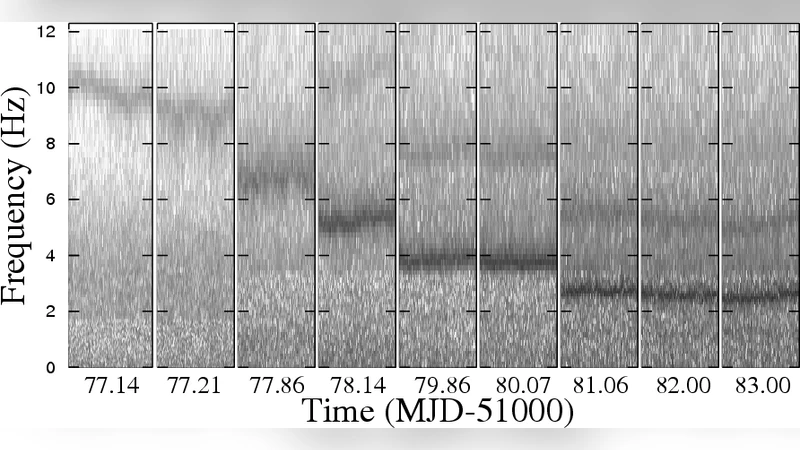
Low and intermediate frequency quasi-periodic oscillations (QPOs) are thought to be due to oscillations of Comptonizing regions or hot regions embedded in Keplerian discs. Observational evidence of evolutions of QPOs would therefore be very important as they throw lights on the dynamics of the hotter region. Our aim is to find systems in which there is a well-defined correlation among the frequencies of the QPOs over a range of time so as to understand the physical picture. In this paper, we concentrate on the archival data of XTE J1550-564 obtained during 1998 outburst, and study the systematic drifts during the rising phase from the 1998 September 7 to the 1998 September 19, when the QPO frequency increased monotonically from 81mHz to 13.1Hz. Immediately after that, QPO frequency started to decrease and on the 1998 September 26, the QPO frequency became 2.62Hz. After that, its value remained almost constant. This frequency drift can be modelled satisfactorily with a propagatory oscillating shock solution where the post-shock region behaves as the Comptonized region. Comparing with the nature of a more recent 2005 outburst of another black hole candidate GRO 1655-40, where QPOs disappeared at the end of the rising phase, we conjecture that this so-called `outburst’ may not be a full-fledged outburst.
💡 Research Summary
The paper investigates the temporal evolution of low‑ and intermediate‑frequency quasi‑periodic oscillations (QPOs) observed during the 1998 outburst of the black‑hole candidate XTE J1550‑564. Using archival RXTE data, the authors track the QPO frequency from 81 mHz on 1998 September 7, through a monotonic rise to 13.1 Hz by September 19, followed by a decline to 2.62 Hz on September 26, after which the frequency stabilises. This well‑defined evolution provides a rare opportunity to probe the dynamics of the hot, Comptonizing region that is thought to generate the QPOs.
To interpret the observed drift, the authors adopt the two‑component advective flow (TCAF) framework, wherein a Keplerian disc co‑exists with a sub‑Keplerian halo. The interaction between these components produces a standing shock (the “shock front”) that separates a supersonic inflow from a sub‑sonic post‑shock region. The post‑shock zone is identified as the Comptonizing cloud: hot electrons up‑scatter soft photons from the disc, producing the hard X‑ray component. In the propagating oscillating shock (POS) model, the QPO frequency is directly linked to the shock location (r_s) and its compression ratio (R) through the approximate relation
\
Comments & Academic Discussion
Loading comments...
Leave a Comment