Measures and Dirichlet forms under the Gelfand transform
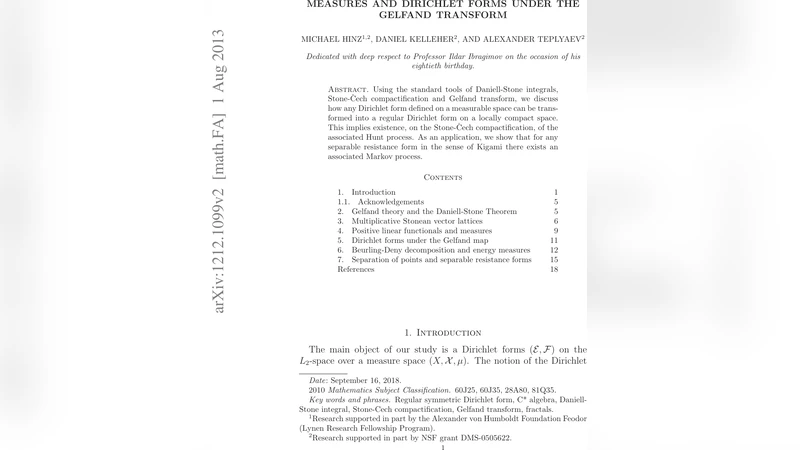
Using the standard tools of Daniell-Stone integrals, Stone-\v{C}ech compactification and Gelfand transform, we discuss how any Dirichlet form defined on a measurable space can be transformed into a regular Dirichlet form on a locally compact space. This implies existence, on the Stone-\v{C}ech compactification, of the associated Hunt process. As an application, we show that for any separable resistance form in the sense of Kigami there exists an associated Markov process.
💡 Research Summary
The paper addresses a fundamental gap in the theory of Dirichlet forms: while regular Dirichlet forms on locally compact spaces admit a rich probabilistic representation via Hunt processes, many natural energy forms arise on measurable spaces that lack a locally compact topology. The authors show that any Dirichlet form defined on a measurable space can be systematically transferred to a regular Dirichlet form on a locally compact space by a three‑step construction that combines the Daniell–Stone integral framework, the Stone–Čech compactification, and the Gelfand transform.
First, given a symmetric, closed, bilinear form (\mathcal{E}) on (L^{2}(X,\mu)) with domain (\mathcal{F}\subset L^{2}), the Daniell–Stone theory is used to enlarge (\mathcal{F}) to a Banach space equipped with the norm (|u|{\mathcal{E}{1}}=\big(\mathcal{E}(u,u)+(u,u){L^{2}(\mu)}\big)^{1/2}). This step provides a functional‑analytic setting in which limits of Cauchy sequences with respect to (\mathcal{E}{1}) are well defined, even when the underlying space has no topology.
Second, the algebra (\mathcal{F}) (viewed as a sub‑algebra of bounded measurable functions) is used to construct the Stone–Čech compactification (\beta X). By definition, (\beta X) is the maximal compact Hausdorff space to which every bounded continuous function on (X) extends continuously. Consequently each element of (\mathcal{F}) extends uniquely to a continuous function on (\beta X), embedding the original measurable structure into a compact topological framework.
Third, the Gelfand transform provides an isometric *‑isomorphism between (\mathcal{F}) and a dense subspace of (C_{0}(\beta X)). Under this isomorphism the original form (\mathcal{E}) is transferred to a new form (\widehat{\mathcal{E}}) on (\beta X) via (\widehat{\mathcal{E}}(\widehat{u},\widehat{v})=\mathcal{E}(u,v)). The authors prove that (\widehat{\mathcal{E}}) is a regular Dirichlet form: its domain contains (C_{c}(\beta X)) densely, and it satisfies the Markov property and locality required for the standard theory. As a result, the classical Fukushima–Oshima–Takeda construction yields a Hunt process (\widehat{X}_{t}) on (\beta X) associated with (\widehat{\mathcal{E}}).
Because the original space (X) sits densely in (\beta X), the Hunt process restricted to (X) provides a Markov process that is “the” probabilistic counterpart of the initial Dirichlet form, even though the original setting lacked a locally compact topology. This resolves the existence problem for associated stochastic processes in a very general context.
The paper then applies the abstract machinery to Kigami’s resistance forms, which are energy forms defined on fractal sets (e.g., the Sierpiński gasket) that are typically not locally compact in the intrinsic resistance metric. By passing through the three‑step construction, each resistance form becomes a regular Dirichlet form on the Stone–Čech compactification of the underlying set. Consequently, a Hunt process—often called the resistance Brownian motion—exists on the compactified space, and its restriction to the original fractal yields the desired diffusion process. This recovers known results in fractal analysis while placing them in a unified, topologically robust framework.
Finally, the authors discuss broader implications. The method works for any symmetric closed form, regardless of locality, non‑local jumps, or infinite dimensionality. Potential extensions include non‑symmetric forms, Dirichlet forms on configuration spaces, and applications to stochastic partial differential equations on non‑compact state spaces. Moreover, the compactification approach opens the door to spectral analysis, heat kernel estimates, and potential theory on the compactified space, which can then be pulled back to the original measurable setting.
In summary, the paper provides a powerful and general bridge from arbitrary Dirichlet forms on measurable spaces to regular Dirichlet forms on compact spaces, guaranteeing the existence of associated Hunt processes and offering a versatile tool for analysis on irregular, fractal, or infinite‑dimensional structures.
Comments & Academic Discussion
Loading comments...
Leave a Comment