Stability and dynamical features of solitary wave solutions for a hydrodynamic-type system taking into account non-local effects
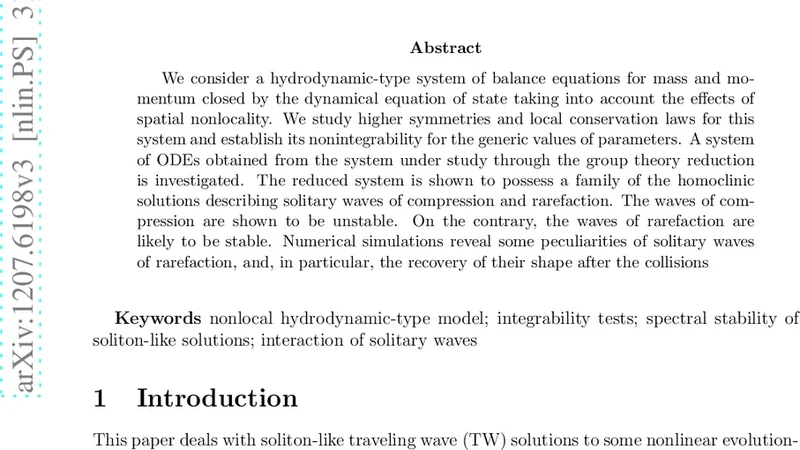
We consider a hydrodynamic-type system of balance equations which is closed by the dynamic equation of state taking into account the effects of spatial nonlocality. Symmetry and local conservation laws of this system are studied. A system of ODEs being obtained via the group theory reduction of the initial system of PDEs is investigated. The reduced system is shown to possess a family of the homoclinic solutions. Depending on the values of the parameters, the homoclinic solutions describe the solitary waves of compression or rarefication. The solutions corresponding to the wave of compression are shown to be unstable. More likely, the waves of rarefication are stable. Numerical simulations demonstrate that the solitary waves of rarefication moving toward each other maintain their shape after the interaction.
💡 Research Summary
The paper investigates a one‑dimensional hydrodynamic system in which the usual balance equations for mass and momentum are closed by a dynamic equation of state (DES) that incorporates spatial non‑locality. The non‑local term is introduced as an integral convolution with a kernel representing long‑range interactions within the medium. This modification leads to a set of coupled partial differential equations that retain the conservation structure but acquire additional complexity due to the integral term.
To analyze the model, the authors apply Lie‑group symmetry methods. They identify translation invariance in time and space as well as scaling symmetries, which allow the construction of similarity variables that reduce the original PDE system to a pair of ordinary differential equations (ODEs) for the density and velocity profiles as functions of a single travelling‑wave coordinate ξ = x − c t, where c is the wave speed. The reduced ODE system is autonomous and can be interpreted as a two‑dimensional dynamical system in the phase plane (ρ, u).
A detailed phase‑plane analysis reveals the existence of saddle‑type equilibrium points. For specific ranges of the non‑local strength parameter and the nonlinear pressure coefficient, a homoclinic orbit connects the saddle to itself. This orbit corresponds to a solitary‑wave (soliton) solution of the original PDE. Depending on the sign of the deviation of the density from its background value along the orbit, the solitary wave manifests either as a compression pulse (density peak) or as a rarefaction pulse (density dip).
Linear stability of the two families of solitary waves is examined by perturbing the homoclinic solution and deriving the associated eigenvalue problem. The compression soliton possesses at least one eigenvalue with a positive real part, indicating exponential growth of perturbations and thus intrinsic instability. In contrast, the rarefaction soliton’s spectrum lies entirely in the left half‑plane or on the imaginary axis, implying that small disturbances either decay or remain bounded, which points to linear stability.
To confirm these analytical predictions, high‑resolution numerical simulations are performed. The authors employ a combination of finite‑difference and pseudo‑spectral schemes to integrate the full non‑local PDE system with initial data taken from the analytical homoclinic profiles. The compression soliton rapidly deforms and eventually breaks apart, consistent with its unstable nature. The rarefaction soliton, however, propagates without noticeable distortion. Moreover, when two rarefaction solitons are launched toward each other, they interact elastically: after collision they re‑emerge with essentially the same shape, amplitude, and speed, demonstrating robust nonlinear stability and particle‑like behavior.
The study concludes that spatial non‑locality fundamentally alters the dynamics of hydrodynamic waves. While it permits the existence of both compressive and rarefactive solitary structures, it stabilizes the latter and destabilizes the former. These findings have potential implications for physical contexts where long‑range interactions are significant, such as in complex fluids, porous media, plasma physics, and metamaterials. The methodological framework—combining non‑local constitutive modeling, symmetry reduction, dynamical‑systems analysis, and direct numerical simulation—offers a powerful template for exploring similar phenomena in other nonlinear continuum models.