Flavor Pairing in Medieval European Cuisine: A Study in Cooking with Dirty Data
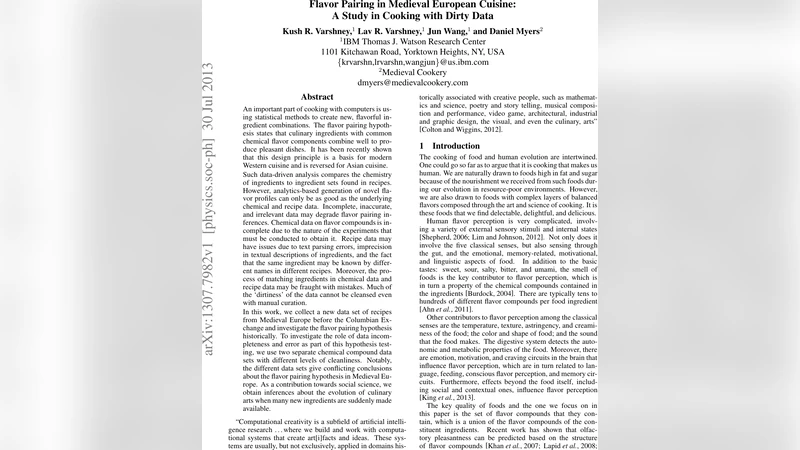
An important part of cooking with computers is using statistical methods to create new, flavorful ingredient combinations. The flavor pairing hypothesis states that culinary ingredients with common chemical flavor components combine well to produce pleasant dishes. It has been recently shown that this design principle is a basis for modern Western cuisine and is reversed for Asian cuisine. Such data-driven analysis compares the chemistry of ingredients to ingredient sets found in recipes. However, analytics-based generation of novel flavor profiles can only be as good as the underlying chemical and recipe data. Incomplete, inaccurate, and irrelevant data may degrade flavor pairing inferences. Chemical data on flavor compounds is incomplete due to the nature of the experiments that must be conducted to obtain it. Recipe data may have issues due to text parsing errors, imprecision in textual descriptions of ingredients, and the fact that the same ingredient may be known by different names in different recipes. Moreover, the process of matching ingredients in chemical data and recipe data may be fraught with mistakes. Much of the `dirtiness’ of the data cannot be cleansed even with manual curation. In this work, we collect a new data set of recipes from Medieval Europe before the Columbian Exchange and investigate the flavor pairing hypothesis historically. To investigate the role of data incompleteness and error as part of this hypothesis testing, we use two separate chemical compound data sets with different levels of cleanliness. Notably, the different data sets give conflicting conclusions about the flavor pairing hypothesis in Medieval Europe. As a contribution towards social science, we obtain inferences about the evolution of culinary arts when many new ingredients are suddenly made available.
💡 Research Summary
The paper investigates the long‑standing “flavor‑pairing hypothesis” – the idea that ingredients sharing many chemical flavor compounds tend to be combined in tasty dishes – within the historical context of pre‑Columbian medieval Europe. The authors assemble a novel corpus of medieval European recipes drawn from a variety of manuscript cookbooks written in Latin, Middle English, Old French and other vernaculars. Because these sources are centuries old, the textual extraction process is fraught with ambiguities: the same ingredient appears under multiple spellings (“emm ental”, “emmental”, “em menthaler”), plural forms, regional synonyms, and occasional OCR errors. The authors therefore develop a normalization pipeline that maps variant names to canonical identifiers, acknowledging that residual “dirty data” will remain.
To test the hypothesis, the study uses two independent flavor‑compound databases. The first is the Volatile Compounds in Food (VCF) 14.1 database, a relatively recent collection of GC‑MS‑derived volatile profiles. The second is the “Handbook of Flavor Ingredients” compiled by Ahn et al., which is based on older literature surveys. Both databases are incomplete: VCF lacks many low‑abundance compounds and suffers from false‑positive/negative detections; the Handbook omits many modern or region‑specific compounds and contains outdated annotations. By linking each normalized ingredient to its set of flavor compounds in each database, the authors compute, for every recipe R with n_R ingredients, the average number of shared compounds N_s(R) = (2 / (n_R·(n_R‑1))) ∑_{i≠j}|C_i∩C_j|. They then calculate the corpus‑wide mean \bar N_s for the real medieval recipes and compare it to the mean obtained from randomly generated ingredient sets drawn from the same overall ingredient universe, yielding ΔN_s = \bar N_real – \bar N_rand. A positive ΔN_s would support the hypothesis; a value near zero would indicate no systematic pairing; a negative value would suggest deliberate avoidance of shared compounds.
When the VCF database is used, ΔN_s is significantly positive. This result implies that medieval cooks, even without modern scientific knowledge, tended to combine ingredients that share volatile compounds. The authors further compute an ingredient‑level contribution χ_i, revealing that herbs and spices (e.g., rosemary, sage, thyme) have high positive χ_i, whereas staple grains (barley, oats, rye) and common meats have low or negative χ_i. This pattern aligns with historical accounts that herbs were prized for flavor enhancement, while grains served primarily as caloric staples.
Conversely, using the Handbook data produces a ΔN_s that is close to zero or slightly negative, indicating no detectable flavor‑pairing effect. The authors attribute this discrepancy to the Handbook’s incomplete coverage of medieval ingredients and its omission of many volatile compounds that are present in the VCF set. The conflicting outcomes underscore the central thesis of the paper: data quality—completeness, accuracy, and consistency—directly shapes the conclusions of computational culinary analysis.
Beyond the methodological contribution, the study offers a historical perspective. Medieval European cuisine was dominated by cereals, legumes, limited animal protein, and a modest selection of herbs. The “myth” that medieval cooks used spices merely to mask spoiled meat is debunked; spices were expensive and used sparingly for genuine flavor enhancement. The authors discuss the impending Columbian Exchange, which introduced New World crops such as potatoes, tomatoes, corn, cacao and peanuts. These ingredients dramatically expanded the pool of flavor compounds available to European kitchens, providing a plausible explanation for why modern Western cuisine exhibits a stronger flavor‑pairing signal when analyzed with the same databases.
The paper acknowledges several limitations. The recipe corpus reflects elite households and may not represent the diet of peasants or urban poor. The ingredient‑to‑compound mapping relies on imperfect experimental data, and the random‑recipe baseline assumes uniform ingredient availability, which may not hold historically. The authors suggest future work that integrates sensory evaluation, more exhaustive GC‑MS profiling, and standardized ontologies for ingredient naming.
In conclusion, the research demonstrates that “dirty data” can invert the outcome of a hypothesis test in computational gastronomy. By juxtaposing two flavor‑compound datasets of differing cleanliness, the authors reveal that medieval European cuisine both conforms to and contradicts the flavor‑pairing hypothesis, depending on the data source. This finding serves as a cautionary tale for any AI‑driven culinary creativity system: without rigorous data curation, the generated “novel” pairings may be based on artefacts rather than genuine sensory chemistry. The study thus bridges food science, data engineering, and historical culinary studies, highlighting the need for high‑quality, well‑curated datasets to unlock reliable computational insights into the evolution of taste.
Comments & Academic Discussion
Loading comments...
Leave a Comment