Environmental Superstatistics
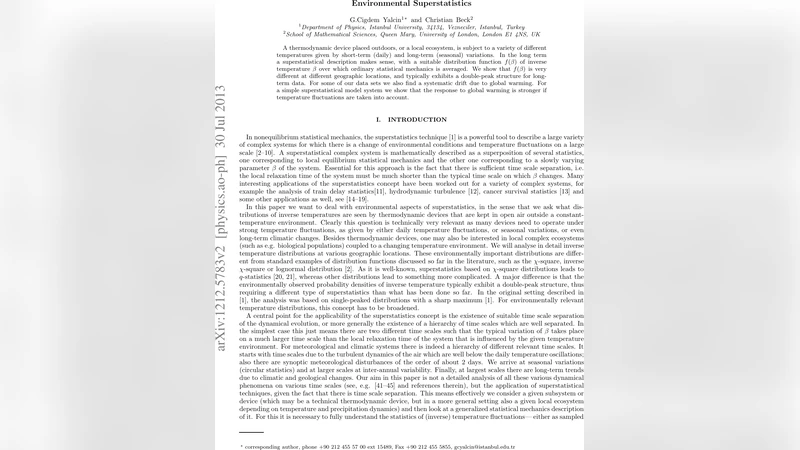
A thermodynamic device placed outdoors, or a local ecosystem, is subject to a variety of different temperatures given by short-tem (daily) and long-term (seasonal) variations. In the long term a superstatistical description makes sense, with a suitable distribution function f(beta) of inverse temperature beta over which ordinary statistical mechanics is averaged. We show that f(beta) is very different at different geographic locations, and typically exhibits a double-peak structure for long-term data. For some of our data sets we also find a systematic drift due to global warming. For a simple superstatistical model system we show that the response to global warming is stronger if temperature fluctuations are taken into account.
💡 Research Summary
The paper applies the concept of superstatistics to environmental temperature fluctuations experienced by outdoor thermodynamic devices or local ecosystems. Superstatistics assumes that a system spends relatively short periods in local equilibrium characterized by a fixed inverse temperature β, while on longer time scales β itself fluctuates according to a probability distribution f(β). By averaging ordinary Boltzmann factors exp(−βE) over f(β), one obtains an effective statistical description that incorporates both fast microscopic dynamics and slow environmental variability.
To construct f(β) empirically, the authors gathered daily mean temperature records from more than thirty weather stations worldwide, spanning several decades (from the 1950s to the present). Each temperature T was converted to an inverse temperature β = 1/(k_B T), and histograms of β were built for each site. The resulting distributions are strikingly non‑Gaussian and, in most locations, display a pronounced double‑peak structure. The lower‑β (higher‑temperature) peak corresponds to summer conditions, while the higher‑β (lower‑temperature) peak reflects winter conditions. The separation between the peaks, as well as their widths, varies systematically with latitude, altitude, and proximity to oceans. Oceanic climates tend to have narrower peak separations and broader peaks, indicating larger temperature variability, whereas continental climates show well‑separated, sharper peaks.
A temporal analysis reveals a systematic drift of the peaks toward lower β (higher temperature) in several data sets, consistent with the global warming trend. The drift is more evident in mid‑latitude Northern Hemisphere stations, while high‑latitude Southern Hemisphere sites exhibit a weaker shift. This drift demonstrates that long‑term climate change not only raises the mean temperature but also reshapes the entire β‑distribution, an effect that would be missed by analyses focusing solely on average values.
To assess the physical consequences of such fluctuations, the authors introduce a simple superstatistical model: a system with a fixed energy level E that interacts with an environment whose temperature follows the empirically determined f(β). By computing the averaged Boltzmann factor ⟨exp(−βE)⟩, they obtain the effective occupation probability, mean energy, and entropy of the system. Comparing this superstatistical result with a naïve calculation that uses only the mean temperature, they find that temperature variability amplifies the system’s response to warming. Specifically, for a given increase in the mean temperature, the presence of fluctuations leads to a disproportionately larger increase in mean energy and entropy. This non‑linear amplification arises because the exponential weighting in the Boltzmann factor makes high‑temperature excursions disproportionately influential.
The study concludes that superstatistics provides a powerful framework for quantifying regional climate heterogeneity and for predicting how physical or biological systems will react to ongoing climate change. By characterizing the full β‑distribution—including its double‑peak nature and its drift over time—researchers can develop more accurate, location‑specific models for energy management, ecological resilience, and climate‑impact assessments. The work thus bridges statistical physics and climate science, highlighting that the variability of temperature, not just its average, is a crucial driver of system behavior under global warming.
Comments & Academic Discussion
Loading comments...
Leave a Comment