Temporal influence over the Last.fm social network
Several recent results show the influence of social contacts to spread certain properties over the network, but others question the methodology of these experiments by proposing that the measured effects may be due to homophily or a shared environment. In this paper we justify the existence of the social influence by considering the temporal behavior of Last.fm users. In order to clearly distinguish between friends sharing the same interest, especially since Last.fm recommends friends based on similarity of taste, we separated the timeless effect of similar taste from the temporal impulses of immediately listening to the same artist after a friend. We measured strong increase of listening to a completely new artist in a few hours period after a friend compared to non-friends representing a simple trend or external influence. In our experiment to eliminate network independent elements of taste, we improved collaborative filtering and trend based methods by blending with simple time aware recommendations based on the influence of friends. Our experiments are carried over the two-year “scrobble” history of 70,000 Last.fm users.
💡 Research Summary
The paper investigates whether genuine social influence exists in the Last.fm music‑listening network, separating it from homophily (the tendency of similar people to connect) and from external trends (e.g., new album releases). Using a large, anonymized dataset of 71,000 users from the United Kingdom, the authors collected two years (2010‑2011) of “scrobble” logs—over 979 million listening events covering more than two million artists—together with the undirected, timestamped friendship graph (285 k edges, average degree ≈ 8).
The core analytical unit is a “first‑time scrobble”: when a user u listens to an artist a for the first time at time t, the authors look back for any earlier scrobble of the same artist by another user v. If v is a friend of u, the time lag Δt = t − t₀ (where t₀ is v’s most recent scrobble of a) is recorded as a potential influence event. Across the dataset, 19 % of first‑time scrobbles have a friend who previously listened to the same artist, yielding roughly 24 million potential influence instances.
To control for confounding factors, two baseline recommenders are built that do not use friendship information: (1) a collaborative‑filtering (CF) model that learns user similarity solely from listening histories, and (2) a temporal popularity model that predicts an artist’s likelihood based on its overall popularity at a given moment. These baselines capture homophily (via CF) and external trend effects (via popularity).
The authors then compute cumulative distribution functions (CDFs) of Δt for all user pairs (CDF_A) and for friend pairs only (CDF_F). The friend CDF lies consistently above the overall CDF, especially within the first 24 hours, indicating that friends tend to be exposed to the same new artist much sooner than random users. An “effectivity” metric is defined as Eff(t) = (CDF_F(t) − CDF_A(t)) / CDF_F(t). The effectivity curve decays slowly and is best fitted by a logarithmic function rather than an exponential, suggesting that influence persists over several days.
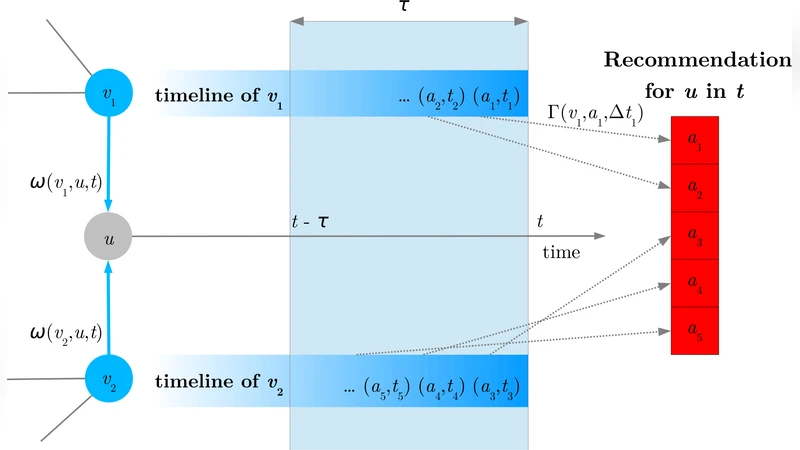
Based on these empirical findings, a time‑aware influence recommender is proposed. For a target user u at time t, the predicted score for artist a is
\hat r(u,a,t) = ∑_{v∈N(u)} Γ(v,a,Δt) · ω(v,u,t)
where N(u) denotes u’s friends. Γ(v,a,Δt) is a decay function of the lag, chosen as Γ = 1 − C·log(Δt) with C = 1 / log(τ) (τ is a maximum lag, e.g., a few days). ω(v,u,t) is a stepwise strength of influence between the pair: it starts at 0, jumps to 1 when the friendship is formed, and is incremented by the same logarithmic decay term each time an influence event (friend v’s prior scrobble) is observed. Only events with Δt ≤ τ are considered, keeping the computation lightweight.
The recommendation task is evaluated in a realistic “real‑time top‑K” setting. The first year of data is used for training; the second year is processed event‑by‑event, requiring the algorithm to generate a ranked list of K = 10 artists for each incoming scrobble. Performance is measured with Discounted Cumulative Gain (DCG@K). When the influence‑based component is blended with the CF and popularity baselines, the system achieves an average DCG improvement of about 4 % over the baselines alone. This gain, while modest, is notable given that the Netflix Prize considered a 10 % gain a major breakthrough, and it demonstrates that even a simple, real‑time friend‑influence signal can add measurable value.
In summary, the paper makes four principal contributions: (1) empirical evidence that friends exert a temporally bounded influence on each other’s music discovery, (2) characterization of the influence decay as a logarithmic function persisting over days, (3) a lightweight, real‑time recommendation algorithm that integrates time‑aware friend influence with traditional CF and popularity signals, and (4) a rigorous experimental methodology that isolates influence from homophily and external trends. The work not only advances understanding of social contagion in music‑streaming platforms but also provides a practical blueprint for incorporating social dynamics into recommender systems across various domains.
Comments & Academic Discussion
Loading comments...
Leave a Comment