Symmetry groups of non-simply-connected four-manifolds
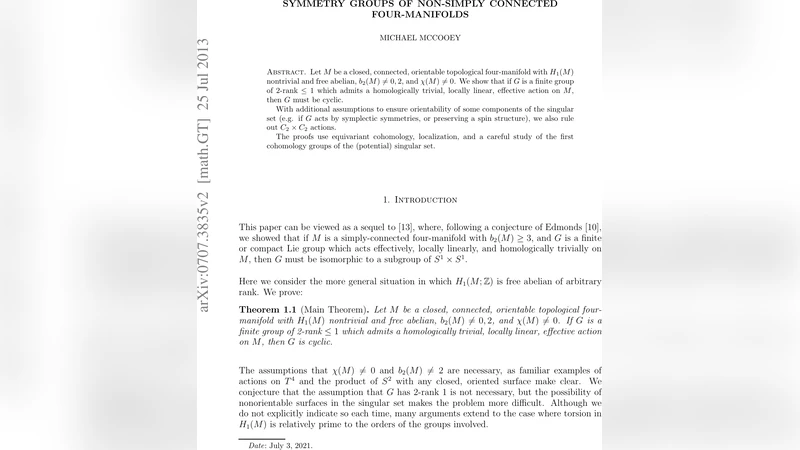
Let $M$ be a closed, connected, orientable topological four-manifold with $H_1(M)$ nontrivial and free abelian, $b_2(M)\ne 0, 2$, and $\chi(M)\ne 0$. We show that if $G$ is a finite group of 2-rank $\le 1$ which admits a homologically trivial, locally linear, effective action on $M$, then $G$ must be cyclic. With additional assumptions to ensure orientability of some components of the singular set (e.g. if $G$ acts by symplectic symmetries, or preserving a spin structure), we also rule out $C_2 \times C_2$ actions. The proofs use equivariant cohomology, localization, and a careful study of the first cohomology groups of the (potential) singular set.
💡 Research Summary
The paper investigates finite symmetry groups acting on a closed, connected, orientable topological four‑manifold M under the following hypotheses: the first homology group H₁(M) is non‑trivial and free abelian (so M is not simply‑connected but its fundamental group is captured entirely by H₁), the second Betti number satisfies b₂(M) ≠ 0, 2, and the Euler characteristic χ(M) is non‑zero. Within this setting the authors consider finite groups G of 2‑rank at most one (i.e. the largest elementary abelian 2‑subgroup of G has rank ≤ 1) that act effectively, locally linearly, and homologically trivially on M.
The main theorem states that any such group G must be cyclic. In other words, the only possible finite symmetry groups of the prescribed type are the cyclic groups Cₙ (including the trivial group). Moreover, when extra orientability conditions on the singular set are imposed—conditions that are automatically satisfied if the action preserves a symplectic form or a spin structure—the authors are able to rule out the elementary abelian group C₂ × C₂ as well. Consequently, under these stronger hypotheses the only admissible 2‑part of the symmetry group is either trivial or a single copy of C₂.
The proof combines three principal tools: equivariant cohomology, the localization theorem, and a careful analysis of the first cohomology of the potential singular set (the fixed‑point set of the action).
- Equivariant Cohomology and Localization.
By working with ℤ₂‑coefficients, the authors consider the Borel construction M_G = (EG × M)/G and its equivariant cohomology H_G^*(M; ℤ₂). The localization theorem asserts that after inverting the Euler classes of the normal bundles to the fixed‑point components, the restriction map
\
Comments & Academic Discussion
Loading comments...
Leave a Comment