Moran Sets and Hyperbolic Boundaries
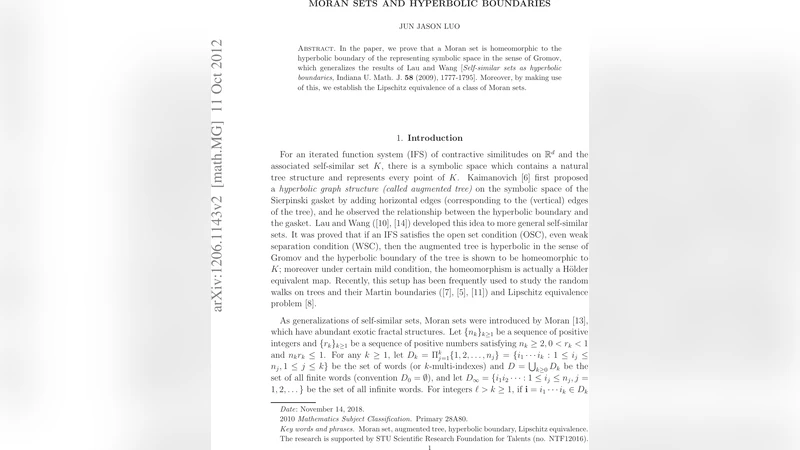
In the paper, we prove that a Moran set is homeomorphic to the hyperbolic boundary of the representing symbolic space in the sense of Gromov, which generalizes the results of Lau and Wang [Indiana U. Math. J. {\bf 58} (2009), 1777-1795]. Moreover, by making use of this, we establish the Lipschitz equivalence of a class of Moran sets.
💡 Research Summary
The paper establishes a deep connection between Moran sets—a broad class of inhomogeneous self‑similar fractals—and the hyperbolic boundaries of their associated symbolic spaces in the sense of Gromov. The authors begin by recalling the construction of a Moran set: starting from an initial interval (or square) one iteratively inserts a finite collection of sub‑intervals at each stage, each with its own contraction ratio r_{n,i} and multiplicity N_n, subject to standard boundedness and non‑degeneracy conditions. This flexible scheme encompasses classical self‑similar sets (Cantor, Sierpiński) as special cases but allows the ratios and numbers of pieces to vary from level to level.
To encode the combinatorial structure, the authors introduce a rooted infinite tree T whose vertices correspond to finite words (α₁,…,α_n) indicating the choices made up to level n. The set of infinite rays ∂T—i.e., the boundary of the tree—forms the symbolic space Σ. On T they define a Gromov‑type metric d_G by measuring the depth of the least common ancestor of two vertices; this metric makes (Σ,d_G) a proper δ‑hyperbolic space, and consequently ∂Σ inherits a natural visual metric.
A natural coding map π:∂Σ→K (where K is the Moran set) sends an infinite ray to the unique point belonging to the nested intersection of the corresponding sequence of construction intervals. The core of the work is to prove that π is a homeomorphism. The authors achieve this by establishing two uniform comparability estimates between the visual metric on ∂Σ and the Euclidean metric on K. For any two rays ξ,η and for sufficiently large level n, the distance ρ_n(ξ,η) induced by the tree at level n satisfies
C^{-1}·ρ_n(ξ,η) ≤ |π(ξ)−π(η)| ≤ C·ρ_n(ξ,η)
for a constant C independent of ξ,η,n. Since ρ_n approximates the Gromov visual distance, continuity and its inverse follow, yielding a topological equivalence between the hyperbolic boundary and the Moran set. This result extends the earlier theorem of Lau and Wang (Indiana U. Math. J. 58 (2009), 1777‑1795), which was limited to homogeneous self‑similar sets, to the fully inhomogeneous Moran framework.
Having identified the two spaces, the authors turn to Lipschitz equivalence. They consider two Moran sets K₁ and K₂ generated by sequences {(r_{n,i}^{(1)},N_n^{(1)})} and {(r_{n,i}^{(2)},N_n^{(2)})}. Assuming that the underlying trees have the same branching pattern and that the collections of ratios at each level are comparable up to a uniform constant, they construct a bijection φ between the boundaries ∂Σ₁ and ∂Σ₂ that respects the tree structure. Composing φ with the homeomorphisms π₁,π₂ yields a map f=π₂∘φ∘π₁^{-1}:K₁→K₂. By the same uniform distance estimates used in the homeomorphism proof, they show that there exists L>0 such that for all x,y∈K₁,
L^{-1}|x−y| ≤ |f(x)−f(y)| ≤ L|x−y|.
Thus K₁ and K₂ are Lipschitz equivalent. This provides a general criterion: two Moran sets are Lipschitz equivalent whenever their symbolic trees are combinatorially identical and their contraction ratios are uniformly comparable. The result subsumes the earlier Lipschitz equivalence theorems for homogeneous self‑similar sets and demonstrates that the hyperbolic boundary viewpoint is a powerful tool for studying metric properties of fractals.
The paper concludes with a discussion of limitations and future directions. The current proofs rely heavily on the δ‑hyperbolicity of the tree and on uniform bounds for the ratios and branching numbers; extending the theory to trees with unbounded branching or to constructions with infinitely many ratios per level remains open. Moreover, connections to measure‑theoretic invariants (e.g., preservation of Hausdorff dimension) and to dynamical systems (e.g., transfer operators defined on the symbolic space) are suggested as promising avenues for further research.
In summary, the authors provide a rigorous framework that identifies Moran sets with the hyperbolic boundaries of their symbolic trees, and they leverage this identification to derive a broad Lipschitz equivalence theorem. This work bridges fractal geometry and Gromov hyperbolic theory, offering new insights into the metric and topological classification of highly irregular self‑similar structures.
Comments & Academic Discussion
Loading comments...
Leave a Comment