Boundaries of Disk-like Self-affine Tiles
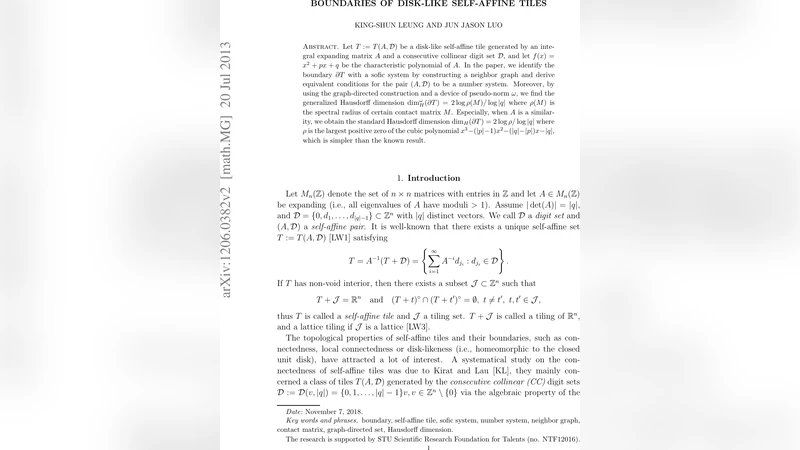
Let $T:= T(A, {\mathcal D})$ be a disk-like self-affine tile generated by an integral expanding matrix $A$ and a consecutive collinear digit set ${\mathcal D}$, and let $f(x)=x^{2}+px+q$ be the characteristic polynomial of $A$. In the paper, we identify the boundary $\partial T$ with a sofic system by constructing a neighbor graph and derive equivalent conditions for the pair $(A,{\mathcal D})$ to be a number system. Moreover, by using the graph-directed construction and a device of pseudo-norm $\omega$, we find the generalized Hausdorff dimension $\dim_H^{\omega} (\partial T)=2\log \rho(M)/\log |q|$ where $\rho(M)$ is the spectral radius of certain contact matrix $M$. Especially, when $A$ is a similarity, we obtain the standard Hausdorff dimension $\dim_H (\partial T)=2\log \rho/\log |q|$ where $\rho$ is the largest positive zero of the cubic polynomial $x^{3}-(|p|-1)x^{2}-(|q|-|p|)x-|q|$, which is simpler than the known result.
💡 Research Summary
The paper investigates the geometric and dimensional properties of disk‑like self‑affine tiles generated by an integral expanding matrix A and a consecutive collinear digit set 𝔇. A self‑affine tile T(A,𝔇) is defined as the unique non‑empty compact set satisfying the set equation
T = A⁻¹(T + 𝔇).
When the interior of T is homeomorphic to a disk, the tile is called disk‑like. The authors focus on the case where 𝔇 consists of equally spaced points along a line, i.e. 𝔇 = {0, v, 2v,…,(|q|−1)v} with v∈ℤ²{0} and q = det A. The characteristic polynomial of A is f(x)=x²+px+q; the coefficients p and q control the algebraic and topological behavior of the tile.
1. Boundary as a Sofic System
The first major contribution is the identification of the boundary ∂T with a sofic shift. The authors construct a finite directed graph (the neighbor graph) whose vertices correspond to distinct neighbor tiles T+ℓ (ℓ∈ℤ²) that intersect T. An edge from vertex i to vertex j is labeled by a digit d∈𝔇 and represents the affine map
x ↦ A⁻¹(x + d).
Infinite walks on this graph generate sequences of digits that encode points on ∂T. Consequently, ∂T is topologically conjugate to the set of infinite admissible paths in the graph, i.e. a sofic shift. This representation captures the self‑similar structure of the boundary while providing a symbolic dynamics framework for further analysis.
2. Number‑System Characterization
A pair (A,𝔇) is called a number system if every integer vector z∈ℤ² can be expressed uniquely as a finite sum
z = Σ_{k=0}^{n−1} A^{k} d_k, d_k∈𝔇.
Using the neighbor graph, the authors derive equivalent conditions: the graph must be strongly connected, every vertex must admit a path back to the origin vertex, and there must be no “dead‑end” loops. These graph‑theoretic conditions translate into simple algebraic inequalities involving p and q, such as |p| ≤ |q|+1 and |q| ≥ 2. The result links the symbolic dynamics of the boundary with classical number‑system theory.
3. Graph‑Directed Construction and Contact Matrix
To compute the Hausdorff dimension of ∂T, the authors employ a graph‑directed iterated function system (GIFS). Each edge of the neighbor graph induces a contraction map on a copy of the boundary piece associated with its source vertex. The interaction between boundary pieces is encoded in a contact matrix M, where M_{ij} counts how many copies of piece j appear in the image of piece i under the GIFS. The matrix M is non‑negative and its spectral radius ρ(M) governs the scaling behavior of the system.
4. Pseudo‑Norm ω and Generalized Hausdorff Dimension
Because A is not necessarily a similarity, the Euclidean norm does not respect the natural scaling of the tile. The authors introduce a pseudo‑norm ω satisfying |A·x|_ω = |q|·|x|_ω. Under this norm, the GIFS becomes uniformly contractive, allowing the use of Hutchinson’s theory for self‑similar sets. They prove that the generalized Hausdorff dimension of the boundary with respect to ω is
dim_H^ω(∂T) = (2 log ρ(M)) / log |q|.
Thus the dimension depends solely on the spectral radius of the contact matrix and the determinant of A.
5. The Similarity Case and a Cubic Polynomial Formula
When A is a similarity (i.e., A = r·R with R a rotation matrix and r>1), the pseudo‑norm coincides with the Euclidean norm, and the generalized dimension equals the classical Hausdorff dimension. In this special case the contact matrix simplifies, and its spectral radius ρ(M) is the unique positive root of the cubic polynomial
x³ – (|p|−1)x² – (|q|−|p|)x – |q| = 0.
Consequently, the Hausdorff dimension of the boundary is given by the remarkably simple formula
dim_H(∂T) = (2 log ρ) / log |q|.
This expression is considerably more tractable than previously known results, which required solving higher‑dimensional eigenvalue problems.
6. Examples and Numerical Verification
The paper concludes with explicit examples. For A =