On the Complexity of Core, Kernel, and Bargaining Set
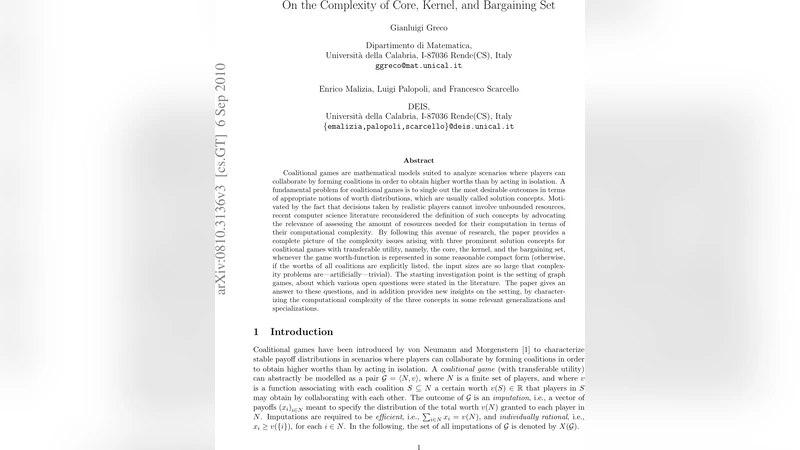
Coalitional games are mathematical models suited to analyze scenarios where players can collaborate by forming coalitions in order to obtain higher worths than by acting in isolation. A fundamental problem for coalitional games is to single out the most desirable outcomes in terms of appropriate notions of worth distributions, which are usually called solution concepts. Motivated by the fact that decisions taken by realistic players cannot involve unbounded resources, recent computer science literature reconsidered the definition of such concepts by advocating the relevance of assessing the amount of resources needed for their computation in terms of their computational complexity. By following this avenue of research, the paper provides a complete picture of the complexity issues arising with three prominent solution concepts for coalitional games with transferable utility, namely, the core, the kernel, and the bargaining set, whenever the game worth-function is represented in some reasonable compact form (otherwise, if the worths of all coalitions are explicitly listed, the input sizes are so large that complexity problems are—artificially—trivial). The starting investigation point is the setting of graph games, about which various open questions were stated in the literature. The paper gives an answer to these questions, and in addition provides new insights on the setting, by characterizing the computational complexity of the three concepts in some relevant generalizations and specializations.
💡 Research Summary
The paper provides a thorough computational complexity analysis of three central solution concepts—core, kernel, and bargaining set—in transferable‑utility (TU) coalitional games when the characteristic function is given in a compact representation. The authors motivate their study by noting that explicit enumeration of all coalition values is infeasible for any realistic instance, and that modern algorithmic game theory therefore focuses on succinct encodings such as graph games, marginal contribution networks, and linear‑programming based representations.
After recalling the formal definitions of the core (the set of imputations that no coalition can improve upon), the kernel (a pairwise balance condition based on excesses), and the bargaining set (a two‑stage objection/counter‑objection structure), the paper surveys known complexity results: core non‑emptiness is coNP‑complete in the general case, while the kernel and bargaining set have been conjectured to lie at higher levels of the polynomial hierarchy but lacked precise classifications.
The core of the contribution lies in establishing exact complexity classifications for these concepts within graph games and several of their extensions. The authors prove that deciding whether the core of a graph game is empty is coNP‑complete, even when the underlying graph is planar. The reduction is from the minimum cut problem and shows that any certificate of emptiness must implicitly encode a cut that separates the graph into coalitions violating the core constraints. Moreover, when the core is non‑empty, a polynomial‑time algorithm based on linear programming can construct a core allocation.
For the kernel, the paper shows that the membership problem (“is a given payoff vector in the kernel?”) is Σ₂^P‑complete. The proof proceeds via a many‑one reduction from quantified Boolean formulas of the form ∃∀, mapping existential choices to candidate payoff vectors and universal quantifiers to the excess comparisons required by the kernel definition. The authors also identify tractable subclasses: on tree‑structured graph games the kernel can be computed in polynomial time, and on complete graphs the problem collapses to P.
The bargaining set analysis yields a Π₂^P‑complete classification for its membership problem. Here the authors construct a reduction from ∀∃‑QBF, encoding objections as existential moves and counter‑objections as universal moves. The reduction demonstrates that verifying that no justified objection exists against a given payoff vector requires a universal quantifier over all possible objections, followed by an existential check for a counter‑objection, precisely matching the Π₂^P structure. Again, special graph topologies (e.g., bounded treewidth) admit polynomial‑time algorithms.
Beyond graph games, the paper extends these results to marginal contribution networks (MC‑Nets) and to games described by linear constraints. In each case, the same complexity hierarchy holds: core emptiness remains coNP‑complete, kernel membership stays Σ₂^P‑complete, and bargaining set membership is Π₂^P‑complete. The authors provide sketch proofs showing how the reductions can be adapted to the richer language of MC‑Nets (rules with positive and negative literals) and to linear programs (by embedding QBF clauses into constraint coefficients).
The discussion section interprets the findings for practical mechanism design. While core existence can be checked with a coNP oracle, the higher‑level complexity of the kernel and bargaining set suggests that exact computation is likely infeasible for large instances, motivating the search for approximation schemes, heuristics, or restricted game classes where the hierarchy collapses. The paper also points out that the results settle several open questions previously raised in the literature on graph games, notably the exact placement of the kernel and bargaining set in the polynomial hierarchy.
Finally, the authors outline future research directions: (1) parameterized complexity analyses with respect to graph parameters such as treewidth or degree; (2) investigation of dynamic coalitional formation where the characteristic function evolves over time; (3) development of interactive proof systems or succinct certificates for kernel and bargaining set membership; and (4) exploration of alternative solution concepts that balance computational tractability with economic fairness. Overall, the work delivers a complete map of the computational landscape for three foundational cooperative‑game solution concepts under realistic, compact representations.
Comments & Academic Discussion
Loading comments...
Leave a Comment