On the iteration of weak wreath products
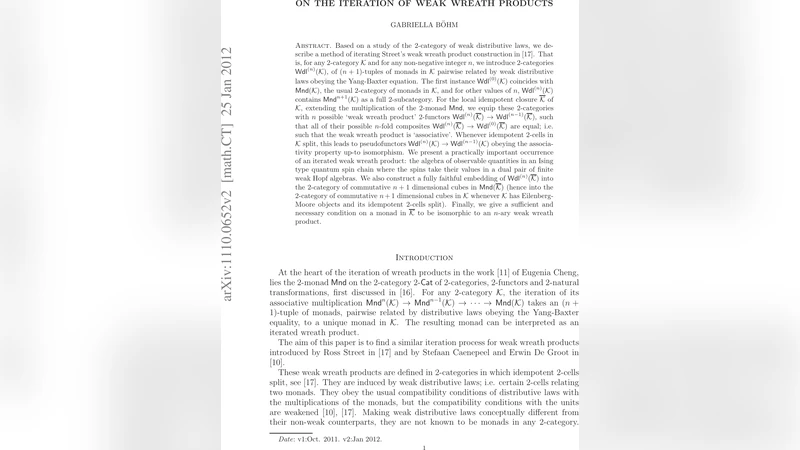
Based on a study of the 2-category of weak distributive laws, we describe a method of iterating Street’s weak wreath product construction. That is, for any 2-category K and for any non-negative integer n, we introduce 2-categories Wdl^{(n)}(K), of (n+1)-tuples of monads in K pairwise related by weak distributive laws obeying the Yang-Baxter equation. The first instance Wdl^{(0)}(K) coincides with Mnd(K), the usual 2-category of monads in K, and for other values of n, Wdl^{(n)}(K) contains Mnd^{n+1}(K) as a full 2-subcategory. For the local idempotent closure K^ of K, extending the multiplication of the 2-monad Mnd, we equip these 2-categories with n possible weak wreath product' 2-functors Wdl^{(n)}(K^) --> Wdl^{(n-1)}(K^), such that all of their possible n-fold composites Wdl^{(n)}(K^) --> Wdl^{(0)}(K^) are equal; i.e. such that the weak wreath product is associative’. Whenever idempotent 2-cells in K split, this leads to pseudofunctors Wdl^{(n)}(K) –> Wdl^{(n-1)}(K) obeying the associativity property up-to isomorphism. We present a practically important occurrence of an iterated weak wreath product: the algebra of observable quantities in an Ising type quantum spin chain where the spins take their values in a dual pair of finite weak Hopf algebras. We also construct a fully faithful embedding of Wdl^{(n)}(K^) into the 2-category of commutative n+1 dimensional cubes in Mnd(K^) (hence into the 2-category of commutative n+1 dimensional cubes in K whenever K has Eilenberg-Moore objects and its idempotent 2-cells split). Finally we give a sufficient and necessary condition on a monad in K^ to be isomorphic to an n-ary weak wreath product.
💡 Research Summary
The paper develops a comprehensive framework for iterating weak wreath products in an arbitrary 2‑category K. Starting from Ross Street’s notion of a weak distributive law— a 2‑cell λ:ts→st between two monads (A,t) and (A,s) that satisfies the usual multiplication compatibility but relaxes the unit compatibility— the authors construct, for each non‑negative integer n, a 2‑category Wdl^{(n)}(K). An object of Wdl^{(n)}(K) consists of (n+1) monads s₀,…,sₙ together with weak distributive laws λ_{i,j}:s_j s_i→s_i s_j for every i<j, subject to the Yang‑Baxter equations. 1‑cells are a common 1‑cell v equipped with 2‑cells ξ_i:s’_i v→v s_i that make each pair (v,ξ_i,ξ_j) a morphism of weak distributive laws, and 2‑cells are ordinary 2‑cells ω:v→v′ in K that are compatible with all ξ_i. This yields a genuine 2‑category because the underlying 2‑category of weak distributive laws is closed under horizontal and vertical composition.
The central contribution is the definition of n distinct “weak wreath product” 2‑functors W_i:Wdl^{(n)}(K)→Wdl^{(n‑1)}(K) (i=1,…,n), each of which collapses two consecutive monads via the weak wreath product construction. The authors prove that all possible composites of these n functors coincide, giving a unique 2‑functor W^{(n)}:Wdl^{(n)}(K)→Wdl^{(0)}(K)=Mnd(K). In other words, regardless of the order in which pairwise weak wreath products are taken, the final monad is the same. This establishes an “associativity” of weak wreath products at the level of 2‑categories. When idempotent 2‑cells split in K, the equality of composites lifts to an isomorphism of pseudofunctors, so the associativity holds up to coherent isomorphism.
Beyond the iterative construction, the paper embeds Wdl^{(n)}(K) fully faithfully into the 2‑category of commutative (n+1)‑dimensional cubes of monads, i.e. into the 2‑category of cubes whose faces are commuting diagrams of monad morphisms. If K admits Eilenberg‑Moore objects and its idempotent 2‑cells split, this embedding further lands in the 2‑category of (n+1)‑cubes inside K itself. This embedding provides a geometric picture of the weak distributive data as higher‑dimensional commuting cubes, generalising the familiar picture for ordinary (strong) distributive laws.
A further theoretical result is a necessary and sufficient condition for a monad r in the local idempotent closure K̂ to be isomorphic to an n‑ary weak wreath product. The condition requires the existence of certain 1‑cells and a 2‑cell π that admits a section ι, together with a bimodule structure of π with respect to the actions induced by the constituent monads. This characterises precisely which monads arise from iterated weak wreath products, extending the binary factorisation theorem known for weak wreath products.
The abstract theory is illustrated with a concrete example from mathematical physics: the algebra of observable quantities in an Ising‑type quantum spin chain whose spins take values in a dual pair of finite weak Hopf algebras. In this setting each site contributes a weak Hopf algebra, and the global observable algebra is obtained by iterating weak wreath products of the local algebras. This demonstrates that, unlike the classical Hopf‑algebra based models where the observable algebra is an iterated (strong) wreath product, the weak Hopf setting naturally leads to iterated weak wreath products, confirming the relevance of the developed theory.
In summary, the paper (1) defines the higher‑arity 2‑categories of weak distributive laws, (2) constructs n compatible weak wreath‑product functors whose composites are uniquely associative, (3) embeds these structures into commutative higher‑dimensional cubes, (4) gives a complete factorisation criterion for monads to be n‑ary weak wreath products, and (5) applies the machinery to a physically motivated model, thereby providing both a solid categorical foundation and a demonstrable application.
Comments & Academic Discussion
Loading comments...
Leave a Comment