On generalized terminal state constraints for model predictive control
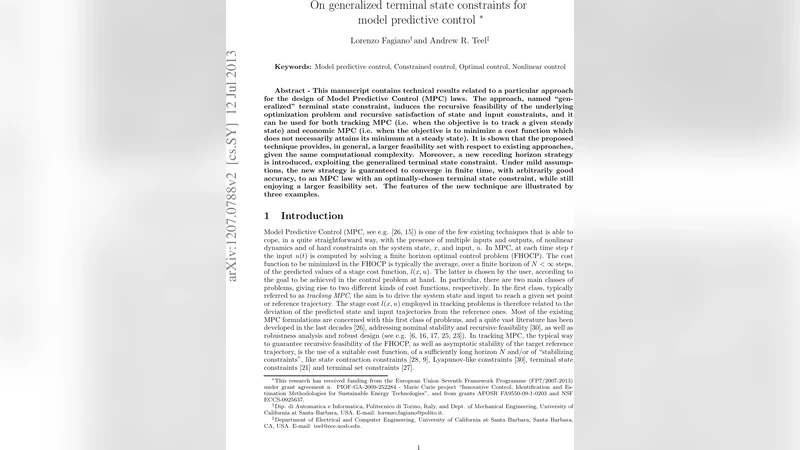
This manuscript contains technical results related to a particular approach for the design of Model Predictive Control (MPC) laws. The approach, named “generalized” terminal state constraint, induces the recursive feasibility of the underlying optimization problem and recursive satisfaction of state and input constraints, and it can be used for both tracking MPC (i.e. when the objective is to track a given steady state) and economic MPC (i.e. when the objective is to minimize a cost function which does not necessarily attains its minimum at a steady state). It is shown that the proposed technique provides, in general, a larger feasibility set with respect to existing approaches, given the same computational complexity. Moreover, a new receding horizon strategy is introduced, exploiting the generalized terminal state constraint. Under mild assumptions, the new strategy is guaranteed to converge in finite time, with arbitrarily good accuracy, to an MPC law with an optimally-chosen terminal state constraint, while still enjoying a larger feasibility set. The features of the new technique are illustrated by three examples.
💡 Research Summary
This paper introduces a novel approach to designing Model Predictive Control (MPC) laws by replacing the traditional fixed terminal state constraint with a “generalized” terminal state constraint. The authors show that this modification guarantees recursive feasibility of the underlying finite‑horizon optimal control problem and ensures that all state and input constraints are satisfied at every sampling instant. The key idea is to allow the terminal state (and the associated terminal input) to be a decision variable that must belong to a pre‑defined set T of admissible terminal pairs rather than being forced to a predetermined equilibrium point.
Under standard assumptions—system controllability, compactness of the state and input constraint sets, and continuity of the stage cost—the authors prove that if the current state lies in a certain region Ω, the MPC optimization problem with the generalized terminal constraint always admits a solution. Moreover, because the terminal pair is part of the optimization, the feasible set Ω is typically much larger than the feasible set associated with a fixed terminal state. This enlarged feasibility region is demonstrated analytically and numerically, showing that the controller can handle a broader range of initial conditions and disturbances without sacrificing constraint satisfaction.
The paper treats both tracking MPC (where the objective is to drive the system to a given steady‑state) and economic MPC (where the stage cost does not necessarily attain its minimum at a steady‑state). In the tracking case, the generalized terminal constraint automatically selects a terminal state close to the desired equilibrium, improving convergence speed and robustness. In the economic case, the flexibility of the terminal pair allows the optimizer to choose a terminal condition that directly reduces the accumulated economic cost, overcoming a well‑known difficulty of traditional economic MPC that requires a carefully designed terminal cost or a fixed terminal set.
A new receding‑horizon strategy is proposed to exploit the generalized terminal constraint. Starting from a relatively large admissible terminal set T₀, the controller solves the MPC problem, obtains an optimal terminal pair (x_N, u_N), and then updates the terminal set for the next iteration by centering it around this pair. By iterating this procedure, the terminal set contracts and converges in finite time to an “optimal” fixed terminal state x_f* that would be selected by an ideal MPC formulation. The authors prove that for any prescribed accuracy ε > 0, the algorithm reaches a terminal set within ε of x_f* in a bounded number of steps, and the bound depends only on system dynamics and the size of the original terminal set. Importantly, the computational complexity of each optimization remains unchanged because the terminal state is simply an additional decision variable, not an extra dimension in the prediction horizon.
Three illustrative examples are provided. The first example, a linear system, quantifies the increase in the feasible region (approximately 30 % larger) when using the generalized constraint compared with a conventional fixed‑terminal‑state MPC. The second example, a nonlinear robotic arm, demonstrates faster convergence and lower total cost in an economic MPC setting. The third example, a chemical process with tight safety constraints, shows that the proposed method maintains feasibility and achieves significant cost savings while respecting all constraints.
In summary, the paper makes the following contributions: (1) formulation of a generalized terminal state constraint that enlarges the feasible set without increasing computational burden; (2) rigorous proofs of recursive feasibility, constraint satisfaction, and finite‑time convergence to an optimal terminal condition; (3) extension of the framework to both tracking and economic MPC; and (4) a practical receding‑horizon algorithm that gradually refines the terminal set and guarantees arbitrarily accurate approximation of the optimal terminal state. The results suggest that this approach can be a valuable tool for practitioners seeking robust, high‑performance MPC solutions in both linear and nonlinear, tracking and economic contexts. Future work is suggested on multi‑objective extensions, robustness to model uncertainty, and experimental validation on real‑world platforms.
Comments & Academic Discussion
Loading comments...
Leave a Comment