Codensity and the ultrafilter monad
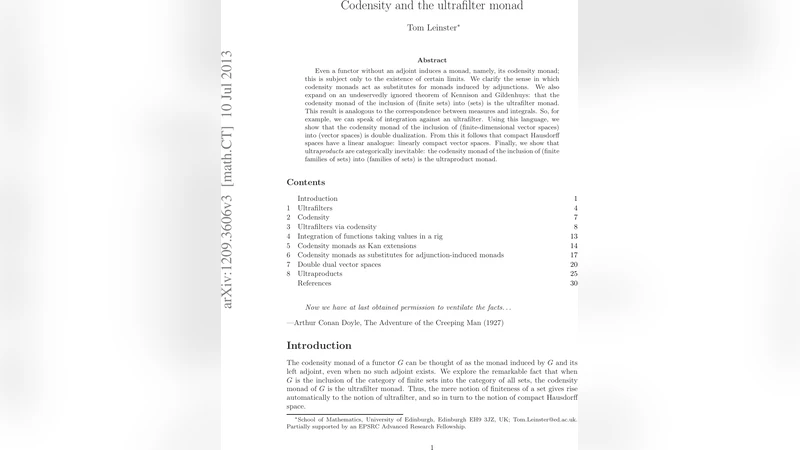
Even a functor without an adjoint induces a monad, namely, its codensity monad; this is subject only to the existence of certain limits. We clarify the sense in which codensity monads act as substitutes for monads induced by adjunctions. We also expand on an undeservedly ignored theorem of Kennison and Gildenhuys: that the codensity monad of the inclusion of (finite sets) into (sets) is the ultrafilter monad. This result is analogous to the correspondence between measures and integrals. So, for example, we can speak of integration against an ultrafilter. Using this language, we show that the codensity monad of the inclusion of (finite-dimensional vector spaces) into (vector spaces) is double dualization. From this it follows that compact Hausdorff spaces have a linear analogue: linearly compact vector spaces. Finally, we show that ultraproducts are categorically inevitable: the codensity monad of the inclusion of (finite families of sets) into (families of sets) is the ultraproduct monad.
💡 Research Summary
The paper investigates the codensity monad, a construction that yields a monad from any functor that admits certain weighted limits, even when the functor has no adjoint. After recalling the definition of the codensity monad as the right Kan extension Ran_F F, the author explains how this monad mimics the algebraic structure of monads arising from adjunctions: when the functor is a fully faithful left adjoint, the codensity monad coincides with the usual monad of the adjunction, and in general it satisfies the same unit‑multiplication axioms.
The central result revisits a theorem of Kennison and Gildenhuys: for the inclusion i : FinSet → Set, the codensity monad is precisely the ultrafilter monad. The proof proceeds by showing that i‑weighted limits of a set X are exactly the limits taken over ultrafilters on X, i.e. the “U‑limit” lim_U X for each ultrafilter U. This identification allows one to view the action of the monad as an integration against an ultrafilter, a 0‑1 valued measure, thereby establishing a categorical analogue of the classical correspondence between measures and integrals.
The paper then turns to a linear analogue. For the inclusion j : FinVect_k → Vect_k of finite‑dimensional k‑vector spaces into all k‑vector spaces, the codensity monad is shown to be double dualization V ↦ V^{}. The argument uses the fact that finite‑dimensional spaces are dense in Vect_k with respect to the appropriate weighted limits, and that the limit of a diagram of finite‑dimensional spaces is computed by taking the double dual. Consequently, the codensity monad provides a “linear ultrafilter” and gives a categorical explanation of why linearly compact vector spaces (those for which the canonical map V → V^{} is an isomorphism) play the same role for vector spaces as compact Hausdorff spaces do for sets.
In the final major example, the inclusion p : FinFam(Set) → Fam(Set) of finite families of sets into arbitrary families is considered. Its codensity monad turns out to be the ultraproduct monad: for a family (X_i)_{i∈I} and an ultrafilter U on I, the monad sends the family to the ultraproduct ∏_U X_i. This shows that ultraproducts are not an ad‑hoc construction of model theory but arise inevitably from a simple categorical density condition.
Throughout, the author emphasizes that codensity monads serve as a unifying framework: they capture “integration” over ultrafilters, “completion” via double dualization, and “ultraproduct” constructions, all as instances of the same limit‑based process. The paper concludes by suggesting that many other seemingly disparate constructions—such as various completion or compactification procedures—might be understood as codensity monads of appropriate dense inclusions, opening a broad avenue for future research.
Comments & Academic Discussion
Loading comments...
Leave a Comment