A lattice in more than two Kac--Moody groups is arithmetic
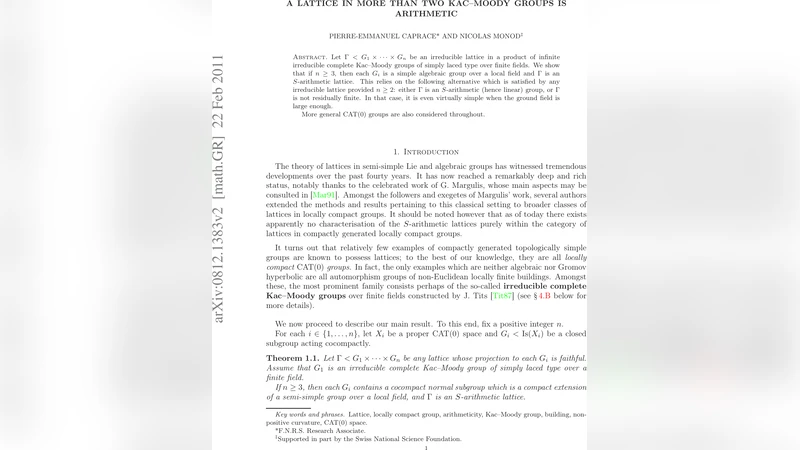
Let $\Gamma$ be an irreducible lattice in a product of n infinite irreducible complete Kac-Moody groups of simply laced type over finite fields. We show that if n is at least 3, then each Kac-Moody groups is in fact a simple algebraic group over a local field and $\Gamma$ is an arithmetic lattice. This relies on the following alternative which is satisfied by any irreducible lattice provided n is at least 2: either $\Gamma$ is an S-arithmetic (hence linear) group, or it is not residually finite. In that case, it is even virtually simple when the ground field is large enough. More general CAT(0) groups are also considered throughout.
💡 Research Summary
The paper investigates irreducible lattices Γ in a product of n infinite, irreducible, complete Kac–Moody groups of simply‑laced type over finite fields. The central achievement is a complete arithmeticity theorem for the case n ≥ 3. The authors prove that each factor in the product must actually be a simple algebraic group over a local field, and consequently Γ is an S‑arithmetic lattice.
A key intermediate result, called the “alternative theorem,” holds already for n ≥ 2. It states that any irreducible lattice Γ in such a product falls into one of two mutually exclusive categories: (i) Γ is S‑arithmetic (hence linear) and can be realized as the S‑integer points of a suitable algebraic group over a global field; or (ii) Γ fails to be residually finite. In the second case, when the underlying finite field is sufficiently large, Γ is shown to be virtually simple. This dichotomy mirrors the classical Margulis‑Zimmer super‑rigidity phenomenon but is established in the non‑classical setting of Kac–Moody groups, which are infinite‑dimensional analogues of semisimple algebraic groups.
The proof of the main theorem proceeds by eliminating the non‑arithmetic alternative when n ≥ 3. The authors first exploit the CAT(0) geometry of the twin buildings associated with each Kac–Moody group. The buildings provide a non‑positively curved space on which each factor acts properly and cocompactly, and they possess a high rank (≥ 2) in the sense of geometric group theory. Using a combination of recent super‑rigidity results for higher‑rank actions on CAT(0) spaces, boundary theory, and the structure of BN‑pairs, they show that a residually‑finite‑free lattice would force the existence of a non‑trivial invariant convex subspace, contradicting the irreducibility of the product action.
When the alternative (i) holds, the authors invoke the Borel–Harish‑Chandra theorem and standard S‑arithmetic constructions to identify Γ with an S‑arithmetic lattice in a product of simple algebraic groups over local fields. The identification is explicit: each Kac–Moody factor G_i is shown to be isomorphic to the group of k_i‑points of a simple, simply‑connected algebraic group defined over a non‑archimedean local field k_i, and Γ corresponds to the S‑integer points of a global group defined over a number field whose completions at the places in S give precisely the fields k_i.
Beyond the Kac–Moody setting, the paper presents a broader framework for groups acting on CAT(0) spaces. The authors prove that any product of at least two non‑compact, non‑positively curved groups with rank ≥ 2 satisfies the same alternative: any irreducible lattice is either S‑arithmetic or not residually finite. This generalization underscores that the phenomenon is not an artifact of the specific algebraic structure of Kac–Moody groups but rather a consequence of high‑rank geometric rigidity.
The paper also discusses the virtual simplicity of non‑residually‑finite lattices in the case n = 2. By leveraging recent work on the simplicity of Kac–Moody groups over large finite fields, the authors show that when the ground field size exceeds a certain threshold, any such lattice contains a finite‑index subgroup that is simple. This result provides concrete examples of lattices that are linear only in the arithmetic case and otherwise exhibit exotic, non‑linear behavior.
In summary, the authors achieve three major contributions: (1) a definitive arithmeticity theorem for products of three or more Kac–Moody groups; (2) an alternative dichotomy for any product of at least two such groups, linking arithmeticity with residual finiteness; and (3) a generalization to CAT(0) groups, highlighting the role of geometric rank in enforcing rigidity. The work bridges infinite‑dimensional Kac–Moody theory, algebraic group arithmetic, and geometric group theory, opening new avenues for studying lattices in non‑classical high‑rank settings.
Comments & Academic Discussion
Loading comments...
Leave a Comment