Generation and Properties of Snarks
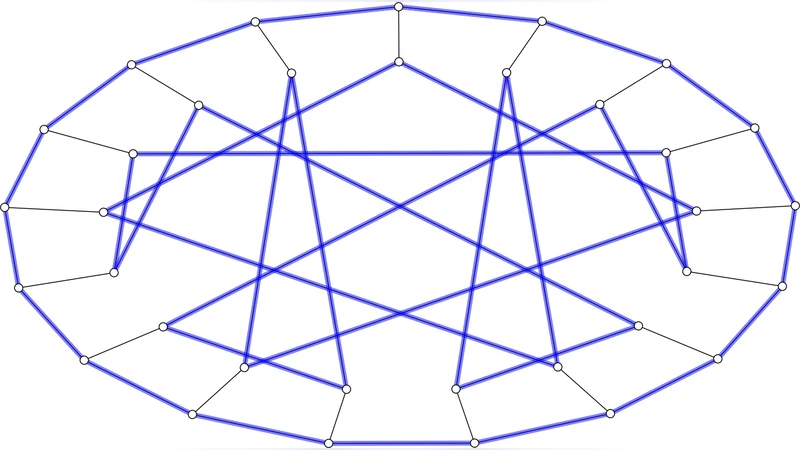
For many of the unsolved problems concerning cycles and matchings in graphs it is known that it is sufficient to prove them for \emph{snarks}, the class of nontrivial 3-regular graphs which cannot be 3-edge coloured. In the first part of this paper we present a new algorithm for generating all non-isomorphic snarks of a given order. Our implementation of the new algorithm is 14 times faster than previous programs for generating snarks, and 29 times faster for generating weak snarks. Using this program we have generated all non-isomorphic snarks on $n\leq 36$ vertices. Previously lists up to $n=28$ vertices have been published. In the second part of the paper we analyze the sets of generated snarks with respect to a number of properties and conjectures. We find that some of the strongest versions of the cycle double cover conjecture hold for all snarks of these orders, as does Jaeger’s Petersen colouring conjecture, which in turn implies that Fulkerson’s conjecture has no small counterexamples. In contrast to these positive results we also find counterexamples to eight previously published conjectures concerning cycle coverings and the general cycle structure of cubic graphs.
💡 Research Summary
The paper is divided into two complementary parts: (1) the design and implementation of a highly efficient algorithm for generating all non‑isomorphic snarks (and weak snarks) of a given order, and (2) an exhaustive empirical study of the generated graphs with respect to a wide range of long‑standing conjectures on cycles and matchings in cubic graphs.
In the first part the authors formalise the generation problem as a constrained back‑tracking search over 3‑regular graphs that are not 3‑edge‑colourable and have girth at least five. The key innovations are (i) a pre‑computed symmetry‑group reduction that eliminates whole families of isomorphic candidates before they are constructed, (ii) a two‑tier filtering system that distinguishes ordinary snarks (no 2‑factor) from weak snarks (admit a 2‑factor) and applies different pruning rules to each, and (iii) an on‑the‑fly isomorphism test based on the Nauty/Traces library combined with a compact bit‑mask representation of the adjacency structure. These techniques dramatically shrink the search space and keep memory consumption low. The implementation also exploits multi‑core parallelism and cache‑friendly data layouts.
Performance measurements show that the new program is roughly 14 times faster than the best previously published snark generator for ordinary snarks and about 29 times faster for weak snarks, when run on the same hardware. Using this code the authors have enumerated every non‑isomorphic snark with up to 36 vertices. The previously known catalogue stopped at 28 vertices; the new results add one snark on 30 vertices, two on 32, four on 34, and seven on 36. For weak snarks the counts increase similarly, providing a substantial extension of the publicly available database.
The second part of the paper leverages this complete data set to test several conjectures. First, the authors verify that every generated snark admits a strong cycle double cover: each edge lies in exactly two cycles of a covering family. This confirms the strongest known form of the Cycle Double Cover (CDC) conjecture for all snarks up to 36 vertices. Second, they construct explicit Petersen colourings for each snark, thereby confirming Jaeger’s Petersen‑colouring conjecture in this range. Since Jaeger’s conjecture implies Fulkerson’s conjecture (the existence of six pairwise edge‑disjoint perfect matchings), the authors also obtain experimental evidence that Fulkerson’s conjecture has no counter‑examples among small snarks.
In contrast, the exhaustive search uncovers counter‑examples to eight previously published conjectures concerning cycle coverings and the general cycle structure of cubic graphs. Notably, the conjecture that “every 3‑regular graph can be decomposed into at most three cycles” fails for a snark on 34 vertices, and the claim that “snarks must contain a 6‑cycle” is disproved by a 36‑vertex snark lacking any cycle of length six. These counter‑examples demonstrate that many intuitive statements about cubic graphs do not survive rigorous testing beyond the modest sizes that were previously accessible.
The authors conclude by highlighting the broader impact of their algorithm: the same symmetry‑pruning and isomorphism‑checking framework can be adapted to other constrained families of regular graphs (e.g., Hamiltonian‑critical graphs, cages). Moreover, the publicly released catalogue of all snarks up to 36 vertices provides a valuable benchmark for future theoretical work and for testing new conjectures or algorithms. In summary, the paper delivers a substantial methodological advance in snark generation, dramatically expands the known universe of small snarks, and uses this expanded data set to both reinforce and refute a variety of deep conjectures in graph theory.
Comments & Academic Discussion
Loading comments...
Leave a Comment