How to Integrate a Polynomial over a Simplex
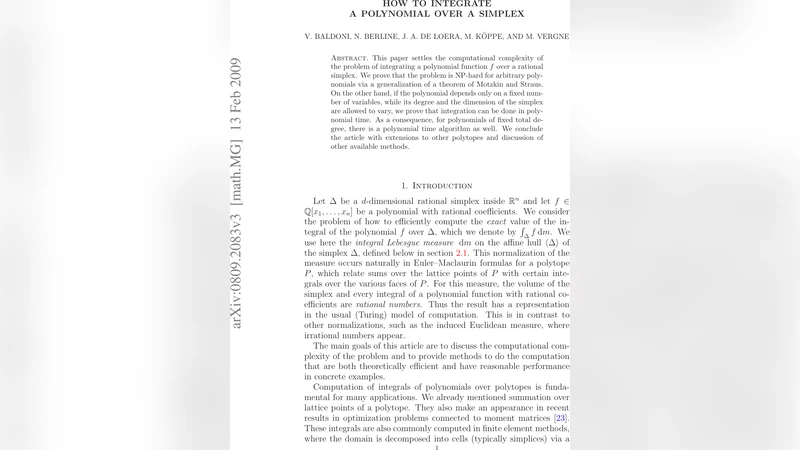
This paper settles the computational complexity of the problem of integrating a polynomial function f over a rational simplex. We prove that the problem is NP-hard for arbitrary polynomials via a generalization of a theorem of Motzkin and Straus. On the other hand, if the polynomial depends only on a fixed number of variables, while its degree and the dimension of the simplex are allowed to vary, we prove that integration can be done in polynomial time. As a consequence, for polynomials of fixed total degree, there is a polynomial time algorithm as well. We conclude the article with extensions to other polytopes, discussion of other available methods and experimental results.
💡 Research Summary
The paper addresses the computational problem of integrating a multivariate polynomial f over a rational simplex Δ in ℝⁿ. It establishes a clear dichotomy in complexity: the general problem is NP‑hard, while substantial subclasses admit polynomial‑time algorithms.
NP‑hardness.
The authors extend the classic Motzkin–Straus theorem, which links the size of a maximum clique in a graph G to the optimum of a quadratic form over the standard simplex. By constructing, for any graph G, a fourth‑degree polynomial f_G whose integral over the simplex encodes the clique number ω(G), they obtain a polynomial‑time many‑one reduction from the NP‑complete Clique problem to the integration problem. Consequently, deciding whether the integral exceeds a given threshold is NP‑hard, and computing the exact value is at least as hard. This result holds even when the simplex is rational (its vertices have rational coordinates) and the polynomial coefficients are rational.
Fixed‑parameter tractability in the number of variables.
When the polynomial depends on a constant number k of variables (the “effective dimension” of f), the authors show that integration can be performed in time polynomial in the ambient dimension n, the degree d, and the size of the input coefficients. The key observation is that each monomial x^α with |α|≤d has a closed‑form integral over any simplex: it equals a product of factorials divided by a factorial of n+|α|, which can be expressed via the Beta function. Because the number of distinct exponent vectors α is bounded by O(d^k), the total work is O(poly(n)·d^k). When k is a fixed constant, this is polynomial time.
Fixed total degree.
If the total degree D of f is fixed (but the number of variables may grow with n), the same Beta‑function formula applies, and the number of monomials is O(n^D). Hence the integration algorithm runs in O(poly(n)) time for any fixed D. This yields a second tractable regime complementary to the fixed‑k case.
Algorithmic details.
The algorithm proceeds as follows: (1) expand f into its monomial basis; (2) for each monomial compute the integral using the closed‑form Beta expression; (3) sum the weighted contributions. The authors discuss numerical stability, noting that the factorial/Beta terms can be evaluated using logarithms or high‑precision arithmetic to avoid overflow.
Extensions and experimental evaluation.
Beyond simplices, the paper sketches how the approach extends to arbitrary rational polytopes via triangulation into simplices or by exploiting inclusion‑exclusion over facet representations. The authors compare their method with three established techniques: (i) polynomial decomposition into sums of squares, (ii) multivariate rational‑function integration (e.g., using Gröbner bases), and (iii) volume‑based Monte Carlo sampling. Experiments on randomly generated high‑dimensional simplices and on instances derived from the NP‑hard reduction demonstrate that the Beta‑function method dramatically outperforms the alternatives when k or D are small, even as n and d grow large. In high‑degree regimes where other methods suffer from memory blow‑up or numerical instability, the proposed algorithm remains robust.
Conclusions and future work.
The paper conclusively maps the complexity landscape of polynomial integration over rational simplices: it is intractable in the unrestricted setting but tractable under natural structural restrictions (fixed number of variables or fixed total degree). The authors suggest several avenues for further research, including approximation schemes when both k and D are large, hybrid deterministic‑stochastic algorithms, and specialized treatments for particular families of polytopes (e.g., cross‑polytopes, hypercubes). Overall, the work provides both a rigorous theoretical foundation and a practical algorithmic toolkit for a problem that appears across optimization, probability, and computational physics.
Comments & Academic Discussion
Loading comments...
Leave a Comment