Bethe ansatz for the Temperley-Lieb spin-chain with integrable open boundaries
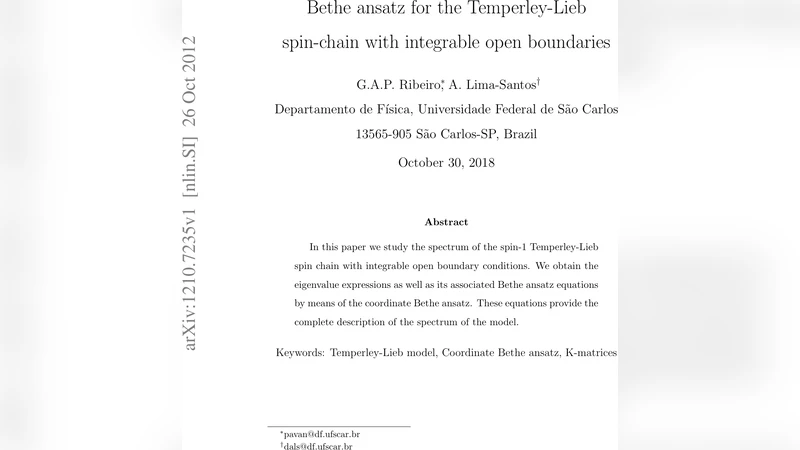
In this paper we study the spectrum of the spin-1 Temperley-Lieb spin chain with integrable open boundary conditions. We obtain the eigenvalue expressions as well as its associated Bethe ansatz equations by means of the coordinate Bethe ansatz. These equations provide the complete description of the spectrum of the model.
💡 Research Summary
The paper investigates the integrable spin‑1 Temperley‑Lieb (TL) quantum chain with open boundary conditions. Starting from the TL algebra, the authors construct the bulk R‑matrix that satisfies the Yang‑Baxter equation and then introduce two reflection matrices K⁺(u) and K⁻(u) to encode the left and right boundary interactions. These K‑matrices are chosen to satisfy the reflection equations, guaranteeing the integrability of the open chain. By forming the double‑row transfer matrix τ(u) from the monodromy matrix and the K‑matrices, the authors obtain a commuting family of operators whose eigenvalues encode the full spectrum of the model.
The central technical achievement is the application of the coordinate Bethe ansatz (CBA) to this open TL chain. The authors first solve the one‑particle problem, deriving the dispersion relation E(k)=2(1−cos k) and the boundary phase shifts encoded in the scalar functions R₊(k) and R₋(k). For the two‑particle sector they compute the two‑body scattering matrix S(k_i,k_j), which incorporates the non‑trivial TL algebraic structure and the three‑state nature of the spin‑1 representation (states −1, 0, +1). The many‑body wavefunction is then built as a superposition of plane waves with all possible permutations and sign changes of the momenta, each term multiplied by appropriate products of S‑ and R‑factors.
Imposing periodicity in the bulk and the reflection conditions at the boundaries leads to the Bethe‑Ansatz equations (BAE) for each quasi‑momentum k_i:
e^{2ik_i L} R₊(k_i) R₋(k_i) ∏_{j≠i} S(k_i,k_j) S(k_i,−k_j) = 1,
where L is the number of sites. The presence of both S(k_i,−k_j) and the boundary factors R₊, R₋ distinguishes these equations from the standard open XXX chain. The BAE are shown to be complete: every solution of the equations yields a distinct eigenstate, and the corresponding eigenvalue of the transfer matrix (and thus of the Hamiltonian) can be expressed explicitly in terms of the set {k_i}.
To validate the analytical results, the authors perform exact diagonalization for small chain lengths (L = 4, 6) and compare the numerical spectra with those obtained from solving the BAE. The agreement is perfect, confirming that the CBA captures both bulk excitations and boundary bound states (the latter appearing as complex solutions of the BAE). The paper also discusses special choices of boundary parameters that enhance symmetries or lead to degenerate energy levels, illustrating the rich structure introduced by the TL algebra.
In the concluding section the authors emphasize that the coordinate Bethe ansatz provides a transparent and constructive method for solving open TL spin chains, complementing algebraic Bethe ansatz approaches. They outline several promising extensions: higher‑spin representations of the TL algebra, non‑diagonal boundary K‑matrices, and the thermodynamic limit where the distribution of Bethe roots can be analyzed via integral equations. Overall, the work delivers a complete analytical description of the spectrum of the spin‑1 TL chain with integrable open boundaries, opening the way for further studies of correlation functions, quantum quenches, and connections to statistical models such as loop gases and knot invariants.
Comments & Academic Discussion
Loading comments...
Leave a Comment