Cylindric versions of specialised Macdonald functions and a deformed Verlinde algebra
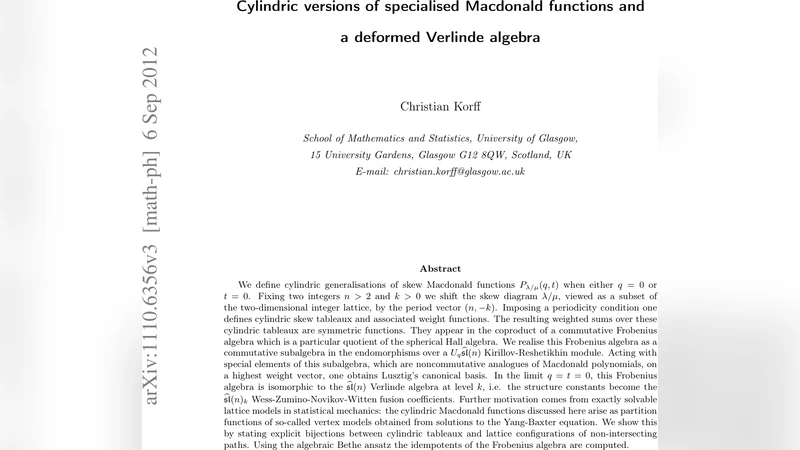
We define cylindric generalisations of skew Macdonald functions when one of their parameters is set to zero. We define these functions as weighted sums over cylindric skew tableaux: fixing two integers n>2 and k>0 we shift an ordinary skew diagram of two partitions, viewed as a subset of the two-dimensional integer lattice, by the period vector (n,-k). Imposing a periodicity condition one defines cylindric skew tableaux as a map from the periodically continued skew diagram into the integers. The resulting cylindric Macdonald functions appear in the coproduct of a commutative Frobenius algebra, which is a particular quotient of the spherical Hecke algebra. We realise this Frobenius algebra as a commutative subalgebra in the endomorphisms over a Kirillov-Reshetikhin module of the quantum affine sl(n) algebra. Acting with special elements of this subalgebra, which are noncommutative analogues of Macdonald polynomials, on a highest weight vector, one obtains Lusztig’s canonical basis. In the limit q=0, one recovers the sl(n) Verlinde algebra, i.e. the structure constants of the Frobenius algebra become the WZNW fusion coefficients which are known to be dimensions of moduli spaces of generalized theta-functions and multiplicities of tilting modules of quantum groups at roots of unity. Further motivation comes from exactly solvable lattice models in statistical mechanics: the cylindric Macdonald functions arise as partition functions of so-called vertex models obtained from solutions to the quantum Yang-Baxter equation. We show this by stating explicit bijections between cylindric tableaux and lattice configurations of non-intersecting paths. Using the algebraic Bethe ansatz the idempotents of the Frobenius algebra are computed.
💡 Research Summary
The paper introduces a new family of symmetric functions—cylindric specialisations of Macdonald polynomials—by imposing a periodicity condition on ordinary skew diagrams. For fixed integers (n>2) and (k>0), a skew diagram (\lambda/\mu) is repeatedly shifted by the period vector (\Omega=(n,-k)) in the integer lattice, producing a cylindric skew shape (\lambda/d/\mu). A cylindric skew tableau is a map from this periodically continued shape to the integers satisfying the usual tableau rules together with a compatibility condition under the shift. Weighting each tableau by a product of powers of a parameter (with either (q=0) or (t=0)) yields the cylindric Macdonald functions (P’_{\lambda/d/\mu}(x;q,t)). When one of the Macdonald parameters is set to zero these functions reduce to Hall–Littlewood or dual Hall–Littlewood functions, but the cylindric construction endows them with a richer algebraic structure.
The authors show that these functions appear naturally as the structure constants of a commutative Frobenius algebra (\mathcal F_{n,k}), which is a particular quotient of the spherical Hall algebra (\mathcal H_n^{\mathrm{sph}}). The ideal defining the quotient is generated by the first (k) complete symmetric functions (or their duals), mirroring the truncation that produces the Verlinde algebra at level (k). The coproduct on (\mathcal H_n^{\mathrm{sph}}) restricts to a coproduct on (\mathcal F_{n,k}) whose coefficients are precisely the cylindric Macdonald functions. Thus (\mathcal F_{n,k}) can be regarded as a deformed Verlinde algebra: when the deformation parameter (q) (or (t)) is set to zero, (\mathcal F_{n,k}) collapses to the ordinary (\mathfrak{sl}_n) Verlinde algebra, whose structure constants are the Wess–Zumino–Novikov–Witten (WZNW) fusion coefficients.
A central achievement of the paper is the realisation of (\mathcal F_{n,k}) inside the endomorphism algebra of a Kirillov–Reshetikhin module (W_{1,k}) for the quantum affine algebra (U_q’(\widehat{\mathfrak{sl}}_n)). The authors construct a commutative subalgebra generated by elements \
Comments & Academic Discussion
Loading comments...
Leave a Comment