Edge Union of Networks on the Same Vertex Set
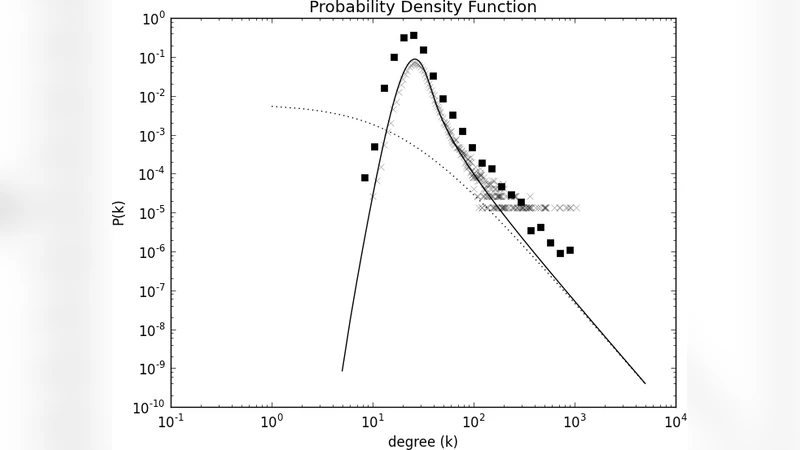
Random networks generators like Erdoes-Renyi, Watts-Strogatz and Barabasi-Albert models are used as models to study real-world networks. Let G^1(V,E_1) and G^2(V,E_2) be two such networks on the same vertex set V. This paper studies the degree distribution and cluster coefficient of the resultant networks, G(V, E_1 U E_2).
💡 Research Summary
This paper investigates the structural properties of the edge‑union of two random graphs that share the same vertex set V. The authors consider three of the most widely used generative models—Erdős–Rényi (ER), Watts–Strogatz (WS), and Barabási–Albert (BA)—and examine all pairwise combinations (ER‑ER, ER‑WS, ER‑BA, WS‑WS, WS‑BA, BA‑BA). The central questions are how the degree distribution and the clustering coefficient of the resulting graph G(V, E₁∪E₂) relate to those of the constituent layers.
Theoretical framework
For any vertex i, the degree in the union is k_i = k_i¹ + k_i² – c_i, where c_i counts edges that appear in both layers. In the sparse regime (average degree O(1) or connection probability p = O(1/n)), the expected overlap E
Comments & Academic Discussion
Loading comments...
Leave a Comment