Colouring the Triangles Determined by a Point Set
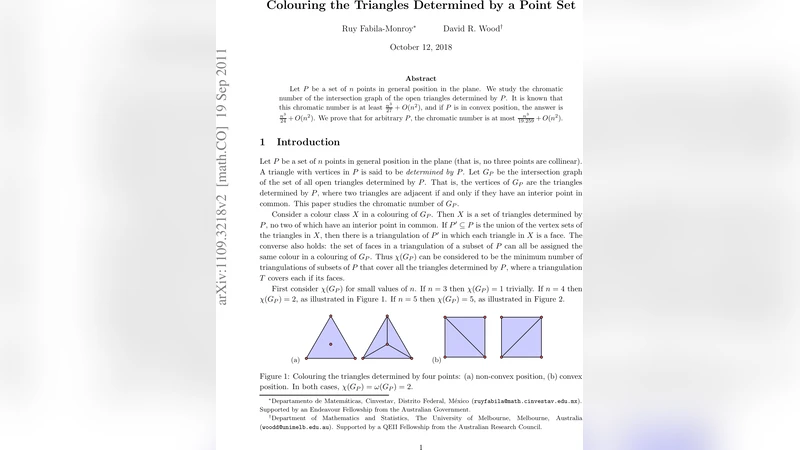
Let P be a set of n points in general position in the plane. We study the chromatic number of the intersection graph of the open triangles determined by P. It is known that this chromatic number is at least n^3/27+O(n^2), and if P is in convex position, the answer is n^3/24+O(n^2). We prove that for arbitrary P, the chromatic number is at most n^3/19.259+O(n^2).
💡 Research Summary
The paper investigates the chromatic number χ(Gₚ) of the intersection graph Gₚ whose vertices are all open triangles determined by a set P of n points in general position in the plane. Two triangles are adjacent in Gₚ if their interiors intersect, i.e., they share at least one interior point. The problem is to assign colors to the triangles so that adjacent triangles receive distinct colors, and to determine how many colors are necessary in the worst case.
Previously, the “first selection lemma” of Boros and Füredi showed that there exists a point contained in at least n³/27 + O(n²) triangles, which yields a lower bound ω(Gₚ) ≥ n³/27 + O(n²) for the size of a maximum clique and consequently χ(Gₚ) ≥ n³/27 + O(n²). For point sets in convex position, Cano et al. proved an exact formula χ(Gₚ)=n³/24 + O(n²). The gap between these bounds for arbitrary point sets remained large.
The main contribution of this work is a new upper bound: for any set P of n points in general position, \
Comments & Academic Discussion
Loading comments...
Leave a Comment