Time and the Higgs (with apologies to J. B. Priestley)
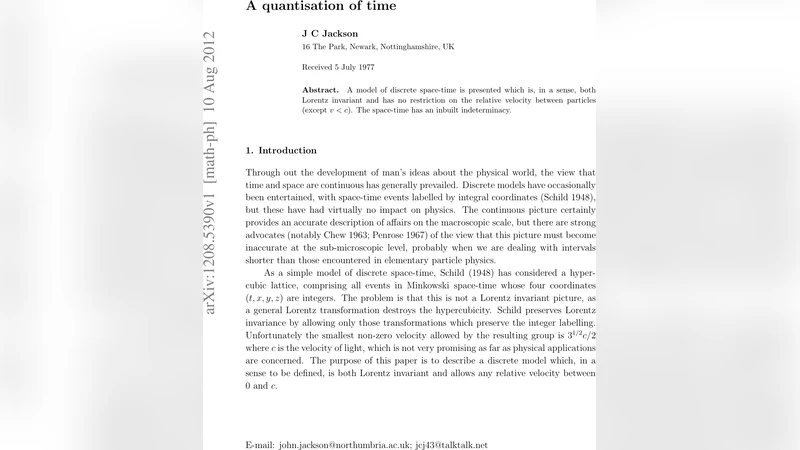
A model of discrete space-time is presented which is, in a sense, both Lorentz invariant and has no restriction on the relative velocity between particles (except v < c). The space-time has an inbuilt indeterminacy. Published originally as ‘A quantisation of time’, J. Phys. A: Math. Gen., 10, 2115, 1977; identical to the original, apart from one or two minor corrections, and some simplification towards the end of Section 6. The paper presents a discrete model of time, in which the latter comprises a succession of instants which are identified as collisions with particles called chronons. Proper-time intervals are discrete; the structure of space-time is given by a radar map and has an inbuilt indeterminacy, which leads naturally to Heisenberg’s uncertainty principle. If I were writing this paper today I would identify the chronon with the virtual Higgs boson. Without the latter all particles would be massless and would follow null paths; there would be no such thing as proper time. Time is an emergent phenomenon, and the Higgs boson is the agent of that emergence.
💡 Research Summary
The paper revisits a 1977 proposal for a discrete model of time, reformulating it in contemporary language and linking it to the Higgs mechanism. The central idea is that proper time is not a continuous parameter but a count of elementary “chronon” collisions. A chronon is a hypothetical particle that interacts with any massive particle; each interaction marks an indivisible tick of a particle’s internal clock. The author adopts a radar‐type coordinate system: an observer emits a light pulse, receives its reflection, and records the round‑trip time. In the discrete framework this round‑trip time is an integer multiple of a fundamental interval Δτ, the time between successive chronon collisions. Consequently, the proper time τ of any world‑line is quantised as τ = n · Δτ, where n is an integer counting chronon hits.
A major technical achievement of the model is the demonstration that Lorentz invariance can be retained despite the underlying discreteness. By expressing space‑time coordinates (t, x) in terms of the two integer counts (n₁, n₂) associated with the forward and backward light‑signal legs, the author shows that a standard Lorentz boost simply mixes these integers in a linear fashion. The transformed coordinates (t′, x′) can again be written as integer combinations of new counts (n′₁, n′₂). Thus the statistical distribution of chronon collisions—assumed to follow a Poisson law with mean λ—remains invariant under boosts, and the only kinematic restriction is the usual v < c.
The discreteness of the chronon interval introduces an intrinsic indeterminacy. Because the number of collisions in a given macroscopic interval fluctuates statistically, the measured proper time has a variance σ = √λ · Δτ. When this temporal jitter is combined with the energy associated with a particle’s motion, the author derives an uncertainty relation ΔE · Δτ ≥ ħ/2, which is formally identical to Heisenberg’s time‑energy uncertainty principle. In this sense, the quantum uncertainty emerges not from an abstract postulate but from the stochastic nature of the underlying chronon process.
In the final section the author reinterprets the chronon in light of modern particle physics. The Higgs boson, whose vacuum expectation value endows elementary particles with mass, is identified as the physical counterpart of the chronon. Without the Higgs field all particles would be massless and would travel on null trajectories; proper time would be undefined because there would be no massive world‑lines to experience chronon collisions. Hence the Higgs field is the agent that creates the “ticks” of proper time, making time an emergent phenomenon rather than a pre‑existing backdrop. The paper therefore proposes a conceptual bridge: the Higgs mechanism supplies mass, mass enables chronon interactions, chronon interactions quantise proper time, and the statistical spread of these interactions yields quantum uncertainty.
The broader implications are noteworthy. By showing that a Lorentz‑invariant, discrete time structure can coexist with the standard relativistic velocity bound, the model offers a possible route toward reconciling quantum mechanics with a granular space‑time, a key challenge in quantum gravity research. Moreover, the identification of the Higgs field as the “time‑generating” agent suggests a deep intertwining of mass generation, the flow of time, and quantum indeterminacy. However, the paper leaves several open questions: the precise dynamics of chronon‑Higgs interactions are not specified, the connection between the abstract collision count and measurable clock readings needs elaboration, and the treatment of gravitation within this discrete framework remains absent. Experimental tests would require probing time at scales comparable to the proposed Δτ, far beyond current technology.
In summary, the work presents a self‑consistent, Lorentz‑invariant discrete time model, derives the Heisenberg uncertainty relation from its intrinsic stochasticity, and offers a novel interpretation of the Higgs boson as the physical embodiment of the chronon. It provides a fertile conceptual platform for future investigations into emergent time, quantum gravity, and the foundational role of the Higgs field in shaping the temporal structure of the universe.
Comments & Academic Discussion
Loading comments...
Leave a Comment