Metastable Chimera States in Community-Structured Oscillator Networks
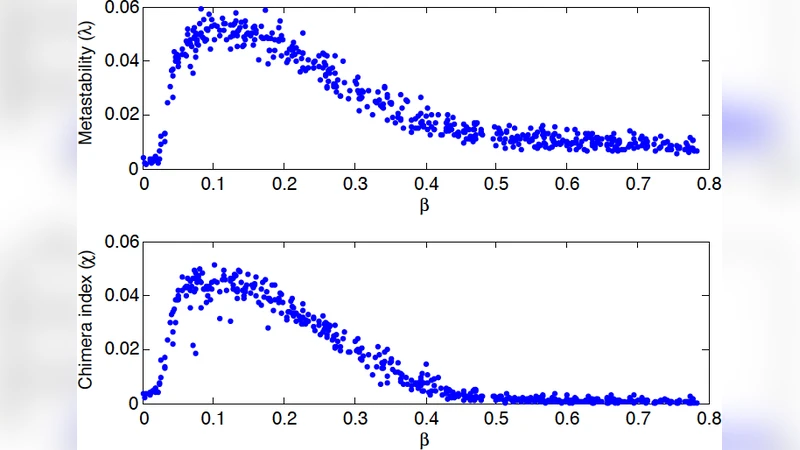
A system of symmetrically coupled identical oscillators with phase lag is presented, which is capable of generating a large repertoire of transient (metastable) “chimera” states in which synchronisation and desynchronisation co-exist. The oscillators are organised into communities, such that each oscillator is connected to all its peers in the same community and to a subset of the oscillators in other communities. Measures are introduced for quantifying metastability, the prevalence of chimera states, and the variety of such states a system generates. By simulation, it is shown that each of these measures is maximised when the phase lag of the model is close, but not equal, to pi/2. The relevance of the model to a number of fields is briefly discussed, with particular emphasis on brain dynamics.
💡 Research Summary
The paper introduces a minimalist yet powerful model of identical phase oscillators arranged in a community‑structured network and coupled with a uniform phase lag (the Kuramoto‑Sakaguchi framework). Within each community every oscillator is fully connected to its peers, while connections to oscillators in other communities are sparse and controlled by a tunable inter‑community coupling probability. The governing equation is
\
Comments & Academic Discussion
Loading comments...
Leave a Comment