Double scaling limits of random matrices and minimal (2m,1) models: the merging of two cuts in a degenerate case
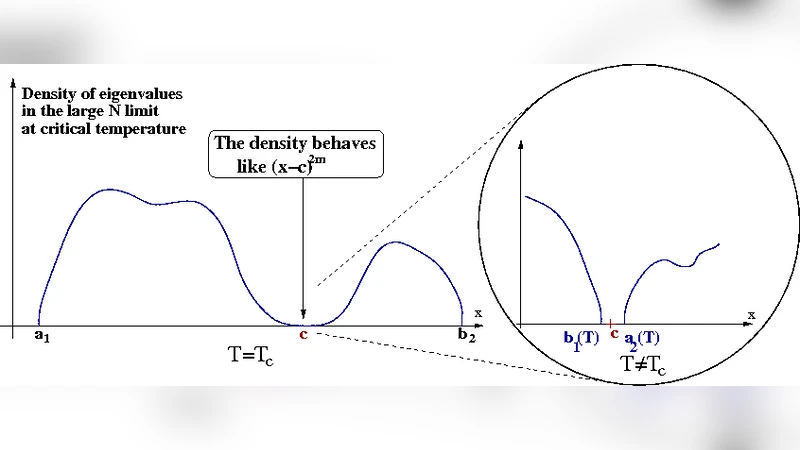
In this article, we show that the double scaling limit correlation functions of a random matrix model when two cuts merge with degeneracy $2m$ (i.e. when $y\sim x^{2m}$ for arbitrary values of the integer $m$) are the same as the determinantal formulae defined by conformal $(2m,1)$ models. Our approach follows the one developed by Berg`{e}re and Eynard in \cite{BergereEynard} and uses a Lax pair representation of the conformal $(2m,1)$ models (giving Painlev'e II integrable hierarchy) as suggested by Bleher and Eynard in \cite{BleherEynard}. In particular we define Baker-Akhiezer functions associated to the Lax pair to construct a kernel which is then used to compute determinantal formulae giving the correlation functions of the double scaling limit of a matrix model near the merging of two cuts.
💡 Research Summary
This paper investigates the double‑scaling limit of Hermitian random matrix models in the critical regime where two spectral cuts coalesce with a degeneracy of order 2m, i.e. the local behavior of the spectral curve near the merging point satisfies y ∼ x^{2m}. The authors demonstrate that the correlation functions obtained in this limit coincide exactly with the determinantal formulas that arise in the conformal minimal (2m,1) models of two‑dimensional quantum gravity.
The analysis builds on the framework introduced by Bergère and Eynard for double‑scaling limits and on the Lax‑pair representation of the (2m,1) models suggested by Bleher and Eynard. Starting from a polynomial potential V(x) whose equilibrium measure has two cuts, the authors tune the coupling constants so that the two cuts approach each other and merge with the prescribed degeneracy. In this regime the loop equations reduce to a nonlinear differential system that can be written as the compatibility condition of a Lax pair (L,M). The Lax pair is precisely the one associated with the m‑th member of the Painlevé II hierarchy.
From the Lax pair the authors construct a set of Baker‑Akhiezer functions ψ_k(x;λ) and their adjoints ψ_k⁎(x;λ), k=0,…,m−1, which solve the linear auxiliary problems and possess the required analyticity and asymptotic properties. Using these functions they define a reproducing kernel
K(x,y)=∑{k=0}^{m−1} ψ_k(x) ψ_k⁎(y).
The kernel satisfies the integrable Christoffel‑Darboux identity and serves as the building block for all n‑point correlation functions in the double‑scaling limit. Specifically, the authors prove that
⟨∏{i=1}^{n} Tr δ(x_i−M)⟩_{DS}=det
Comments & Academic Discussion
Loading comments...
Leave a Comment