Interaction and observation: categorical semantics of reactive systems trough dialgebras
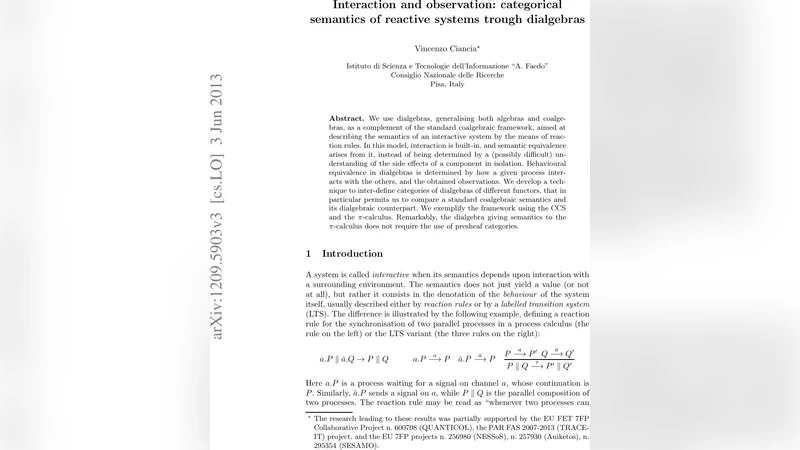
We use dialgebras, generalising both algebras and coalgebras, as a complement of the standard coalgebraic framework, aimed at describing the semantics of an interactive system by the means of reaction rules. In this model, interaction is built-in, and semantic equivalence arises from it, instead of being determined by a (possibly difficult) understanding of the side effects of a component in isolation. Behavioural equivalence in dialgebras is determined by how a given process interacts with the others, and the obtained observations. We develop a technique to inter-define categories of dialgebras of different functors, that in particular permits us to compare a standard coalgebraic semantics and its dialgebraic counterpart. We exemplify the framework using the CCS and the pi-calculus. Remarkably, the dialgebra giving semantics to the pi-calculus does not require the use of presheaf categories.
💡 Research Summary
The paper introduces dialgebras as a categorical structure that simultaneously generalises algebras (which generate behaviour) and coalgebras (which observe behaviour). By embedding interaction directly into the semantic model, dialgebras shift the focus from observing isolated component effects to analysing how a process interacts with its environment and what observations result from that interaction. A dialgebra consists of two functors F and B: F produces the set of possible interactions a state can initiate, while B maps the outcomes of those interactions to observable results. Behavioural equivalence is defined as a bisimulation that respects both the interaction step and the subsequent observation, thereby capturing a notion of “observable interaction” rather than merely matching transition labels.
The authors develop a technique for inter‑defining categories of dialgebras built from different functors. Given a coalgebraic functor T, they construct a corresponding dialgebraic functor (F,T) and, conversely, from a dialgebraic pair (F,B) they derive a coalgebraic functor T′. This inter‑definability enables a precise comparison between a standard coalgebraic semantics and its dialgebraic counterpart, showing how the latter can be translated back into the former and vice versa without loss of behavioural information.
To demonstrate practicality, the framework is instantiated for two well‑known process calculi. For CCS, the usual labelled transition rules are re‑expressed as a dialgebra where the interaction functor encodes the synchronisation of complementary actions and the observation functor records the resulting communication. For the π‑calculus, which traditionally requires presheaf categories to handle name generation and mobility, the authors show that a dialgebra can capture name creation directly within the interaction functor. Consequently, the π‑calculus semantics can be given without resorting to the technically heavy presheaf machinery, highlighting the expressive power of dialgebras for name‑binding languages.
The paper also outlines an algorithmic approach to checking dialgebraic bisimilarity. When the interaction functor yields a finite set of possible interactions, the system can be unfolded into a labelled graph, and a standard partition‑refinement algorithm can be applied to the observable outcomes. Because of the inter‑definability results, existing coalgebraic model‑checking tools can be reused after translating a dialgebraic model into its coalgebraic image.
In the broader context, the work suggests that interaction‑centric semantics can simplify reasoning about concurrent and distributed systems. By making the exchange of actions part of the semantic definition, one obtains a more intuitive behavioural equivalence that aligns with how engineers think about protocols and interfaces. Moreover, the ability to move seamlessly between dialgebraic and coalgebraic views opens the door to hybrid toolchains, where design‑time interaction models are verified using coalgebraic techniques and then exported back to dialgebraic specifications for further refinement or code generation.
In summary, the paper provides a solid categorical foundation for reactive system semantics based on dialgebras, establishes a bridge to traditional coalgebraic semantics, and validates the approach with concrete examples from CCS and the π‑calculus. The elimination of presheaf categories for the π‑calculus and the clear definition of behavioural equivalence via observable interaction are the most striking contributions, paving the way for future research on dialgebra‑based verification tools and extensions to more complex name‑binding or dynamic‑creation paradigms.
Comments & Academic Discussion
Loading comments...
Leave a Comment