Mathematical aspects of degressive proportionality
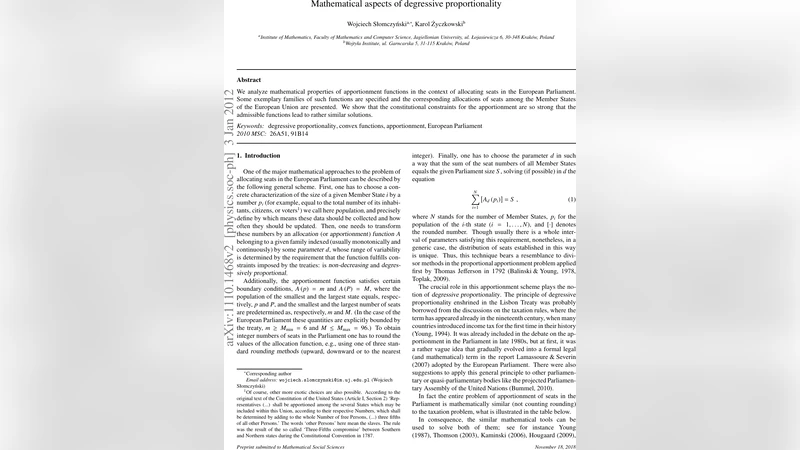
We analyze properties of apportionment functions in context of the problem of allocating seats in the European Parliament. Necessary and sufficient conditions for apportionment functions are investigated. Some exemplary families of apportionment functions are specified and the corresponding partitions of the seats in the European Parliament among the Member States of the European Union are presented. Although the choice of the allocation functions is theoretically unlimited, we show that the constraints are so strong that the acceptable functions lead to rather similar solutions.
💡 Research Summary
The paper provides a rigorous mathematical treatment of degressive proportionality as it applies to the allocation of seats in the European Parliament. Degressive proportionality is defined as a rule whereby larger Member States receive fewer seats per capita than smaller ones, thereby granting relatively greater representation to the latter. To formalize this principle, the authors introduce an “apportionment function” f :
Comments & Academic Discussion
Loading comments...
Leave a Comment