Characterizing Truthful Multi-Armed Bandit Mechanisms
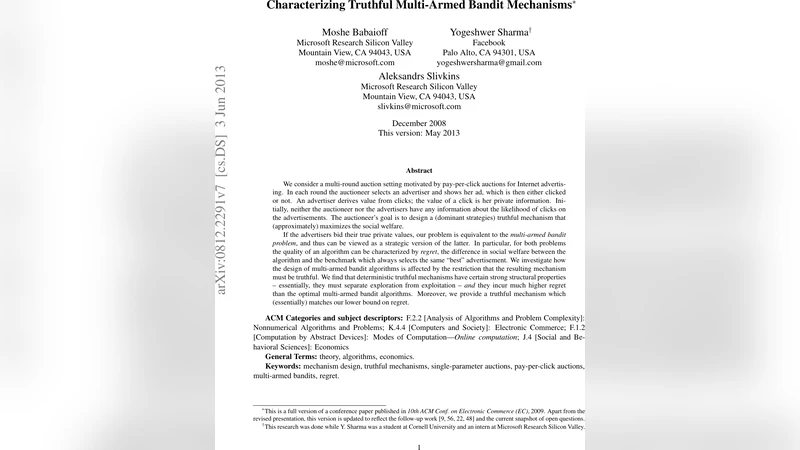
We consider a multi-round auction setting motivated by pay-per-click auctions for Internet advertising. In each round the auctioneer selects an advertiser and shows her ad, which is then either clicked or not. An advertiser derives value from clicks; the value of a click is her private information. Initially, neither the auctioneer nor the advertisers have any information about the likelihood of clicks on the advertisements. The auctioneer’s goal is to design a (dominant strategies) truthful mechanism that (approximately) maximizes the social welfare. If the advertisers bid their true private values, our problem is equivalent to the “multi-armed bandit problem”, and thus can be viewed as a strategic version of the latter. In particular, for both problems the quality of an algorithm can be characterized by “regret”, the difference in social welfare between the algorithm and the benchmark which always selects the same “best” advertisement. We investigate how the design of multi-armed bandit algorithms is affected by the restriction that the resulting mechanism must be truthful. We find that truthful mechanisms have certain strong structural properties – essentially, they must separate exploration from exploitation – and they incur much higher regret than the optimal multi-armed bandit algorithms. Moreover, we provide a truthful mechanism which (essentially) matches our lower bound on regret.
💡 Research Summary
The paper studies a multi‑round auction model inspired by pay‑per‑click (PPC) advertising, where in each round the auctioneer selects one advertiser, displays her ad, and observes whether a click occurs. Each advertiser derives a private value per click, which is unknown to both the auctioneer and the other advertisers. The auctioneer’s objective is to design a mechanism that is dominant‑strategy truthful (i.e., advertisers are incentivized to report their true per‑click values) while approximately maximizing social welfare, the sum of the advertisers’ realized values from clicks.
If advertisers bid truthfully, the problem reduces to the classic stochastic multi‑armed bandit (MAB) problem: each advertiser corresponds to an arm, the unknown click‑through rate (CTR) of an arm is the probability of a click, and the reward of pulling an arm is the product of the CTR and the advertiser’s true value. In the standard MAB setting, the performance of an algorithm is measured by regret, the expected loss in total reward compared to a benchmark that always pulls the best arm. The novelty of this work lies in imposing the additional constraint of truthfulness on the bandit algorithm, thereby creating a “strategic” version of the MAB problem.
The authors first prove a structural property of any truthful mechanism: exploration and exploitation must be cleanly separated. In other words, an advertiser whose estimated CTR is currently lower than that of others can receive opportunities only during designated exploration phases; during exploitation phases the mechanism must always select the arm that maximizes the product of the reported value and the current CTR estimate. This separation is forced by the need to preserve incentive compatibility: if an advertiser could influence the exploitation decision by misreporting, she would have an incentive to deviate from truthfulness.
From this structural requirement they derive a lower bound on achievable regret. Using an information‑theoretic argument, they show that if the fraction of rounds devoted to exploration is too small (sub‑polynomial in T), the mechanism cannot gather enough samples to estimate the CTRs with the precision required for truthfulness. Consequently, any dominant‑strategy truthful mechanism must incur regret on the order of Θ(T^{2/3}) (or larger), which is dramatically higher than the optimal O(√T) regret attainable by unconstrained bandit algorithms such as UCB or Thompson Sampling.
To match this lower bound, the paper proposes a concrete mechanism called Truthful‑Explore‑Exploit (TEE). The TEE mechanism operates in two phases. In the exploration phase, each advertiser is selected a predetermined number of times (roughly T^{2/3}) uniformly at random, allowing the auctioneer to collect unbiased click data for every arm. In the exploitation phase, the mechanism computes an empirical CTR (\hat μ_i) for each advertiser i, multiplies it by the reported value b_i, and selects the advertiser with the highest product. Payments are set using a Vickrey‑Clarke‑Groves (VCG) style rule: the selected advertiser pays the externality she imposes on the others, which depends only on the empirical estimates and reported values of the other advertisers. This payment rule guarantees dominant‑strategy truthfulness because an advertiser’s payoff is maximized when she reports her true value, regardless of the reports of others.
The regret analysis of TEE splits the loss into two components. The exploration phase contributes O(T^{2/3}) regret because during those rounds the mechanism may not be pulling the optimal arm. In the exploitation phase, the estimation error of the CTRs decays as O(T^{-1/3}), leading to an additional regret term of the same order. Summing both parts yields total regret Θ(T^{2/3}), which matches the previously established lower bound up to constant factors.
The paper situates its contributions within the broader literature. Classical MAB research focuses on minimizing regret without regard to strategic behavior, achieving √T‑type bounds. Recent work on “bandit auctions” has begun to incorporate incentive constraints, but often under restrictive assumptions (e.g., known CTRs, single‑parameter settings, or limited exploration). This work extends the theory by showing that in the most natural stochastic MAB setting with private values, truthfulness forces a fundamental trade‑off: the mechanism must sacrifice a polynomial factor of efficiency to preserve incentive compatibility.
From a practical standpoint, the results suggest that PPC platforms wishing to enforce truthful bidding must allocate a substantial portion of traffic to systematic exploration, which may temporarily reduce short‑term revenue. However, the exploration data can be reused to improve future targeting and pricing, and the VCG‑style payments ensure that advertisers have no incentive to inflate or deflate their bids. The authors also discuss possible extensions, such as contextual bandits, non‑stationary CTRs, or richer payment schemes, indicating that the exploration‑exploitation separation may persist as a core design principle in many strategic learning environments.
In summary, the paper establishes that truthful multi‑armed bandit mechanisms inevitably incur higher regret than their non‑strategic counterparts, proves a Θ(T^{2/3}) lower bound, and constructs a matching mechanism. This work bridges mechanism design and online learning, highlighting the intrinsic cost of incentive compatibility in sequential decision‑making problems.
Comments & Academic Discussion
Loading comments...
Leave a Comment