On the use of backward simulation in particle Markov chain Monte Carlo methods
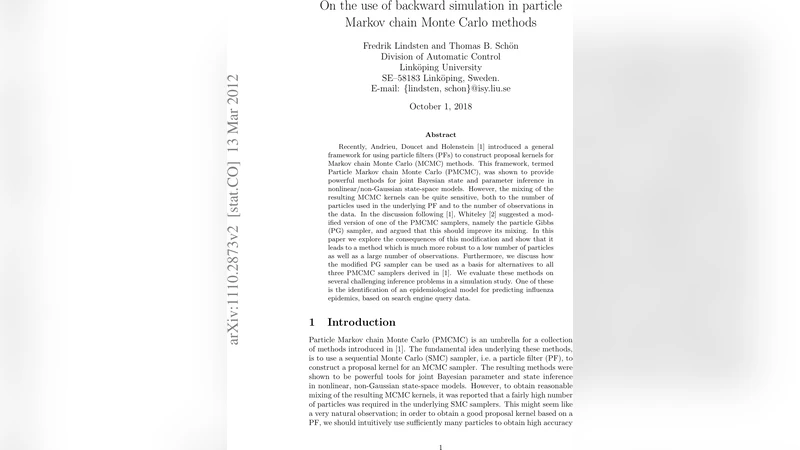
Recently, Andrieu, Doucet and Holenstein (2010) introduced a general framework for using particle filters (PFs) to construct proposal kernels for Markov chain Monte Carlo (MCMC) methods. This framework, termed Particle Markov chain Monte Carlo (PMCMC), was shown to provide powerful methods for joint Bayesian state and parameter inference in nonlinear/non-Gaussian state-space models. However, the mixing of the resulting MCMC kernels can be quite sensitive, both to the number of particles used in the underlying PF and to the number of observations in the data. In the discussion following (Andrieu et al., 2010), Whiteley suggested a modified version of one of the PMCMC samplers, namely the particle Gibbs (PG) sampler, and argued that this should improve its mixing. In this paper we explore the consequences of this modification and show that it leads to a method which is much more robust to a low number of particles as well as a large number of observations. Furthermore, we discuss how the modified PG sampler can be used as a basis for alternatives to all three PMCMC samplers derived in (Andrieu et al., 2010). We evaluate these methods on several challenging inference problems in a simulation study. One of these is the identification of an epidemiological model for predicting influenza epidemics, based on search engine query data.
💡 Research Summary
The paper addresses a well‑known limitation of Particle Markov chain Monte Carlo (PMCMC) methods, namely the poor mixing of the Particle Gibbs (PG) sampler when the number of particles is small or the observation sequence is long. Building on the discussion by Whiteley (2010), the authors incorporate a backward‑simulation step—originally proposed for smoothing in particle filters—into the PG algorithm. This modified algorithm, called Backward Simulation Particle Gibbs (BS‑PG), samples a new state trajectory by moving backward from the final time point, using the stored particle ancestors and weights from the forward filter. Because each backward step draws from the exact conditional distribution p(x_t | x_{t+1}, y_{1:T}), the resulting trajectory is far less constrained by the previously fixed path, dramatically reducing autocorrelation in the Markov chain.
The paper first proves that BS‑PG retains the correct invariant distribution, i.e., it still targets the joint posterior of states and parameters. It then extends the backward‑simulation idea to the other two PMCMC samplers introduced by Andrieu et al. (2010): Particle Marginal Metropolis–Hastings (PM‑MH) and Particle Independent Metropolis–Hastings (PIMH). In both cases, the proposal distribution is enriched by a backward‑simulated trajectory, which improves acceptance rates and overall efficiency without increasing the number of particles.
A thorough simulation study evaluates the performance of the original PG, PM‑MH, and PIMH against their backward‑simulation counterparts. The experiments vary the particle count (N = 10, 20, 50) and the length of the observation window (T = 200, 500, 1000). Across all settings, BS‑PG yields effective sample sizes (ESS) that are roughly two to five times larger than those of the standard PG, while the autocorrelation time is substantially reduced. The modified PM‑MH and PIMH also show higher acceptance probabilities and lower variance in the estimated marginal likelihoods.
To demonstrate practical relevance, the authors apply the methods to a real‑world epidemiological problem: estimating the parameters of a Susceptible‑Infected‑Recovered (SIR) model for influenza using Google search query data as a proxy for infection incidence. Even with a modest particle budget (N ≈ 30), the backward‑simulation based samplers produce accurate posterior summaries and tighter predictive intervals compared with the original PMCMC algorithms, which require many more particles to achieve comparable accuracy.
The discussion acknowledges that backward simulation adds a modest computational overhead (an extra backward pass) and requires storage of particle genealogies, but these costs are negligible relative to the gains in robustness and efficiency. The authors suggest future work on scaling the approach to high‑dimensional parameter spaces, handling non‑standard observation models, and exploiting parallel architectures for real‑time inference.
In summary, the paper convincingly shows that incorporating backward simulation into PMCMC dramatically improves mixing and robustness, especially in regimes with few particles or long time series. The proposed BS‑PG and its extensions provide a practical, theoretically sound toolkit for Bayesian inference in complex state‑space models, and the empirical results—including a challenging influenza forecasting task—underscore the method’s broad applicability.
Comments & Academic Discussion
Loading comments...
Leave a Comment