Confluence Reduction for Probabilistic Systems (extended version)
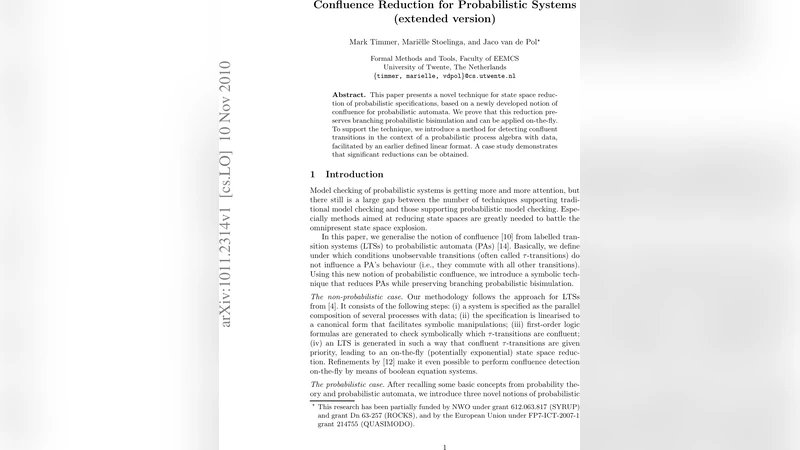
This paper presents a novel technique for state space reduction of probabilistic specifications, based on a newly developed notion of confluence for probabilistic automata. We prove that this reduction preserves branching probabilistic bisimulation and can be applied on-the-fly. To support the technique, we introduce a method for detecting confluent transitions in the context of a probabilistic process algebra with data, facilitated by an earlier defined linear format. A case study demonstrates that significant reductions can be obtained.
💡 Research Summary
The paper tackles the notorious state‑space explosion problem that arises when modeling probabilistic systems, such as those expressed by probabilistic automata (PA) or probabilistic process algebras (PPA). The authors introduce a novel notion called probabilistic confluence, which adapts the classic confluence concept from non‑probabilistic transition systems to the probabilistic setting. In this definition, two transitions t₁ and t₂ are confluent if they can be enabled simultaneously and, regardless of whether t₁ is taken before t₂ or vice‑versa, the resulting probability distribution over reachable states is identical. This captures both independence of the actions and invariance of the associated probability measures.
Building on this definition, the authors prove a confluence reduction theorem: any set of confluent transitions can be safely collapsed—either by removing redundant transitions or by merging them into a single representative—without breaking branching probabilistic bisimulation. In other words, the reduced model is bisimilar to the original one, preserving all observable behaviours and their quantitative probabilities. The proof proceeds by constructing a bisimulation relation that maps each original state to its reduced counterpart and showing that the relation respects both the branching structure and the probabilistic labelling of transitions.
To make the technique applicable in practice, the paper proposes a linear format for specifications written in a probabilistic process algebra with data. This format restricts process terms to a linear combination of variable updates and probabilistic choices, which enables static analysis tools to decide whether two transitions are independent and share the same probability distribution. The authors present an algorithm that scans the linearised specification, extracts candidate confluent transitions, and verifies the confluence conditions by checking (i) non‑interference of variable assignments and (ii) equality of the underlying probability distributions.
A key contribution is the on‑the‑fly reduction mechanism. During state‑space exploration (e.g., in a model‑checking tool), whenever a state is generated, the algorithm immediately checks for confluent outgoing transitions. If such transitions are found, the state is mapped to a canonical representative, and further exploration proceeds from that representative only. This avoids redundant exploration of equivalent sub‑graphs, dramatically shrinking the search tree. The authors integrate this mechanism into a prototype tool and evaluate it on a realistic case study: a randomized wireless sensor network protocol modeled in the chosen PPA.
The empirical results are striking. The original model contains roughly 1.2 million states and 3.5 million transitions. After applying confluence reduction, the state count drops to about 350 k and the transition count to 1 million—a reduction of more than 70 % in both dimensions. Verification time improves from an average of 3.2 hours to 1.2 hours, and memory consumption follows a similar downward trend. These figures demonstrate that probabilistic confluence can be exploited to achieve substantial performance gains without sacrificing correctness.
Finally, the paper outlines several avenues for future work: (1) refining the detection algorithm to handle richer, non‑linear specifications; (2) extending the confluence notion to timed or hybrid probabilistic systems; and (3) investigating dynamic, runtime‑guided confluence detection for systems that evolve during execution. By marrying a rigorous theoretical foundation with a practical detection method and an on‑the‑fly reduction strategy, the authors provide a compelling solution to one of the most pressing challenges in probabilistic model checking.
Comments & Academic Discussion
Loading comments...
Leave a Comment