Adaptive-Gain Second Order Sliding Mode Observer Design for Switching Power Converters
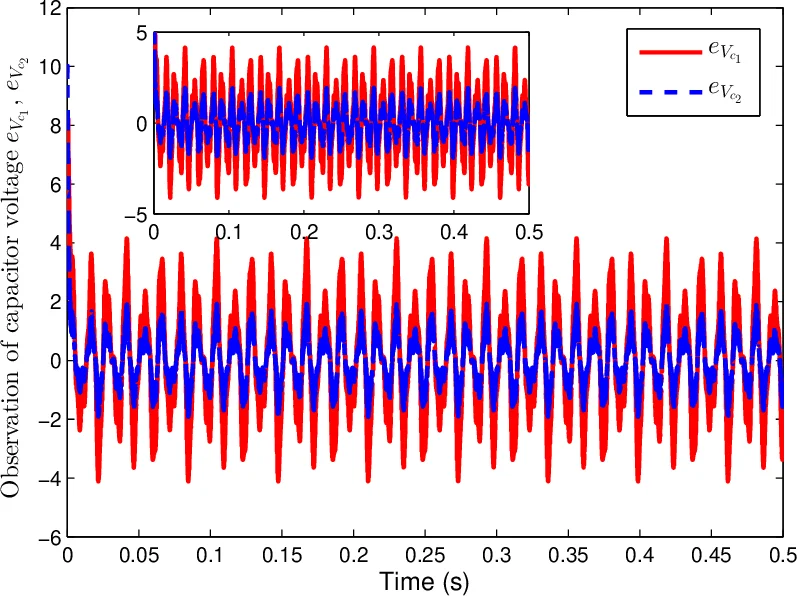
In this paper, a novel adaptive-gain Second Order Sliding Mode (SOSM) observer is proposed for multicell converters by considering it as a class of hybrid systems. The aim is to reduce the number of voltage sensors by estimating the capacitor voltages only from the measurement of load current. The proposed observer is proven to be robust in the presence of perturbations with \emph{unknown} boundary. However, the states of the system are only partially observable in the sense of observability rank condition. Due to its switching behavior, a recent concept of $Z(T_N)$ observability is used to analysis its hybrid observability, since its observability depends upon the switching control signals. Under certain condition of the switching sequences, the voltage across each capacitor becomes observable. Simulation results and comparisons with Luenberger switched observer highlight the effectiveness and robustness of the proposed observer with respect to output measurement noise and system uncertainties (load variations).
💡 Research Summary
This paper addresses the challenge of reducing the number of voltage sensors in multicell power converters, which are crucial for high-power applications. The authors propose a novel adaptive-gain Second Order Sliding Mode (SOSM) observer designed specifically for this class of hybrid systems. The primary objective is to accurately estimate the voltages across the flying capacitors using only measurements of the load current and the known switching control signals, thereby eliminating the need for direct voltage sensors on each capacitor.
The core of the work begins with modeling the multicell converter as a switched affine system, where the continuous states (load current and capacitor voltages) interact with discrete switching inputs. A conventional observability analysis using the rank condition of the observability matrix reveals that the system is only partially observable from the load current output. To overcome this limitation, the paper employs the concept of Z(T_N)-observability, a framework tailored for hybrid systems. This analysis proves that under specific sequences of switching modes (e.g., a sequence involving modes
Comments & Academic Discussion
Loading comments...
Leave a Comment