Dark Forces and Light Dark Matter
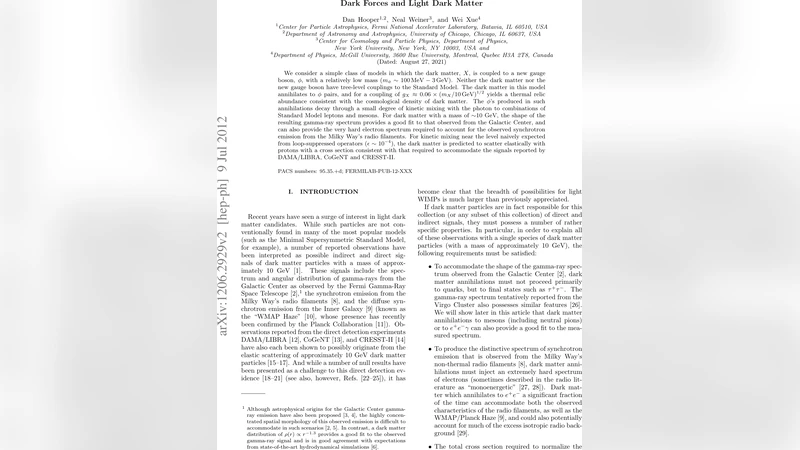
We consider a simple class of models in which the dark matter, X, is coupled to a new gauge boson, phi, with a relatively low mass (m_phi \sim 100 MeV-3 GeV). Neither the dark matter nor the new gauge boson have tree-level couplings to the Standard Model. The dark matter in this model annihilates to phi pairs, and for a coupling of g_X \sim 0.06 (m_X/10 GeV)^1/2 yields a thermal relic abundance consistent with the cosmological density of dark matter. The phi’s produced in such annihilations decay through a small degree of kinetic mixing with the photon to combinations of Standard Model leptons and mesons. For dark matter with a mass of \sim10 GeV, the shape of the resulting gamma-ray spectrum provides a good fit to that observed from the Galactic Center, and can also provide the very hard electron spectrum required to account for the observed synchrotron emission from the Milky Way’s radio filaments. For kinetic mixing near the level naively expected from loop-suppressed operators (epsilon \sim 10^{-4}), the dark matter is predicted to scatter elastically with protons with a cross section consistent with that required to accommodate the signals reported by DAMA/LIBRA, CoGeNT and CRESST-II.
💡 Research Summary
The paper proposes a minimal dark‑sector framework in which a light dark‑matter particle X interacts only with a new Abelian gauge boson φ. The φ boson has a mass in the range 100 MeV – 3 GeV and does not couple directly to Standard Model (SM) fields at tree level. Interaction between the dark sector and the SM is mediated solely by kinetic mixing between φ and the photon, characterized by a small parameter ε.
Thermal freeze‑out calculations show that X annihilates dominantly into φ‑pairs (X X̄ → φ φ). For a dark‑sector gauge coupling g_X ≈ 0.06 × (m_X/10 GeV)¹ᐟ², the annihilation cross‑section ⟨σv⟩ ≈ 3 × 10⁻²⁶ cm³ s⁻¹ yields a relic abundance matching the observed dark‑matter density (Ω_DM h² ≈ 0.12). Because φ is lighter than X, the annihilation is kinematically allowed and proceeds efficiently without requiring large couplings to SM particles.
The kinetic‑mixing term ε ≈ 10⁻⁴ (the size expected from loop‑suppressed operators) allows φ to decay promptly into SM leptons and light mesons. For m_φ below about 1 GeV the dominant decay modes are φ → e⁺e⁻ and φ → μ⁺μ⁻; above this threshold hadronic channels such as φ → π⁺π⁻ open. The decay products inherit the energy of the original X annihilation, producing a hard spectrum of electrons, positrons, and photons.
When m_X ≈ 10 GeV, the resulting γ‑ray spectrum from inverse‑Compton scattering of the energetic e⁺/e⁻ on ambient radiation fields reproduces the shape of the excess observed by Fermi‑LAT in the Galactic Center. Simultaneously, the same hard electron population can explain the unusually bright synchrotron emission seen in the Milky Way’s radio filaments, which requires electrons with energies of several GeV.
Direct‑detection implications arise because kinetic mixing also induces elastic scattering of X off nucleons via φ exchange. The predicted spin‑independent X‑proton cross‑section is σ_p ≈ 10⁻⁴⁰ cm² for ε ≈ 10⁻⁴, precisely the magnitude needed to accommodate the modulation signals reported by DAMA/LIBRA, the low‑energy excesses seen by CoGeNT, and the nuclear recoil events reported by CRESST‑II.
The authors discuss several phenomenological constraints. Values of ε much larger than 10⁻⁴ are excluded by beam‑dump, fixed‑target, and precision electroweak measurements, while ε much smaller would lengthen φ’s lifetime, potentially conflicting with Big‑Bang Nucleosynthesis and Cosmic‑Microwave‑Background observations. For φ masses above ~1 GeV, the opening of hadronic decay channels modifies the γ‑ray spectrum, risking disagreement with the Galactic Center data. Additionally, if m_X falls below ~5 GeV, the simple thermal freeze‑out underproduces dark matter, suggesting the need for non‑thermal production mechanisms or additional dark‑sector states.
Overall, the paper demonstrates that a dark sector consisting of a light dark matter particle and a sub‑GeV gauge boson, linked to the Standard Model only through kinetic mixing, can simultaneously explain three seemingly unrelated observations: the Galactic Center γ‑ray excess, the hard synchrotron emission from radio filaments, and the low‑mass direct‑detection anomalies. The model is highly predictive: future low‑energy fixed‑target experiments (e.g., DarkLight, HPS, LDMX) can probe the ε ≈ 10⁻⁴ region, and more precise γ‑ray and radio observations can test the spectral shapes predicted by φ decay. If confirmed, this framework would provide a compelling example of how a modest “dark force” can bridge the gap between cosmological dark‑matter abundance and terrestrial detection signals.