130 GeV dark matter and the Fermi gamma-ray line
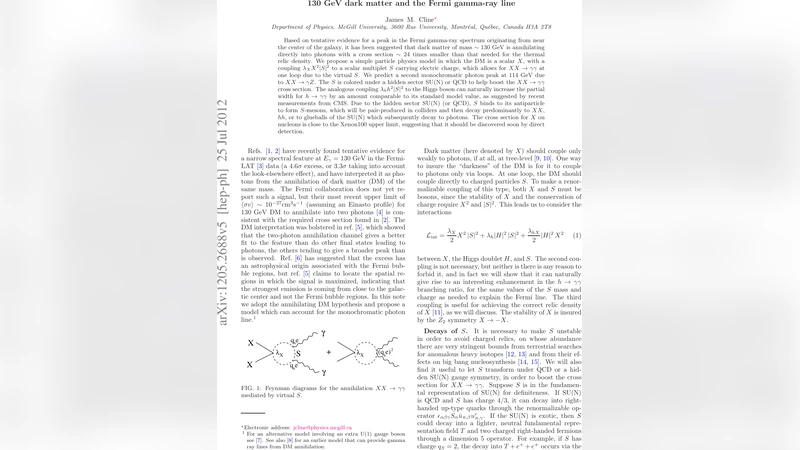
Based on tentative evidence for a peak in the Fermi gamma-ray spectrum originating from near the center of the galaxy, it has been suggested that dark matter of mass ~130 GeV is annihilating directly into photons with a cross section ~24 times smaller than that needed for the thermal relic density. We propose a simple particle physics model in which the DM is a scalar X, with a coupling lambda_X X^2|S|^2 to a scalar multiplet S carrying electric charge, which allows for XX -> gamma gamma at one loop due to the virtual S. We predict a second monochromatic photon peak at 114 GeV due to XX-> gamma Z. The S is colored under a hidden sector SU(N) or QCD to help boost the XX -> gamma gamma cross section. The analogous coupling lambda_h h^2 |S|^2 to the Higgs boson can naturally increase the partial width for h -> gamma gamma by an amount comparable to its standard model value, as suggested by recent measurements from CMS. Due to the hidden sector SU(N) (or QCD), S binds to its antiparticle to form S-mesons, which will be pair-produced in colliders and then decay predominantly to XX, hh, or to glueballs of the SU(N) which subsequently decay to photons. The cross section for X on nucleons is close to the Xenon100 upper limit, suggesting that it should be discovered soon by direct detection.
💡 Research Summary
The paper addresses the tentative 130 GeV gamma‑ray line reported by the Fermi‑LAT collaboration and proposes a minimal particle‑physics framework that can simultaneously explain this feature, a possible enhancement of the Higgs‑to‑diphoton decay rate, and predictions for collider and direct‑detection experiments. The dark matter candidate is a real scalar X with mass ≈130 GeV. Its only interaction with the Standard Model is through a second scalar multiplet S that carries electric charge and is also charged under a hidden non‑Abelian gauge group SU(N) (or ordinary QCD). The Lagrangian contains the quartic terms
λ_X X²|S|² and λ_h h²|S|²,
where h denotes the Standard Model Higgs doublet.
Because S is electrically charged, the annihilation process X X → γγ proceeds at one‑loop order via a virtual S loop. The hidden SU(N) charge supplies an additional color factor, enhancing the loop amplitude relative to a purely electromagnetic charged particle. By choosing λ_X of order unity, S’s electric charge Q_S ≈ 1, and a modest SU(N) representation (e.g., N = 3), the authors obtain an annihilation cross‑section ⟨σv⟩ ≈ 2.4 × 10⁻²⁸ cm³ s⁻¹, roughly 1/24 of the canonical thermal relic value, which matches the strength of the observed line.
The same loop also mediates X X → γZ, producing a second monochromatic line at E_γ ≈ m_X – m_Z²/(4 m_X) ≈ 114 GeV. This prediction is a clear, testable signature: a weaker line should appear in the Fermi data if the model is correct.
The λ_h h²|S|² coupling allows S to run in the Higgs‑to‑diphoton loop, potentially increasing the partial width Γ(h → γγ) by an amount comparable to the Standard Model contribution. This aligns with the modest excess reported by CMS in the h → γγ channel.
Because S is also charged under the hidden SU(N), it experiences strong self‑interactions and forms bound states (S‑mesons) analogous to quarkonia. At the LHC, S‑mesons can be pair‑produced via QCD‑like processes. Their dominant decay modes are:
1. X X, yielding missing‑energy signatures;
2. h h, leading to di‑Higgs final states (e.g., 4 b‑jets or 2 b + 2 γ);
3. Hidden gluon (glueball) pairs, which subsequently decay back to Standard Model photons, giving multi‑photon events.
These exotic signatures differentiate the model from simpler scalar‑photon portal scenarios and provide several avenues for experimental verification.
Direct detection proceeds through t‑channel exchange of the scalar S (or the Higgs, via λ_h). The spin‑independent X‑nucleon cross‑section can be tuned to lie just below the Xenon100 upper limit (~10⁻⁴⁵ cm²). Consequently, upcoming experiments such as LUX‑ZEPLIN, XENONnT, and PandaX‑4T should be able to probe the relevant parameter space within the next few years.
The authors discuss theoretical constraints: vacuum stability requires λ_X and λ_h not to be too large; perturbativity limits the size of the hidden gauge group and the representation of S; and cosmological considerations (e.g., Big‑Bang nucleosynthesis, relic glueball decay) impose bounds on the hidden sector confinement scale. They also note that the non‑observation of the predicted 114 GeV γZ line would severely restrict the viable region of parameter space.
In summary, the paper presents a coherent and economical model that links four seemingly unrelated observations: (i) the 130 GeV gamma‑ray line, (ii) a possible h → γγ rate enhancement, (iii) distinctive LHC signatures from S‑meson production and decay, and (iv) a direct‑detection cross‑section near current limits. The model’s key testable predictions are the existence of a 114 GeV γZ line, multi‑photon events from hidden glueball decays, and an imminent signal in next‑generation dark‑matter detectors. Future high‑resolution gamma‑ray observations, dedicated LHC searches for scalar bound states, and improved direct‑detection sensitivity will be decisive in confirming or falsifying this scenario.