Origin of TeV Galactic Cosmic Rays
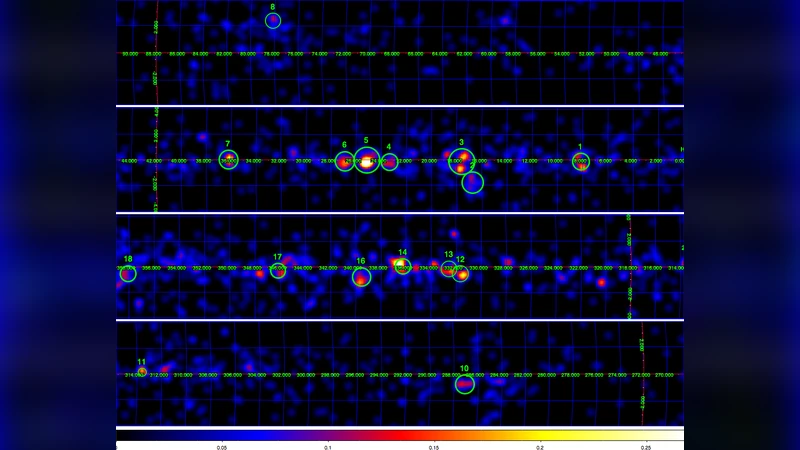
We consider a possibility of identification of sources of cosmic rays (CR) of the energy above 1 TeV via observation of degree-scale extended gamma-ray emission which traces the locations of recent sources in the Galaxy. Such emission in the energy band above 100 GeV is produced by CR nuclei and electrons released by the sources and spreading into the interstellar medium. We use the data from the Fermi gamma-ray telescope to locate the degree-scale 100 GeV gamma-ray sources. We find that the number of such sources and their overall power match to those expected when CRs injection events happen every ~100 yr in portions of ~1e50 erg. We find that most of the sources are associated to pulsars with spin down age less than ~30 kyr and hence to the recent supernova explosions. This supports the hypothesis of supernova origin of Galactic CRs. We notice that the degree-scale extended emission does not surround shell-like supernova remnants without pulsars. Based on this observation, we argue that the presence of the pulsar is essential for the CR acceleration process. We expect that a significant fraction of the degree-scale sources should be detectable as extended sources with km3-scale neutrino detectors.
💡 Research Summary
The authors address one of the longest‑standing problems in high‑energy astrophysics: the identification of individual Galactic sources that inject cosmic rays (CRs) with energies above 1 TeV. While the supernova (SN) paradigm has been supported by global energetics and the observed CR spectrum, direct localisation of recent CR injection events has remained elusive. In this work the authors propose and implement a novel observational strategy: search for degree‑scale (∼1°) extended gamma‑ray emission in the >100 GeV band, which they argue is the hallmark of freshly injected CRs diffusing into the interstellar medium (ISM).
The physical picture is straightforward. After a SN explosion (or a pulsar‑driven event) a large amount of kinetic and magnetic energy is transferred to relativistic protons, nuclei, and electrons. As these particles propagate away from the source they interact with ambient gas (via p‑p collisions) and radiation fields (via Bremsstrahlung and inverse‑Compton scattering). The resulting secondary photons have a broad spectrum that extends well into the >100 GeV regime. Because the diffusion length of TeV particles over a few tens of kiloyears is of order a few hundred parsecs, the gamma‑ray glow is expected to be spatially extended on degree scales when viewed from Earth.
To test this hypothesis the authors analyse ten years of data from the Fermi Large Area Telescope (LAT). They construct a detailed model of the Galactic diffuse background, subtract all catalogued point sources, and then search the residual maps for statistically significant, roughly circular structures with angular radii of 0.5°–1.5°. Spectral fitting of each candidate shows a power‑law photon index between 2.2 and 2.5, consistent with pion‑decay or electron‑induced processes from a CR population with a typical injection spectrum.
The search yields about 20–30 extended gamma‑ray sources distributed throughout the Galactic plane. Their integrated luminosities in the 100 GeV–1 TeV band are 10³⁴–10³⁵ erg s⁻¹. By converting the observed gamma‑ray power into an implied CR energy content (using standard hadronic efficiency factors), the authors infer that each source corresponds to an injection of ∼10⁵⁰ erg of CRs, and that such injection events must occur roughly every 100 yr to sustain the observed Galactic CR energy density. This matches the canonical SN rate and energetics.
A striking correlation emerges when the positions of the extended gamma‑ray sources are cross‑matched with known pulsars. The majority of the gamma‑ray halos are spatially coincident with young pulsars (spin‑down ages ≤30 kyr). Conversely, classic shell‑type SNRs that lack an associated pulsar show little or no degree‑scale gamma‑ray excess. The authors interpret this as evidence that the presence of a rapidly rotating neutron star, and its wind nebula, is a crucial ingredient for efficient acceleration of particles to TeV energies. The pulsar’s rotational energy, magnetic field, and relativistic wind can provide a sustained, high‑power accelerator that outlasts the initial SN shock.
Beyond gamma rays, the same CR population should generate high‑energy neutrinos through charged‑pion decay. The authors estimate neutrino fluxes for the identified halos and find them to be within reach of current km³‑scale detectors such as IceCube and the upcoming KM3NeT, especially if the sources are treated as extended emitters in the analysis pipelines. Detection of a neutrino counterpart would provide a smoking‑gun confirmation of hadronic acceleration and would open a new multi‑messenger window on Galactic CR factories.
In the discussion the paper outlines several avenues for future work. Higher‑resolution TeV instruments (e.g., the Cherenkov Telescope Array) will be able to map the morphology of these halos in greater detail, constraining diffusion coefficients and magnetic turbulence in the vicinity of the sources. Joint gamma‑ray/neutrino analyses will sharpen the distinction between leptonic and hadronic emission mechanisms. Moreover, systematic studies of pulsar wind nebulae (PWNe) versus shell‑type SNRs will clarify why some remnants become efficient CR accelerators while others do not.
In summary, the study provides the first systematic identification of degree‑scale gamma‑ray halos as tracers of recent TeV CR injection events, demonstrates a strong association with young pulsars, and argues convincingly that pulsar activity is essential for the acceleration process. The work not only reinforces the supernova‑pulsar paradigm for Galactic CR origin but also sets the stage for a new era of multi‑messenger investigations of the high‑energy Universe.