Search for a simultaneous signal from small transient events in the Pierre Auger Observatory and the Tupi muon telescopes
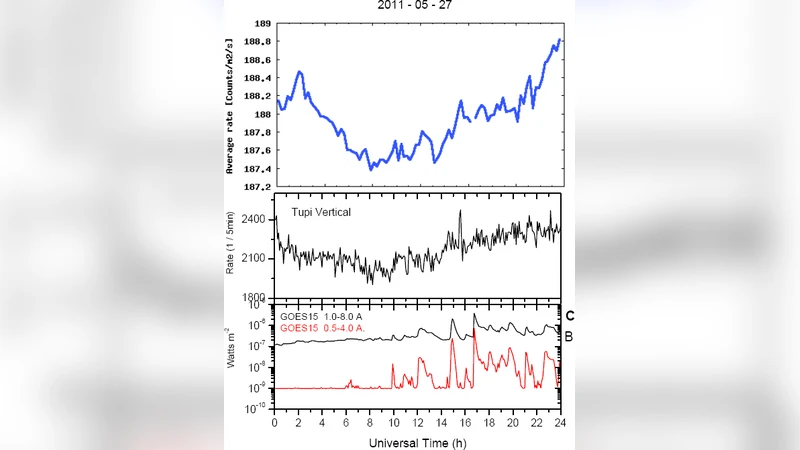
We present results of a search for a possible signal from small scale solar transient events (such as flares and interplanetary shocks) as well as possible counterparts to Gamma-Ray Burst (GRB) observed simultaneously by the Tupi muon telescope Niteroi-Brazil, 22.90S, 43.20W, 3 m above sea level) and the Pierre Auger Observatory surface detectors (Malargue-Argentina, 69.30S, 35.30W, altitude 1400 m). Both cosmic ray experiments are located inside the South Atlantic Anomaly (SAA) region. Our analysis of several examples shows similarities in the behavior of the counting rate of low energy (above 100 MeV) particles in association with the solar activity (solar flares and interplanetary shocks). We also report an observation by the Tupi experiment of the enhancement of muons at ground level with a significance higher than 8 sigma in the 1-sec binning counting rate (raw data) in close time coincidence (T-184 sec) with the Swift-BAT GRB110928B (trigger=504307). The GRB 110928B coordinates are in the field of view of the vertical Tupi telescope, and the burst was close to the MAXI source J1836-194. The 5-min muon counting rate in the vertical Tupi telescope as well as publicly available data from Auger (15 minutes averages of the scaler rates) show small peaks above the background fluctuations at the time following the Swift-BAT GRB 110928B trigger. In accordance with the long duration trigger, this signal can possibly suggest a long GRB, with a precursor narrow peak at T-184 sec.
💡 Research Summary
The paper investigates simultaneous ground‑based detections of low‑energy cosmic‑ray enhancements associated with small‑scale solar transients (solar flares and interplanetary shocks) and a gamma‑ray burst (GRB) using two experiments located within the South Atlantic Anomaly (SAA): the Tupi muon telescopes in Niterói, Brazil, and the surface detector (SD) array of the Pierre Auger Observatory (PAO) in Malargüe, Argentina. The SAA is characterized by an anomalously weak geomagnetic field, which lowers the rigidity cutoff and allows particles with energies as low as ~100 MeV to reach sea level. This unique environment makes the two detectors especially sensitive to transient increases in the flux of primary cosmic rays and secondary particles (muons, photons) generated in the atmosphere.
The Tupi system consists of two plastic‑scintillator telescopes (one vertical, one inclined at ~45°) separated by 3 m and shielded by concrete, giving an energy threshold of >0.1 GeV for muons. It records coincidences with 1‑second resolution, synchronized via GPS. The PAO SD comprises more than 1600 water‑Cherenkov tanks spaced 1.5 km apart; in scaler mode each tank registers any particle depositing ≳100 MeV, yielding an average count rate of ~2000 counts s⁻¹ per detector. Although the PAO tanks have a much larger effective solid angle (~3.14 sr) than the Tupi telescopes (~0.37 sr), both instruments sample the same low‑energy particle population because they share the same geomagnetic environment.
The authors first examine several C‑class solar flares. For the 14 July 2010 event (C‑class) the GOES X‑ray onset at 20:30 UT was followed by a muon excess in the vertical Tupi telescope at 21:27 UT (≈1 h delay) and a modest peak in the PAO scaler data at 22:05 UT. A similar pattern appears for the 27 May 2011 C2.0 flare: GOES X‑ray peak at 14:46 UT, Tupi muon enhancement at 15:24 UT (significance ≈13 %), and a PAO scaler increase at 15:14 UT. These coincidences suggest that, in the SAA, solar‑accelerated particles can reach ground level with relatively short propagation times, producing detectable muon bursts.
The paper also discusses interplanetary shocks (coronal mass ejections, CMEs). Because CMEs typically arrive 2–3 days after solar eruption, the authors focus on “backward” shocks observed at Earth. In several cases, both Tupi and PAO recorded small, temporally aligned count‑rate bumps coincident with shock passages, reinforcing the idea that the weakened geomagnetic shielding in the SAA permits shock‑accelerated particles of modest energy to penetrate to the surface.
The most striking result concerns Swift‑BAT GRB 110928B (trigger 504307). The burst’s coordinates lay within the field of view of the vertical Tupi telescope. The Tupi data show an 8‑sigma muon excess in a 1‑second bin occurring 184 seconds before the GRB trigger (T‑184 s). The PAO scaler data, averaged over 15 minutes, display a small peak shortly after the trigger. The authors interpret the pre‑burst muon spike as a possible GRB precursor or as part of a long‑duration GRB with an early narrow component. The proximity of the burst to the MAXI source J1836‑194 further supports a multi‑wavelength association.
In the discussion, the authors emphasize that the SAA provides a natural laboratory for studying low‑energy cosmic‑ray transients. The combined use of a high‑time‑resolution muon telescope (Tupi) and a large‑area, high‑statistics surface detector (PAO) enables cross‑validation of weak signals that would be indistinguishable in a single instrument. They acknowledge limitations: the statistical significance of many PAO peaks is modest, background fluctuations can mimic small enhancements, and a detailed energy spectrum of the detected particles is not directly measured. Future work should involve longer data sets, refined background modeling, and possibly coordinated observations with satellite instruments (e.g., Fermi‑GBM, GOES, ACE) to improve event classification.
In conclusion, the study demonstrates that simultaneous observations of low‑energy particle enhancements from solar flares, interplanetary shocks, and at least one GRB are feasible within the SAA using complementary ground‑based detectors. This approach opens a new avenue for multi‑messenger astrophysics, especially for transient phenomena that produce modest particle fluxes at Earth.
Comments & Academic Discussion
Loading comments...
Leave a Comment