Time-Scale and Noise Optimality in Self-Organized Critical Adaptive Networks
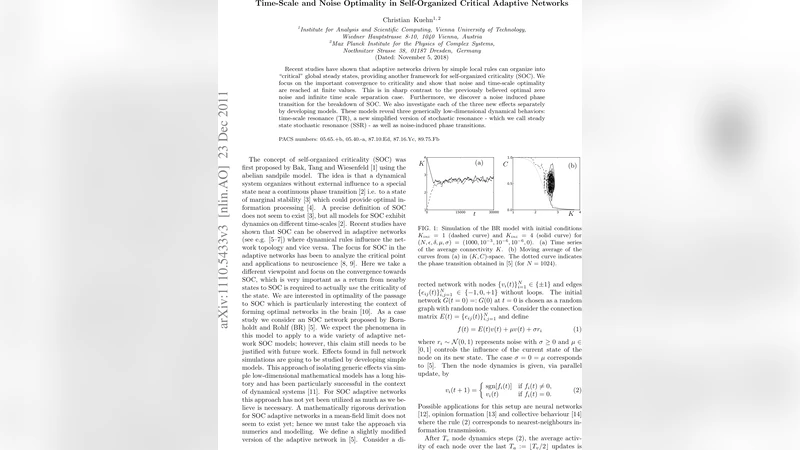
Recent studies have shown that adaptive networks driven by simple local rules can organize into “critical” global steady states, providing another framework for self-organized criticality (SOC). We focus on the important convergence to criticality and show that noise and time-scale optimality are reached at finite values. This is in sharp contrast to the previously believed optimal zero noise and infinite time scale separation case. Furthermore, we discover a noise induced phase transition for the breakdown of SOC. We also investigate each of the three new effects separately by developing models. These models reveal three generically low-dimensional dynamical behaviors: time-scale resonance (TR), a new simplified version of stochastic resonance - which we call steady state stochastic resonance (SSR) - as well as noise-induced phase transitions.
💡 Research Summary
The paper investigates how adaptive networks that evolve under simple local rules self‑organize into a critical state, a phenomenon known as self‑organized criticality (SOC). While earlier work suggested that the optimal situation occurs when there is no external noise (σ = 0) and an infinite separation of time scales (the fast node dynamics and the slow topology updates are infinitely apart), the authors demonstrate that both noise and time‑scale separation have finite optimal values. Using the Bornholdt‑Rohlf (BR) model as a testbed, they perform extensive simulations with 1 000 nodes, varying the time‑scale parameter ε = 1/T_v (the inverse of the number of node‑update steps between topology updates) and the noise amplitude σ that perturbs the node update rule.
Key empirical findings:
-
Time‑scale optimality (TR) – When ε is varied from 10⁻⁶ up to order unity, the average connectivity K_T and the frozen‑node fraction C_T after a long transient are closest to their theoretical critical values (K_c ≈ 2, C_c ≈ 0.5) for intermediate ε (≈10⁻³–10⁻¹). Both very small and very large ε lead to larger deviations, indicating that a finite separation of fast and slow processes yields the fastest convergence to SOC.
-
Noise optimality (SSR) – Introducing white Gaussian noise of strength σ into the node dynamics, the authors find that a modest amount of noise (σ ≈ 0.2) minimizes the error in the final connectivity, i.e., the network reaches the critical connectivity more accurately than in the noiseless case. However, when σ exceeds a critical value σ_c ≈ 0.25, the system undergoes a sharp transition: K_T collapses toward zero and the frozen‑node fraction drops, signifying a breakdown of SOC. This phenomenon is termed a noise‑induced phase transition.
To explain these observations, three low‑dimensional mathematical models are constructed:
-
Model 1 (Fast‑slow ODE): dx/dt = f(x,y), dy/dt = ε g(x,y) with f = (y − 1)² − x and g = 1 − y. The system possesses a stable fixed point (x_c, y_c) = (0, 1) representing the SOC state. Analytical and numerical analysis shows that the distance |x_T − x_c| and the total error have a global minimum at a finite ε, illustrating the “time‑scale resonance” (TR) effect.
-
Model 2 (Stochastic pitchfork): dx/dt = y x − x³ + σ̃ ξ(t), dy/dt = (x* − |x|). Here (x*, x*²) is a small‑amplitude steady state close to a pitchfork bifurcation. Adding a moderate noise σ̃ shortens the bifurcation delay, allowing trajectories to settle into the steady state more quickly. This is identified as “steady‑state stochastic resonance” (SSR).
-
Model 3 (Stochastic potential for connectivity): dK/dt = −∇V(K; σ̃) + σ̃ ξ(t) with V(K; σ̃) = K⁴/4 − K³/(3 + σ̃) + (3 σ̃/2) K². For σ̃ = 0 the potential has a single minimum at K_c = 3; as σ̃ grows, the shape of V changes, eventually eliminating the minimum and driving K toward zero. Numerical integration reproduces the noise‑induced phase transition observed in the full network simulations.
These models reveal that the optimal convergence to SOC is not a trivial limit of vanishing noise and infinite time‑scale separation, but rather a balance between stochastic fluctuations and the relative speeds of node and topology dynamics. The authors argue that such balance may be a generic feature of multiscale complex systems, including neural circuits, evolutionary processes, and opinion dynamics.
In the discussion, the paper emphasizes several implications:
-
Design of artificial neural networks: Realistic implementations should consider finite ε and σ rather than idealized limits, because the optimal information‑processing performance may occur at intermediate values.
-
Biological relevance: Neural systems exhibit intrinsic noise and plasticity on comparable time scales; the identified SSR mechanism could explain why moderate synaptic noise improves learning and why excessive noise disrupts critical brain dynamics.
-
Evolutionary perspective: Evolution may tune both the speed of genetic/epigenetic changes (analogous to ε) and environmental variability (analogous to σ) toward values that maximize adaptability by keeping the system near criticality.
Finally, the authors note that the traditional analytical approach, which often expands around (ε, σ) → (0, 0), may miss essential finite‑parameter effects. Future work should aim at quantitative parameter estimation from empirical data and explore how TR and SSR interact in higher‑dimensional, heterogeneous networks. The paper thus provides a fresh conceptual framework for understanding how time‑scale separation and stochasticity jointly shape the emergence and robustness of self‑organized critical states.
Comments & Academic Discussion
Loading comments...
Leave a Comment