The Influence of Network Topology on Sound Propagation in Granular Materials
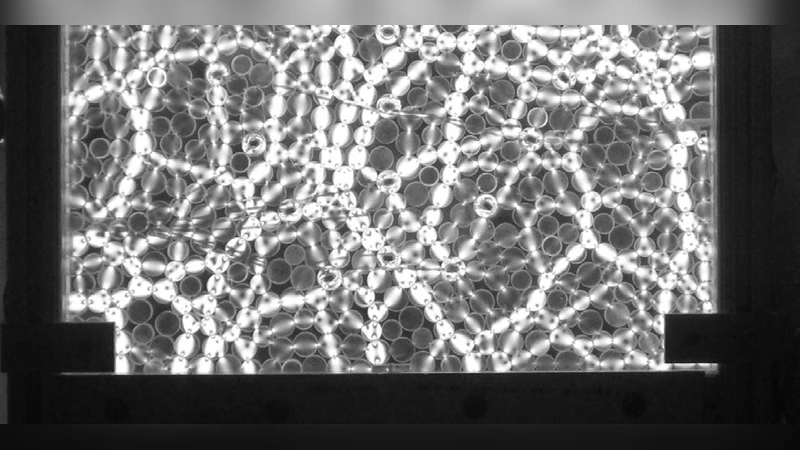
Granular materials, whose features range from the particle scale to the force-chain scale to the bulk scale, are usually modeled as either particulate or continuum materials. In contrast with either of these approaches, network representations are natural for the simultaneous examination of microscopic, mesoscopic, and macroscopic features. In this paper, we treat granular materials as spatially-embedded networks in which the nodes (particles) are connected by weighted edges obtained from contact forces. We test a variety of network measures for their utility in helping to describe sound propagation in granular networks and find that network diagnostics can be used to probe particle-, curve-, domain-, and system-scale structures in granular media. In particular, diagnostics of meso-scale network structure are reproducible across experiments, are correlated with sound propagation in this medium, and can be used to identify potentially interesting size scales. We also demonstrate that the sensitivity of network diagnostics depends on the phase of sound propagation. In the injection phase, the signal propagates systemically, as indicated by correlations with the network diagnostic of global efficiency. In the scattering phase, however, the signal is better predicted by meso-scale community structure, suggesting that the acoustic signal scatters over local geographic neighborhoods. Collectively, our results demonstrate how the force network of a granular system is imprinted on transmitted waves.
💡 Research Summary
This paper investigates how the topology of particle contact networks influences acoustic wave propagation in granular media. The authors treat a quasi‑two‑dimensional assembly of photoelastic disks as a spatially embedded network: nodes represent particles and edges represent contacts, weighted by the measured normal force at each contact. Two network representations are constructed for each experimental run—a binary contact network (A) that records only the presence of a contact, and a weighted force‑chain network (W) where each edge weight is the contact force normalized by the mean force.
Seventeen distinct particle configurations are prepared by manually rearranging the disks, and high‑speed imaging (4000 fps) captures the evolution of the acoustic signal generated by a 750 Hz sinusoidal pulse injected from the bottom. Brightness changes (ΔI) in each particle are used as a proxy for stress changes, allowing the authors to map the acoustic amplitude across all particles without relying on a limited set of embedded piezoelectric sensors.
A broad suite of network diagnostics is evaluated: global efficiency (E_w), geodesic node betweenness (B_w), clustering coefficient (C_w), and modularity‑based community structure (X with intra‑community strength z‑score). The authors demonstrate that each metric is sensitive to a different spatial scale: E_w captures system‑wide connectivity, B_w highlights one‑dimensional force‑chain pathways, C_w reflects local particle‑scale clustering, and the community measures reveal mesoscopic domains.
By varying the modularity resolution parameter γ (and its transformed version ξ(γ) that quantifies the effective fraction of antiferromagnetic edges), the authors identify a characteristic community size of roughly 5–8 particles, corresponding to 50–100 communities in the full system. This scale may relate to the width of shear bands or to a theoretical “cutting length” that balances bulk and perimeter contacts.
The acoustic signal is analyzed in two temporal phases. During the injection phase (frames 0–40), the signal propagates coherently across the entire sample, and its amplitude correlates strongly with global efficiency (high E_w → stronger signal). In the subsequent scattering phase (frames 40–80), the signal becomes localized and attenuated; here, the community structure metrics (X, z‑score) show the highest correlation, indicating that local geographic clusters of strong force chains dominate scattering and energy loss.
Random geometric graphs are used as null models to confirm that the observed correlations are not artifacts of spatial embedding alone. Across all 17 experimental runs, the network diagnostics exhibit high reproducibility, underscoring the robustness of the contact‑force network as a descriptor of granular dynamics.
In summary, the study provides compelling evidence that (i) network science offers a powerful multiscale framework for characterizing granular packings, (ii) global efficiency predicts acoustic transmission during the initial, system‑wide propagation, and (iii) mesoscopic community structure governs the later scattering regime. The findings suggest new avenues for non‑destructive evaluation, seismic probing of granular media, and the design of materials where wave transport can be tuned via engineered contact networks.
Comments & Academic Discussion
Loading comments...
Leave a Comment