New alphabet-dependent morphological transition in a random RNA alignment
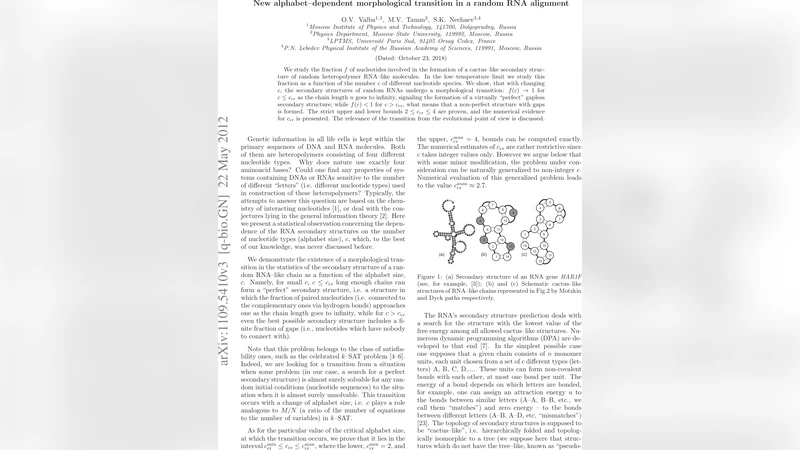
We study the fraction $f$ of nucleotides involved in the formation of a cactus–like secondary structure of random heteropolymer RNA–like molecules. In the low–temperature limit we study this fraction as a function of the number $c$ of different nucleotide species. We show, that with changing $c$, the secondary structures of random RNAs undergo a morphological transition: $f(c)\to 1$ for $c \le c_{\rm cr}$ as the chain length $n$ goes to infinity, signaling the formation of a virtually “perfect” gapless secondary structure; while $f(c)<1$ for $c>c_{\rm cr}$, what means that a non-perfect structure with gaps is formed. The strict upper and lower bounds $2 \le c_{\rm cr} \le 4$ are proven, and the numerical evidence for $c_{\rm cr}$ is presented. The relevance of the transition from the evolutional point of view is discussed.
💡 Research Summary
The authors investigate how the number of distinct nucleotide types, denoted by c, influences the formation of cactus‑like secondary structures in random RNA‑like heteropolymers. In the zero‑temperature limit the problem reduces to finding the ground‑state energy, which is directly related to the fraction f(c) of nucleotides that participate in base‑pair bonds. For a given sequence of length n the ground‑state energy can be expressed through a recursion that is equivalent to the well‑known dynamic‑programming formulation used in RNA folding. The key result is that the behavior of f(c) changes dramatically at a critical alphabet size c₍cr₎.
First, the authors prove that when c = 2 a perfect matching ( f = 1 ) is achievable for any sequence in the limit n → ∞. They provide a constructive algorithm that repeatedly removes adjacent identical pairs and finally pairs the remaining alternating A‑B pattern in a nested fashion, leaving at most two unpaired bases. This shows that for binary alphabets the fraction of paired nucleotides tends to one.
Next, they consider larger alphabets. By mapping secondary structures onto Dyck paths (gapless structures) and Motzkin paths (structures with gaps), they count the number of possible ground‑state configurations. The number of Dyck paths of even length n is the Catalan number C_{n/2}, which grows asymptotically as (2 √c)^{n} n^{‑3/2}. Comparing this with the total number of primary sequences c^{n}, they find that for c < 4 the Dyck‑path configurations dominate, implying that almost all sequences can achieve a perfect match. For c > 4 the Dyck contribution becomes exponentially small, and Motzkin paths with a finite fraction of horizontal steps (gaps) become overwhelmingly more numerous.
The authors derive an analytical upper bound for f(c) in the regime c ≥ c₍max₎ = 4 by evaluating the entropy of Motzkin paths with a given gap fraction f. They obtain a function Δw(f,c) that measures the exponential excess of sequences supporting a given f over the total number of sequences. Setting Δw = 0 yields the typical fraction \bar f(c). This leads to the piecewise expression (9) in the paper, which predicts a sharp drop of \bar f once c exceeds a critical value.
Numerical simulations were performed for sequences of length n = 200 for integer values of c from 2 to 8. The measured average f(c) matches the theoretical trend: it stays close to 1 for c ≤ 2, begins to decline for c ≈ 3, and falls significantly for c ≥ 4. By extrapolating to infinite length the authors estimate the critical alphabet size to be around c ≈ 2.7.
To explore non‑integer alphabet sizes, they introduce a Bernoulli matching model where each possible pair of positions is a match with probability 1/c and a mismatch otherwise. This random matrix formulation allows a continuous interpolation of c, and simulations confirm that the transition from perfect to imperfect matching still occurs near c ≈ 2.7.
The biological discussion emphasizes that real RNA uses exactly four nucleotides, a value close to the upper bound of the critical interval (2 < c₍cr₎ < 4). Short alphabets (c < c₍cr₎) would produce many degenerate ground states, reducing structural specificity, while long alphabets (c > c₍cr₎) would leave many nucleotides unpaired, compromising stability. Thus a four‑letter alphabet may represent an evolutionary optimum, balancing foldability and robustness—an idea that resonates with the RNA‑world hypothesis for the origin of life.
In summary, the paper demonstrates a novel alphabet‑dependent morphological transition in random RNA secondary structure formation. It rigorously bounds the critical alphabet size between 2 and 4, provides analytical estimates for the paired‑fraction curve f(c), validates them with extensive simulations, and connects the findings to evolutionary considerations of nucleotide alphabet size.
Comments & Academic Discussion
Loading comments...
Leave a Comment