Pulsar timing arrays as imaging gravitational wave telescopes: angular resolution and source (de)confusion
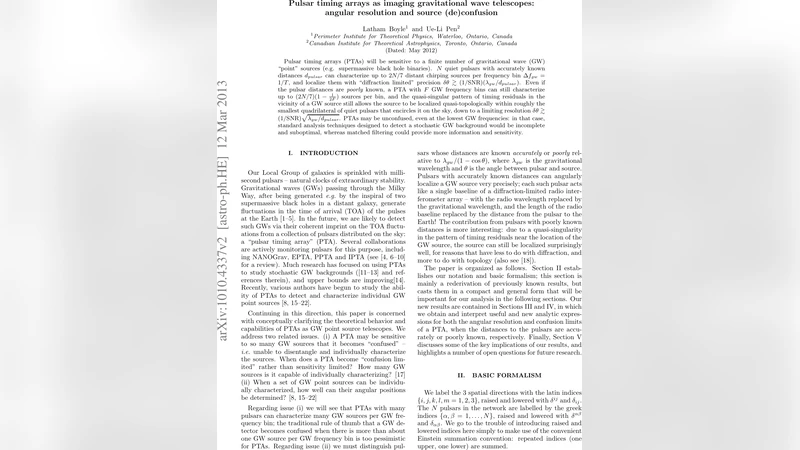
Pulsar timing arrays (PTAs) will be sensitive to a finite number of gravitational wave (GW) “point” sources (e.g. supermassive black hole binaries). N quiet pulsars with accurately known distances d_{pulsar} can characterize up to 2N/7 distant chirping sources per frequency bin \Delta f_{gw}=1/T, and localize them with “diffraction limited” precision \delta\theta \gtrsim (1/SNR)(\lambda_{gw}/d_{pulsar}). Even if the pulsar distances are poorly known, a PTA with F frequency bins can still characterize up to (2N/7)[1-(1/2F)] sources per bin, and the quasi-singular pattern of timing residuals in the vicinity of a GW source still allows the source to be localized quasi-topologically within roughly the smallest quadrilateral of quiet pulsars that encircles it on the sky, down to a limiting resolution \delta\theta \gtrsim (1/SNR) \sqrt{\lambda_{gw}/d_{pulsar}}. PTAs may be unconfused, even at the lowest frequencies, with matched filtering always appropriate.
💡 Research Summary
The paper presents a comprehensive theoretical framework for treating pulsar timing arrays (PTAs) as imaging gravitational‑wave (GW) telescopes capable of resolving individual point‑like sources such as supermassive black‑hole binaries. Starting from the premise that each pulsar provides a precise measurement of the GW‑induced timing residual, the authors perform a Fisher‑matrix analysis to count the number of independent parameters that can be extracted from a given frequency bin Δf_gw = 1/T (where T is the total observation time). If N “quiet” pulsars have accurately known distances d_pulsar, then each frequency bin can accommodate up to 2N/7 distinct chirping sources, because each source requires at least seven parameters (amplitude, phase, frequency, sky position (two angles), frequency derivative, and distance‑related phase term). This capacity far exceeds the naïve expectation that only N/2 sources could be distinguished.
The authors then derive the angular resolution achievable by such an array. The key quantity is the ratio of the GW wavelength λ_gw to the pulsar‑Earth distance d_pulsar. With a signal‑to‑noise ratio (SNR) of ρ, the diffraction‑limited localization error is δθ ≳ (1/ρ)(λ_gw/d_pulsar). This expression mirrors the classic diffraction limit of a conventional telescope, confirming that a PTA can indeed act as a true imaging instrument for low‑frequency GWs.
When pulsar distances are poorly known, the analysis is modified by treating the distance as an additional unknown parameter. By dividing the total observation band into F independent frequency bins, the array can still resolve up to (2N/7)
Comments & Academic Discussion
Loading comments...
Leave a Comment