Decelerated spreading in degree-correlated networks
While degree correlations are known to play a crucial role for spreading phenomena in networks, their impact on the propagation speed has hardly been understood. Here we investigate a tunable spreading model on scale-free networks and show that the propagation becomes slow in positively (negatively) correlated networks if nodes with a high connectivity locally accelerate (decelerate) the propagation. Examining the efficient paths offers a coherent explanation for this result, while the $k$-core decomposition reveals the dependence of the nodal spreading efficiency on the correlation. Our findings should open new pathways to delicately control real-world spreading processes.
💡 Research Summary
**
The paper “Decelerated spreading in degree‑correlated networks” investigates how degree correlations—assortativity (positive correlation) and disassortativity (negative correlation)—affect the speed of spreading processes on scale‑free networks. While previous work has largely focused on the final size of an outbreak or the epidemic threshold, the authors argue that the time required for a contagion to reach the whole network is a distinct and practically important metric, especially for real‑time interventions in epidemiology, information diffusion, and cyber‑security.
Model.
The authors generate synthetic scale‑free graphs (P(k) ∝ k⁻³) and then rewire edges to obtain a desired assortativity coefficient r while preserving the degree sequence. A tunable spreading rule is introduced: each node of degree k transmits the contagion to each neighbor with probability β(k) = k^α per time step. The exponent α controls the role of high‑degree nodes: α > 0 makes hubs accelerators (they spread more efficiently), whereas α < 0 makes hubs decelerators (they spread less efficiently). The process starts from a single seed and proceeds in discrete synchronous updates. The primary observable is the average arrival time T, defined as the mean number of steps until all nodes have been infected; the inverse of T is taken as a measure of spreading speed.
Efficient‑path perspective.
To understand why certain (α, r) combinations slow down the diffusion, the authors define a link cost w_ij = 1/β(k_i). The efficient path between two nodes is the minimum‑cost path under these weights, reflecting the routes that the contagion is most likely to follow. In assortative networks, high‑degree nodes are densely interconnected, creating low‑cost “core” corridors. When α > 0, these corridors allow rapid spreading inside the core, but the sparse connections between the core and peripheral low‑degree nodes become bottlenecks, inflating the global arrival time. Conversely, when α < 0, the core becomes a high‑cost region; the contagion must detour through many peripheral nodes, again lengthening the efficient‑path distances.
In disassortative networks, hubs are preferentially linked to low‑degree nodes. For α > 0 this yields a classic hub‑spoke architecture: low‑cost edges radiate from hubs to many periphery nodes, producing short efficient‑paths that cover the whole graph quickly. For α < 0, however, each hub imposes a high transmission cost on its many spokes, so the efficient‑paths become long and winding, dramatically slowing the spread.
k‑core decomposition.
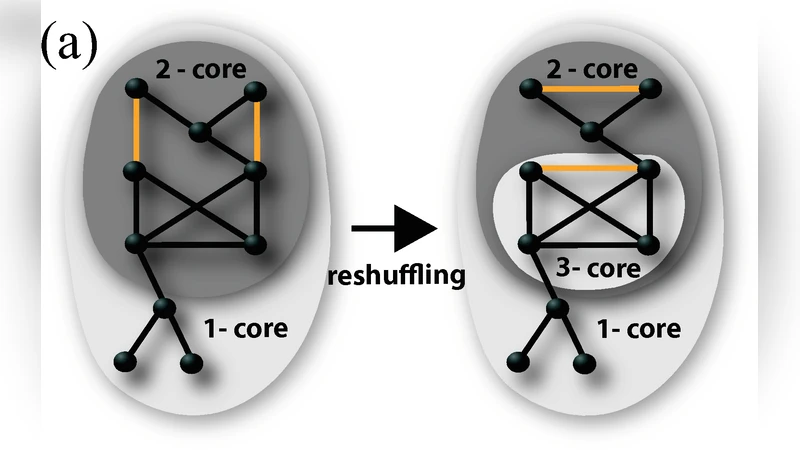
The authors complement the efficient‑path analysis with a k‑core decomposition, which partitions the network into nested subgraphs where each node has at least k connections within the subgraph. Nodes in higher‑k cores are typically high‑degree hubs. By measuring the spreading efficiency (inverse of the average infection time) of each core, they find systematic patterns:
-
With α > 0, high‑k cores act as “engines” that ignite rapid diffusion. In assortative graphs, these engines are poorly coupled to lower‑k shells, so the overall diffusion is limited by the weak interface. In disassortative graphs, the coupling is strong, and the engines efficiently drive the contagion outward.
-
With α < 0, high‑k cores become “shields” that retard propagation. In disassortative graphs the shields are spread throughout the network, creating many high‑cost barriers and leading to the slowest observed T. In assortative graphs the shields are confined to a dense core, so the periphery can still be reached relatively faster, though still slower than the α > 0 case.
Results.
Systematic Monte‑Carlo simulations over a grid of (α, r) values confirm these qualitative insights. The most pronounced deceleration occurs for (α > 0, r > 0) and (α < 0, r < 0), i.e., when the intrinsic role of hubs (accelerator or decelerator) is reinforced by the network’s degree correlation. The opposite combinations (α > 0, r < 0) produce the fastest spreading, while (α < 0, r > 0) yields intermediate speeds.
Implications.
The study demonstrates that controlling spreading speed does not require altering the overall degree distribution; instead, modest rewiring that changes assortativity, or targeted interventions that modify the transmission capability of hubs, can achieve substantial speed modulation. Practical applications include:
- Epidemiology: To slow an outbreak, one could reduce the effective transmission rate of high‑degree individuals (e.g., through targeted vaccination or behavior change) and simultaneously encourage assortative mixing (e.g., by limiting cross‑community contacts), thereby creating a high‑cost core that traps the disease.
- Information dissemination: To accelerate viral marketing, one could enhance the sharing propensity of influencers (α > 0) and promote disassortative connections (e.g., linking influencers to diverse audience segments), creating a hub‑spoke network that maximizes reach in minimal time.
- Infrastructure resilience: In power or communication grids, deliberately designing disassortative topologies while ensuring that critical high‑degree nodes have reduced failure propagation rates can prevent cascading failures from spreading rapidly.
Future directions.
The authors suggest extending the framework to (i) temporal networks where edges appear and disappear, (ii) multiplex or multilayer settings where multiple contagion processes interact, and (iii) empirical datasets (social media, transportation, biological networks) to validate the theoretical predictions. Moreover, exploring optimal rewiring strategies that achieve a desired spreading speed under cost constraints would be a natural next step.
In summary, the paper provides a clear, mechanistic explanation for why degree correlations can decelerate spreading under certain conditions, introduces efficient‑path and k‑core analyses as powerful diagnostic tools, and opens a pathway toward precise, structure‑aware control of dynamic processes on complex networks.
Comments & Academic Discussion
Loading comments...
Leave a Comment