📝 Original Info
- Title: Knowledge Acquisition by Networks of Interacting Agents in the Presence of Observation Errors
- ArXiv ID: 0807.2031
- Date: 2013-05-29
- Authors: ** J. B. Batista, L. da F. Costa **
📝 Abstract
In this work we investigate knowledge acquisition as performed by multiple agents interacting as they infer, under the presence of observation errors, respective models of a complex system. We focus the specific case in which, at each time step, each agent takes into account its current observation as well as the average of the models of its neighbors. The agents are connected by a network of interaction of Erd\H{o}s-Renyi or Barabasi-Albert type. First we investigate situations in which one of the agents has a different probability of observation error (higher or lower). It is shown that the influence of this special agent over the quality of the models inferred by the rest of the network can be substantial, varying linearly with the respective degree of the agent with different estimation error. In case the degree of this agent is taken as a respective fitness parameter, the effect of the different estimation error is even more pronounced, becoming superlinear. To complement our analysis, we provide the analytical solution of the overall behavior of the system. We also investigate the knowledge acquisition dynamic when the agents are grouped into communities. We verify that the inclusion of edges between agents (within a community) having higher probability of observation error promotes the loss of quality in the estimation of the agents in the other communities.
💡 Deep Analysis
Deep Dive into Knowledge Acquisition by Networks of Interacting Agents in the Presence of Observation Errors.
In this work we investigate knowledge acquisition as performed by multiple agents interacting as they infer, under the presence of observation errors, respective models of a complex system. We focus the specific case in which, at each time step, each agent takes into account its current observation as well as the average of the models of its neighbors. The agents are connected by a network of interaction of Erd\H{o}s-Renyi or Barabasi-Albert type. First we investigate situations in which one of the agents has a different probability of observation error (higher or lower). It is shown that the influence of this special agent over the quality of the models inferred by the rest of the network can be substantial, varying linearly with the respective degree of the agent with different estimation error. In case the degree of this agent is taken as a respective fitness parameter, the effect of the different estimation error is even more pronounced, becoming superlinear. To complement our anal
📄 Full Content
arXiv:0807.2031v2 [physics.soc-ph] 1 May 2009
Knowledge Acquisition by Networks of Interacting Agents
in the Presence of Observation Errors
J. B. Batista and L. da F. Costa
Institute of Physics at S˜ao Carlos, University of S˜ao Paulo,
P.O. Box 369, S˜ao Carlos, S˜ao Paulo, 13560-970 Brazil
(Dated: 24th April 2009)
In this work we investigate knowledge acquisition as performed by multiple agents interacting
as they infer, under the presence of observation errors, respective models of a complex system.
We focus the specific case in which, at each time step, each agent takes into account its current
observation as well as the average of the models of its neighbors. The agents are connected by a
network of interaction of Erd˝os-R´enyi or Barab´asi-Albert type. First we investigate situations in
which one of the agents has a different probability of observation error (higher or lower). It is shown
that the influence of this special agent over the quality of the models inferred by the rest of the
network can be substantial, varying linearly with the respective degree of the agent with different
estimation error. In case the degree of this agent is taken as a respective fitness parameter, the effect
of the different estimation error is even more pronounced, becoming superlinear. To complement our
analysis, we provide the analytical solution of the overall behavior of the system. We also investigate
the knowledge acquisition dynamic when the agents are grouped into communities. We verify that
the inclusion of edges between agents (within a community) having higher probability of observation
error promotes the loss of quality in the estimation of the agents in the other communities.
PACS numbers: 07.05.Mh, 64.60.aq, 01.40.Ha
‘Knowledge is of two kinds: we know a subject our-
selves, or we know where we can find information upon
it.’ (S. Johson)
I.
INTRODUCTION
Several important systems in nature, from the brain
to society, are characterized by intricate organization.
Being naturally related to such systems, humans have
been trying to understand them through the construc-
tion of models which can reasonably reproduce and pre-
dict the respectively observed properties. Model building
is the key component in the scientific method. The de-
velopment of a model involves the observation and mea-
surement of the phenomenon of interest, its representa-
tion in mathematical terms, followed by simulations and
respective confrontation with further experimental evi-
dences. Because of the challenging complexity of the re-
maining problems in science, model building has become
intrinsically dependent on collaboration between scien-
tists or agents.
The problem of multiple-agent knowl-
edge acquisition and processing has been treated in the
literature (e.g.
[1, 2]), but often under assumption of
simple schemes of interactions between the agents (e.g.
lattice or pool). Introduced recently, complex networks
( [3, 4, 5, 6, 7]) have quickly become a key research area
mainly because of the generality of this approach to rep-
resent virtually any discrete system, allied to the possi-
bilities of relating network topology and dynamics. As
such, complex networks stand out as being a fundamental
resource for complementing and enhancing the scientific
method.
The present study addresses the issue of modeling how
one or more agents (e.g. scientists) progress while mod-
eling a complex system. We start by considering a sin-
gle agent and then proceed to more general situations
involving several agents interacting through networks of
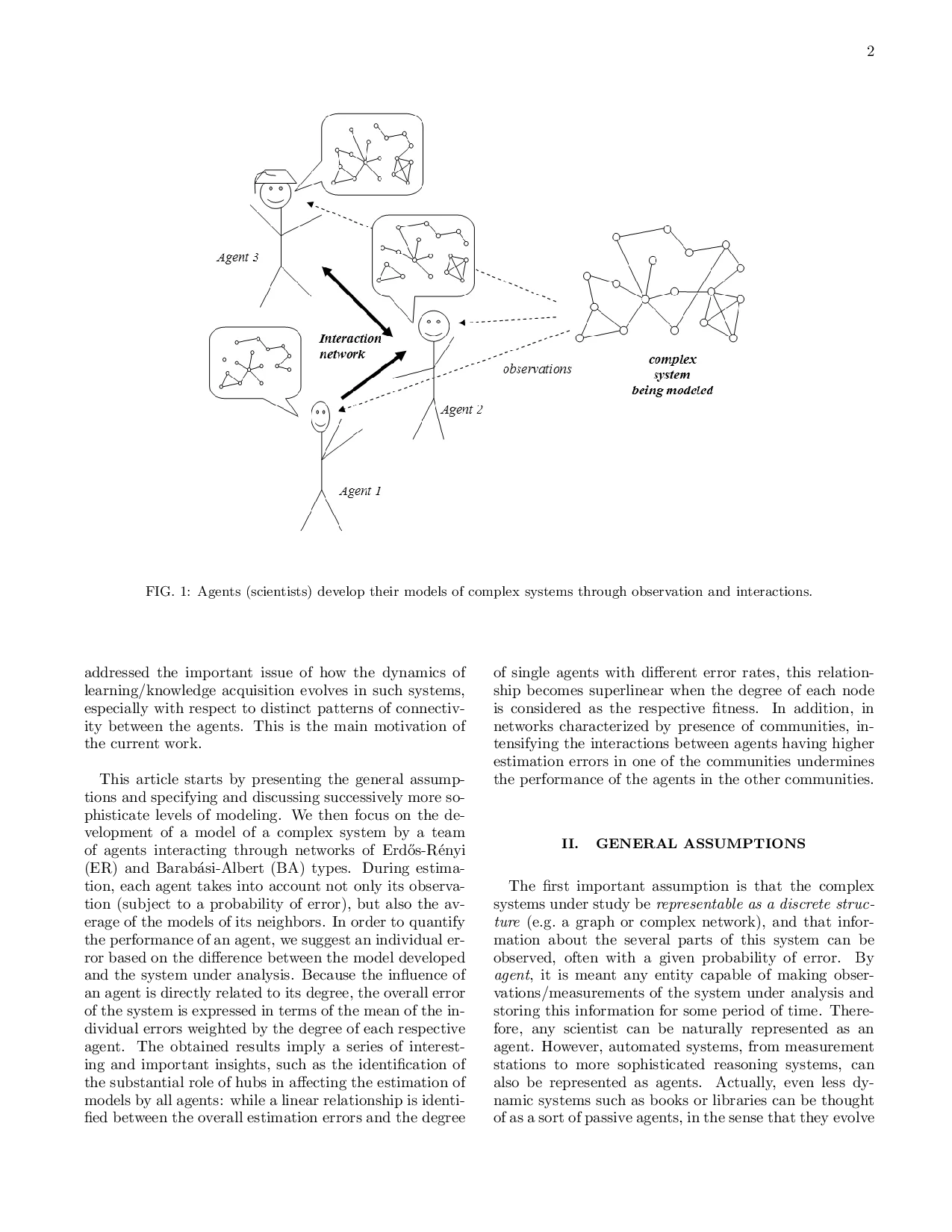
relationships (see Figure 1). The agents investigating the
system (one or more) are allowed to make observations
and take measurements of the system as they develop
and complement their respective individual models. Er-
rors, incompleteness, noise and forgetting are typically
involved during a such model estimation. The main fea-
tures of interest include the quality of the obtained mod-
els and the respective amount of time required for their
estimation.
The plural in ‘models’ stands for the fact
that the models obtained respectively by each agent are
not necessarily identical and will often imply in substan-
tial diversity. Though corresponding to a largely simpli-
fied version of real scientific investigation, our approach
captures some of the main elements characterizing the in-
volvement of a large number of interacting scientists who
continuously exchange information and modify their re-
spective models and modeling approaches. As a matter of
fact, in some cases the development of models may even
affect the system being modeled (e.g. the perturbation
implied by the measurements on the analyzed systems).
Because interactions between scientists can be effec-
tively represented in terms of complex networks (e.g. [8,
9, 10, 11, 12, 13, 14]), it is natural to resource to such
an approach in our investigation.
It is interesting to
observe that the agents may not be limited to scien-
tists, but can also include intelligent m
…(Full text truncated)…
📸 Image Gallery
Reference
This content is AI-processed based on ArXiv data.