Near-Optimal Truthful Auction Mechanisms in Secondary Spectrum Markets
In this work, we study spectrum auction problem where each request from secondary users has spatial, temporal, and spectral features. With the requests of secondary users and the reserve price of the primary user, our goal is to design truthful mechanisms that will either maximize the social efficiency or maximize the revenue of the primary user. As the optimal conflict-free spectrum allocation problem is NP-hard, in this work, we design near optimal spectrum allocation mechanisms separately based on the following techniques: derandomized allocation from integer programming formulation, its linear programming (LP) relaxation, and the dual of the LP. We theoretically prove that 1) our near optimal allocation methods are bid monotone, which implys truthful auction mechanisms; and 2) our near optimal allocation methods can achieve a social efficiency or a revenue that is at least $1-\frac{1}{e}$ times of the optimal respectively. At last, we conduct extensive simulations to study the performances (social efficiency, revenue) of the proposed methods, and the simulation results corroborate our theoretical analysis.
💡 Research Summary
**
This paper tackles the spectrum auction problem in secondary markets where each buyer’s request is characterized by spatial location, time interval, and channel (frequency) dimensions, allowing reuse across all three domains. The authors first formalize the conflict relationships among requests using a conflict graph and matrices that capture spatial overlap and channel licensing. The allocation problem—maximizing either total true valuation (social welfare) or the auctioneer’s expected revenue—is shown to be NP‑hard.
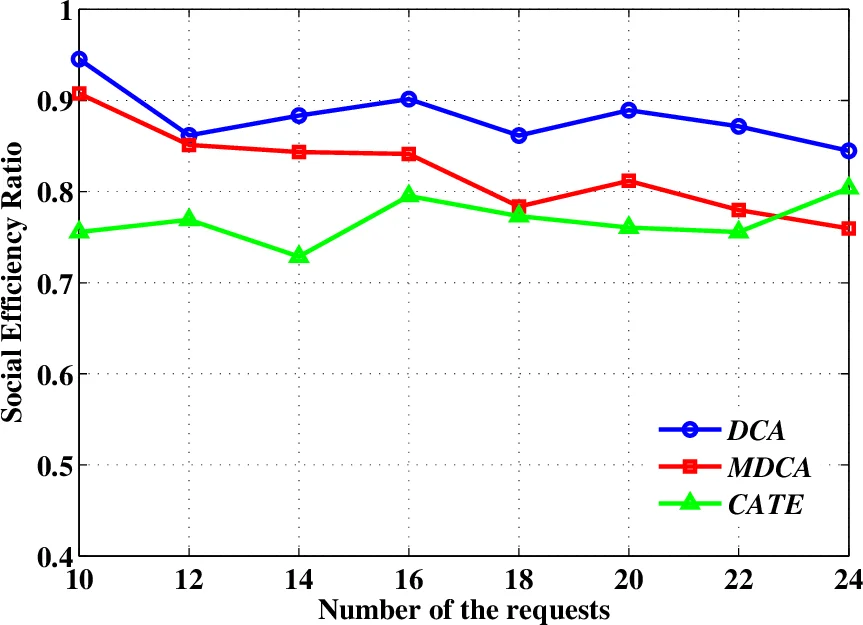
To obtain tractable solutions, the integer program is relaxed to a linear program (LP). Solving the LP yields a fractional allocation, which is then converted to an integral solution via a two‑stage derandomization process. The initial deterministic channel allocation (DCA) guarantees an expected weight of at least (1 − 1/e) of the optimal but fails the monotonicity required for truthfulness. The authors therefore propose a monotone version (MDCA) that preserves bid‑monotonicity, enabling the use of critical‑value payments to achieve a fully truthful mechanism for social‑welfare maximization.
For revenue maximization, Myerson’s virtual valuation is employed. Requests whose virtual bids exceed a preset virtual reserve price are fed into the same MDCA framework; after allocation, virtual payments are transformed back to real payments via the inverse virtual‑valuation function, forming the CA‑TE (truthful in expectation) mechanism. Both mechanisms are proven to achieve a (1 − 1/e) approximation ratio to the respective optimal objectives while remaining computationally polynomial.
Extensive simulations varying channel numbers, request densities, and time‑slot lengths confirm that the proposed mechanisms consistently outperform existing random or greedy approaches, achieving 10‑20 % higher social welfare and revenue, and approaching the theoretical approximation bound as the problem size grows. The work thus delivers the first truthful spectrum auction scheme that simultaneously handles spatial, temporal, and spectral reuse with provable performance guarantees. Future directions include handling variable‑length time requests, multi‑region cooperation, and dynamic bidding environments.
Comments & Academic Discussion
Loading comments...
Leave a Comment