Bisections of graphs
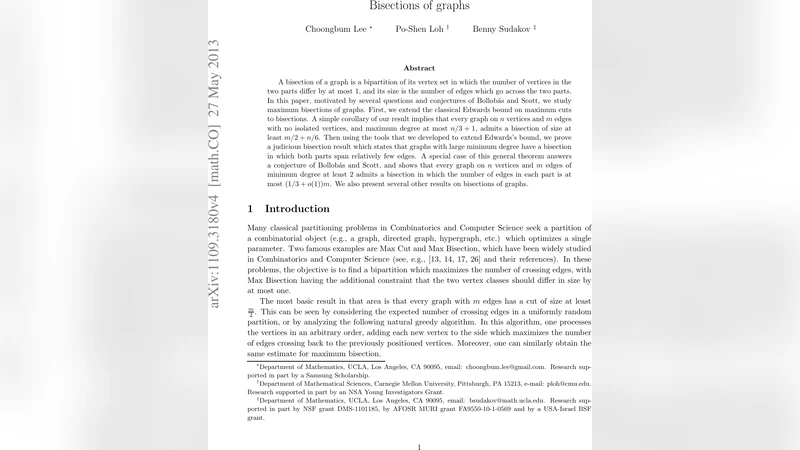
A bisection of a graph is a bipartition of its vertex set in which the number of vertices in the two parts differ by at most 1, and its size is the number of edges which go across the two parts. In this paper, motivated by several questions and conjectures of Bollob'as and Scott, we study maximum bisections of graphs. First, we extend the classical Edwards bound on maximum cuts to bisections. A simple corollary of our result implies that every graph on $n$ vertices and $m$ edges with no isolated vertices, and maximum degree at most $n/3 + 1$, admits a bisection of size at least $m/2 + n/6$. Then using the tools that we developed to extend Edwards’s bound, we prove a judicious bisection result which states that graphs with large minimum degree have a bisection in which both parts span relatively few edges. A special case of this general theorem answers a conjecture of Bollob'as and Scott, and shows that every graph on $n$ vertices and $m$ edges of minimum degree at least 2 admits a bisection in which the number of edges in each part is at most $(1/3+o(1))m$. We also present several other results on bisections of graphs.
💡 Research Summary
The paper investigates the problem of finding large bisections in graphs, extending classical results on maximum cuts to the more restrictive setting where the two vertex classes must be of almost equal size. The authors begin by recalling Edwards’ theorem, which guarantees a cut of size at least m/2 + (√(2m + 1) − 1)/8 for any graph with m edges, and Bollobás–Scott’s judicious cut result, which simultaneously maximises the cut size while keeping the number of edges inside each side small. The central contribution is a suite of new theorems that adapt these ideas to bisections.
Theorem 1.3 (Extended Edwards bound for bisections).
For a graph G with maximum degree Δ and τ tight components (a newly defined structural notion), there exists a bisection of size at least
m/2 + (n − max{τ, Δ − 1})/4.
The bound is shown to be tight for both parameters τ and Δ, with examples ranging from disjoint triangles to stars. Immediate corollaries give clean formulas when only Δ is bounded: if Δ ≤ n/3 + 1 and the graph has no isolated vertices, a bisection of size at least m/2 + n/6 exists (Corollary 1.5). More generally, any n‑vertex graph admits a bisection of size at least m/2 + (n + 1 − Δ)/4 (Corollary 1.4).
Judicious bisections.
The authors turn to the harder problem of finding a bisection that is not only large but also “judicious”, i.e., each part spans few edges. The star K₁,ₙ₋₁ shows that without extra conditions a large bisection can still have Θ(n²) internal edges. Bollobás and Scott conjectured that if the minimum degree δ ≥ 2, then a bisection exists with at most m/3 edges inside each side. The paper confirms this conjecture asymptotically (Theorem 1.8) and determines the exact constant for any even δ (Theorem 1.9):
e(V_i) ≤ (δ + 2)/(4(δ + 1))·m + o(m).
For odd δ the same bound follows by applying the even‑δ result to δ − 1. The authors exhibit two families of extremal constructions—disjoint cliques of size δ or δ + 1 together with a universal vertex, and the complete bipartite graph K_{δ+1, n‑δ‑1}—that show the bound cannot be improved.
Technical tools.
The proofs rely on a blend of probabilistic and martingale techniques. A short second‑moment argument (Lemma 2.1) yields a large random bisection when the graph is sparse or has bounded maximum degree. To control the internal edges, the authors develop a martingale concentration framework (Theorem 1.11) that, given a bound on the number τ of tight components, guarantees each side contains at most m/4 − (n + τ)/8 + εn edges. This result is a “randomized” analogue of Theorem 1.3 and is robust enough to handle graphs with a few high‑degree vertices: those vertices are first split optimally, and the remaining low‑degree part is treated via Theorem 1.11.
Further extensions.
The paper also studies “α‑bisections”, where each side may be slightly larger than n/2. Theorem 1.6 shows that for any fixed α ≤ 1/6, every graph without isolated vertices contains an α‑bisection of size at least m/2 + αn, thereby generalising the n/6 term in (3). Moreover, Theorem 1.13 provides almost‑bisections for graphs with bounded maximum degree r, achieving cut sizes (r + 1)/(2r)·m (r odd) or (r + 2)/(2(r + 1))·m (r even) while allowing a size imbalance of at most r² + 1. Corollaries recover known results for regular graphs (Theorem 1.14).
Organization.
Section 2 presents the second‑moment argument leading to Theorem 1.7. Section 3 develops the theory of tight components and proves Theorems 1.3 and 1.6 together with the corollaries. Section 4 introduces the martingale concentration method and proves Theorem 1.11. Sections 5 and 6 combine these tools with a careful handling of high‑degree vertices to establish Theorems 1.8 and 1.9, respectively, and Proposition 1.10 confirms their optimality. Section 7 contains proofs of auxiliary results from Section 1.3, and the paper concludes with remarks and open problems.
In summary, the authors provide a comprehensive treatment of maximum bisections, extending classical cut bounds, establishing tight judicious bisection results for graphs with large minimum degree, and introducing versatile probabilistic‑combinatorial techniques that may be useful for related partitioning problems in graph theory and computer science.
Comments & Academic Discussion
Loading comments...
Leave a Comment