Generalized detailed Fluctuation Theorem under Nonequilibrium Feedback control
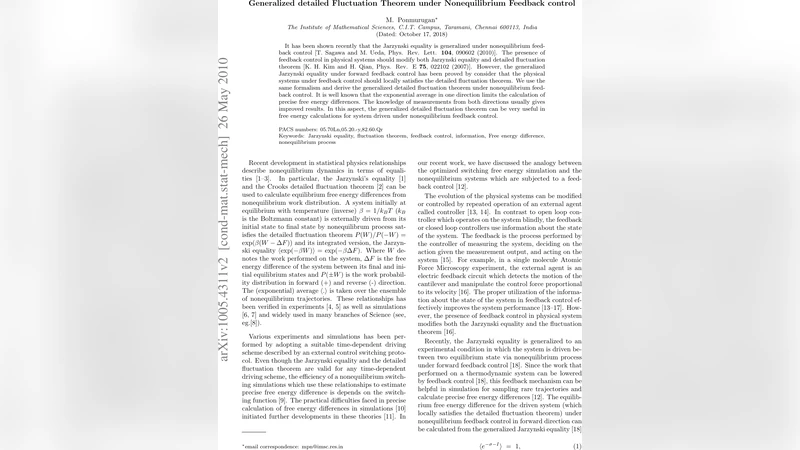
It has been shown recently that the Jarzynski equality is generalized under nonequilibrium feedback control [T. Sagawa and M. Ueda, Phys. Rev. Lett. {\bf 104}, 090602 (2010)]. The presence of feedback control in physical systems should modify both Jarzynski equality and detailed fluctuation theorem [K. H. Kim and H. Qian, Phys. Rev. E {\bf 75}, 022102 (2007)]. However, the generalized Jarzynski equality under forward feedback control has been proved by consider that the physical systems under feedback control should locally satisfies the detailed fluctuation theorem. We use the same formalism and derive the generalized detailed fluctuation theorem under nonequilibrium feedback control. It is well known that the exponential average in one direction limits the calculation of precise free energy differences. The knowledge of measurements from both directions usually gives improved results. In this aspect, the generalized detailed fluctuation theorem can be very useful in free energy calculations for system driven under nonequilibrium feedback control.
💡 Research Summary
The paper addresses a fundamental gap in nonequilibrium statistical mechanics: how the detailed fluctuation theorem (DFT) must be modified when a system is subject to feedback control based on measurements. Building on the earlier work of Sagawa and Ueda, who showed that the Jarzynski equality acquires an extra information term under feedback, the authors ask whether a similar correction appears in the more stringent DFT, which relates the probability of a forward trajectory to that of its time‑reversed counterpart.
Using the same “local detailed balance” framework employed by Kim and Qian, the authors consider a generic stochastic dynamics (continuous Langevin or discrete Markov jump) in which at a prescribed time a measurement m is performed, and the subsequent control protocol Λ(m) depends explicitly on the outcome. For a given measurement record m, the forward path probability P_F
Comments & Academic Discussion
Loading comments...
Leave a Comment