Noise and critical phenomena in biochemical signaling cycles at small molecule numbers
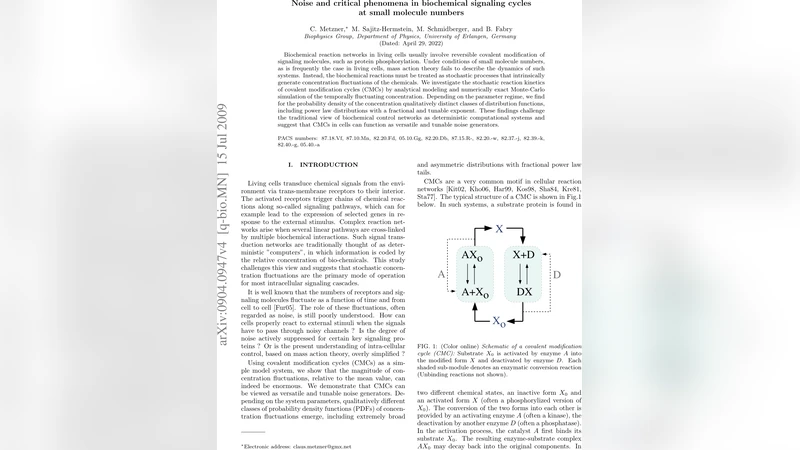
Biochemical reaction networks in living cells usually involve reversible covalent modification of signaling molecules, such as protein phosphorylation. Under conditions of small molecule numbers, as is frequently the case in living cells, mass action theory fails to describe the dynamics of such systems. Instead, the biochemical reactions must be treated as stochastic processes that intrinsically generate concentration fluctuations of the chemicals. We investigate the stochastic reaction kinetics of covalent modification cycles (CMCs) by analytical modeling and numerically exact Monte-Carlo simulation of the temporally fluctuating concentration. Depending on the parameter regime, we find for the probability density of the concentration qualitatively distinct classes of distribution functions, including power law distributions with a fractional and tunable exponent. These findings challenge the traditional view of biochemical control networks as deterministic computational systems and suggest that CMCs in cells can function as versatile and tunable noise generators.
💡 Research Summary
The paper addresses the stochastic dynamics of covalent modification cycles (CMCs), a ubiquitous motif in cellular signaling where a substrate is reversibly modified—most commonly by phosphorylation and dephosphorylation—through the action of two opposing enzymes. While classical mass‑action kinetics treat concentrations as continuous variables governed by deterministic differential equations, this approximation breaks down when the absolute numbers of molecules involved are low, a situation that frequently occurs in living cells. In such regimes, each elementary reaction event is a discrete, random occurrence, and the system must be described by a master equation that captures the probability distribution of molecular counts over time.
The authors first formulate the full master equation for a generic CMC, explicitly accounting for binding and unbinding of substrate–enzyme complexes, catalytic conversion, and the reverse reaction. By applying a system‑size expansion (van Kampen’s Ω‑expansion), they derive a Fokker‑Planck approximation that separates deterministic drift (the usual mass‑action term) from a diffusion term representing intrinsic noise. The diffusion coefficient depends on the kinetic parameters (forward and reverse rate constants) and on the total amounts of substrate and enzymes, revealing how noise amplitude varies across parameter space.
To validate the analytical results, the authors perform exact stochastic simulations using Gillespie’s algorithm. These simulations generate time series of substrate concentration for a wide range of kinetic regimes, and the resulting histograms are compared with the analytical probability density functions (PDFs). The agreement is excellent, confirming that the Fokker‑Planck approximation captures the essential features of the stochastic dynamics.
A central finding is that the shape of the stationary PDF falls into three qualitatively distinct classes, depending on the relative magnitudes of the enzymatic saturation and the forward‑reverse rate ratio:
-
Linear (low‑saturation) regime – When both enzymes operate far from saturation, the system behaves almost linearly. The PDF is narrow and approximately Gaussian, and the variance scales inversely with the total molecule number, as expected from the central limit theorem.
-
Saturation (high‑saturation) regime – When one or both enzymes are saturated with substrate, the deterministic fixed point becomes less stable and fluctuations are amplified. The PDF develops a long exponential tail; in some parameter sets it resembles a log‑normal distribution. This reflects the fact that the effective reaction propensity becomes a highly nonlinear function of the substrate count.
-
Critical (near‑bifurcation) regime – At a specific balance between forward and reverse catalytic rates, the system approaches a kinetic “critical point.” Here the PDF follows a power‑law over several decades, (P(x) \sim x^{-\alpha}), with an exponent (\alpha) that can be continuously tuned by adjusting enzyme concentrations or rate constants. When the forward conversion dominates strongly, (\alpha) approaches 1, producing a 1/f‑like noise spectrum.
The emergence of power‑law statistics is particularly striking because it signals scale‑free fluctuations reminiscent of phase transitions in physical systems. The authors argue that CMCs can therefore act as intrinsic, tunable noise generators: by modestly changing enzyme expression levels or catalytic efficiencies, a cell can shift from a regime of low, Gaussian noise to one where fluctuations are heavy‑tailed and dominate system behavior.
The biological implications are profound. Traditional views treat signaling pathways as deterministic computational devices that aim to suppress noise. This work suggests the opposite: cells may deliberately exploit stochasticity to achieve functions such as probabilistic decision‑making, bet‑hedging, or the generation of heterogeneous responses within a population. For example, a power‑law distribution of a phosphorylated transcription factor could produce a broad spectrum of gene‑expression states, enabling a subpopulation of cells to survive sudden environmental changes.
Finally, the paper outlines future directions. Experimental verification could involve single‑cell fluorescence or flow cytometry to measure the distribution of phosphorylated substrates under controlled enzyme expression. Synthetic biology offers a testbed: engineered CMC modules with adjustable kinetic parameters could be inserted into microbes to program desired noise characteristics, opening avenues for stochastic computing or robust biosensing. In summary, the study demonstrates that stochastic effects in low‑copy‑number biochemical cycles are not merely a nuisance but a functional resource, and that covalent modification cycles provide a versatile platform for generating and tuning intracellular noise.
Comments & Academic Discussion
Loading comments...
Leave a Comment