Tolerating the Community Detection Resolution Limit with Edge Weighting
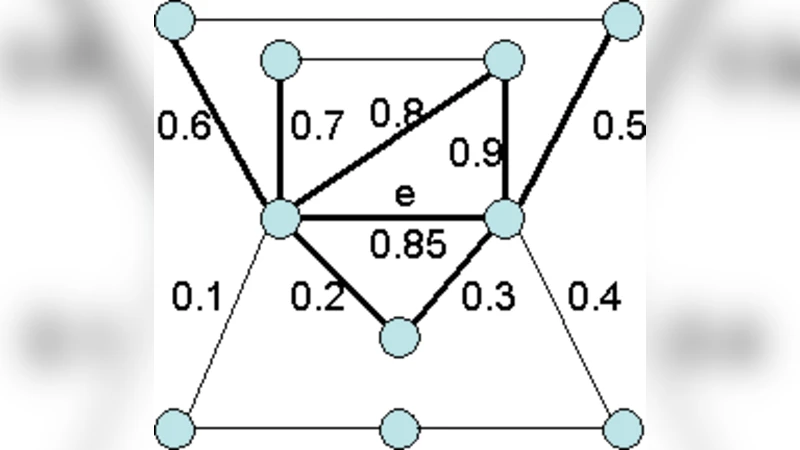
Communities of vertices within a giant network such as the World-Wide Web are likely to be vastly smaller than the network itself. However, Fortunato and Barth'{e}lemy have proved that modularity maximization algorithms for community detection may fail to resolve communities with fewer than $\sqrt{L/2}$ edges, where $L$ is the number of edges in the entire network. This resolution limit leads modularity maximization algorithms to have notoriously poor accuracy on many real networks. Fortunato and Barth'{e}lemy’s argument can be extended to networks with weighted edges as well, and we derive this corollary argument. We conclude that weighted modularity algorithms may fail to resolve communities with fewer than $\sqrt{W \epsilon/2}$ total edge weight, where $W$ is the total edge weight in the network and $\epsilon$ is the maximum weight of an inter-community edge. If $\epsilon$ is small, then small communities can be resolved. Given a weighted or unweighted network, we describe how to derive new edge weights in order to achieve a low $\epsilon$, we modify the ``CNM’’ community detection algorithm to maximize weighted modularity, and show that the resulting algorithm has greatly improved accuracy. In experiments with an emerging community standard benchmark, we find that our simple CNM variant is competitive with the most accurate community detection methods yet proposed.
💡 Research Summary
The paper addresses a well‑known shortcoming of modularity‑based community detection: the resolution limit first identified by Fortunato and Barthélemy. Their theorem states that any algorithm that maximizes the standard (unweighted) modularity Q cannot reliably separate communities that contain fewer than √(L/2) edges, where L is the total number of edges in the network. In practice this means that small but meaningful groups are often merged into larger clusters, leading to poor accuracy on real‑world graphs such as the World‑Wide Web, social media networks, or biological interaction maps.
The authors extend the original argument to weighted graphs. By replacing the total edge count L with the total edge weight W and introducing ε as the maximum weight of any inter‑community edge, they derive a weighted resolution bound of √(W ε / 2). The bound shows that if ε can be made sufficiently small, the threshold for detectable community size drops dramatically, allowing the detection of much smaller groups.
To exploit this insight, the paper proposes a two‑step edge‑weight re‑scaling procedure. First, all edges are assigned a baseline weight based on a similarity measure (e.g., inverse shortest‑path distance or cosine similarity) and then normalized so that the overall weight sum W is controlled. Second, a damping factor is applied selectively to edges that are likely to cross community boundaries. The damping factor can be derived from a cheap preliminary labeling (such as a few iterations of label propagation) or from domain‑specific knowledge. By attenuating only the inter‑community edges, the maximum inter‑community weight ε is reduced without substantially altering the intrinsic structure of the network.
With the re‑scaled weights in hand, the authors modify the classic Clauset‑Newman‑Moore (CNM) agglomerative algorithm to maximize the weighted modularity
Q_w = (1/2W) ∑_{ij}
Comments & Academic Discussion
Loading comments...
Leave a Comment