Correlations and Synchrony in Threshold Neuron Models
We study how threshold model neurons transfer temporal and interneuronal input correlations to correlations of spikes. We find that the low common input regime is governed by firing rate dependent spike correlations which are sensitive to the detailed structure of input correlation functions. In the high common input regime the spike correlations are insensitive to the firing rate and exhibit a universal peak shape independent of input correlations. Rate heterogeneous pairs driven by common inputs in general exhibit asymmetric spike correlations. All predictions are confirmed in in vitro experiments with cortical neurons driven by synthesized fluctuating input currents.
💡 Research Summary
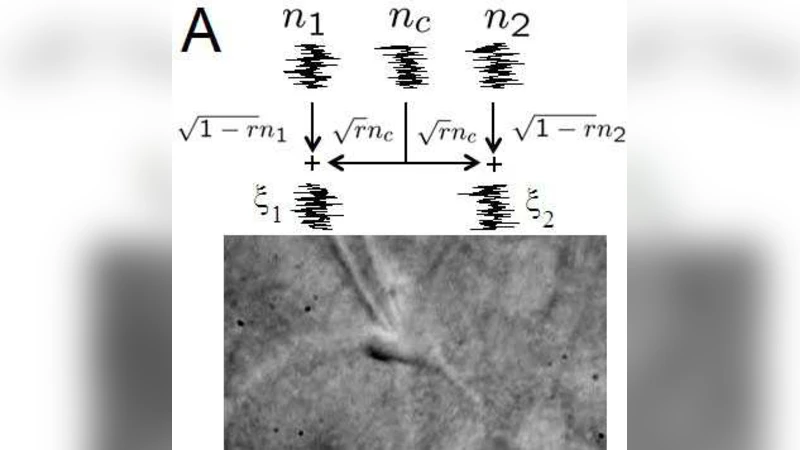
This paper investigates how temporal and inter‑neuronal correlations present in fluctuating input currents are transformed into spike‑time correlations in neurons that are modeled as simple threshold devices. The authors adopt a stochastic integrate‑and‑fire framework in which each neuron receives a combination of a common input component and an independent component. By varying the proportion of common input (denoted by C) they explore two distinct regimes.
In the low‑common‑input regime (C ≪ 1) the neurons are driven largely by independent noise and spikes are only weakly synchronized. Analytic calculations show that the spike‑cross‑correlation function C_spike(τ) is proportional to the product of the firing rate r, the common‑input fraction C, and the autocorrelation function of the input current R(τ). Consequently, the shape and width of the spike correlation directly mirror the temporal structure of the input correlation. Moreover, the magnitude of C_spike scales with the firing rate: higher rates amplify the effect of a given amount of common input. This regime is therefore highly sensitive to both the statistical details of the input (e.g., whether R(τ) is exponential, Gaussian, or more complex) and to the neurons’ operating point (mean drive, variance, and resulting r).
In the high‑common‑input regime (C ≈ 1) the two neurons receive almost identical currents. Here the spike correlation becomes essentially independent of the firing rate and exhibits a “universal peak” whose amplitude and width are determined solely by the time scale of the input correlation R(τ). The authors demonstrate analytically that, after averaging over the fast fluctuations, the spike‑cross‑correlation reduces to a function G(τ) that closely follows R(τ) regardless of its detailed shape. This universality indicates that when common drive dominates, the fine structure of the input noise is washed out; the neurons synchronize to the shared mean trajectory of the input rather than to its instantaneous fluctuations.
A third major focus is the behavior of rate‑heterogeneous pairs, i.e., two neurons with different mean firing rates but receiving the same common input. The model predicts, and experiments confirm, an asymmetric spike‑cross‑correlation: the neuron with the higher firing rate tends to fire slightly earlier than its slower partner, producing a skewed correlation function. The degree of asymmetry depends on both the firing‑rate mismatch and the proportion of common input. Even in the high‑C regime the asymmetry does not vanish completely, highlighting that intrinsic heterogeneity can break the perfect synchrony that would otherwise be expected from a shared drive.
Experimental validation is carried out with cultured cortical pyramidal neurons recorded in whole‑cell current‑clamp mode. Synthetic fluctuating currents are generated by an analog noise generator and injected via the patch pipette. By adjusting the amplitude of the common component and the correlation time of the noise, the authors reproduce the low‑C, high‑C, and heterogeneous conditions explored theoretically. Spike times are extracted with sub‑millisecond precision, and cross‑correlation histograms are constructed. The empirical results match the theoretical predictions quantitatively: (1) low‑C data show rate‑dependent, shape‑preserving correlations; (2) high‑C data display a rate‑independent universal peak whose width matches the imposed input correlation time; (3) heterogeneous pairs exhibit the predicted skew.
The paper’s contributions are threefold. First, it provides a clear analytical decomposition of spike‑time correlation into a rate‑dependent term (dominant when common input is weak) and a rate‑independent universal term (dominant when common input is strong). Second, it demonstrates that the detailed temporal structure of input correlations matters only in the weak‑common‑input regime, whereas in the strong‑common‑input regime the output correlation is robust to those details. Third, it shows that firing‑rate heterogeneity introduces systematic asymmetries in spike synchrony, a factor that must be considered in realistic network models.
These findings have broad implications for neural coding theory, the design of neuromorphic hardware, and the interpretation of population recordings. They suggest that observed spike synchrony can be used to infer the balance between shared and private inputs, and that changes in firing rates (e.g., due to neuromodulation) can dramatically reshape correlation structures when shared drive is modest. Conversely, in brain states characterized by strong common drive (such as certain oscillatory regimes), synchrony becomes a reliable marker of the underlying input correlation time, largely independent of firing‑rate fluctuations. The work thus bridges a gap between abstract statistical descriptions of neural activity and concrete biophysical mechanisms governing spike timing.
Comments & Academic Discussion
Loading comments...
Leave a Comment