Dynamical Phase Transitions In Driven Integrate-And-Fire Neurons
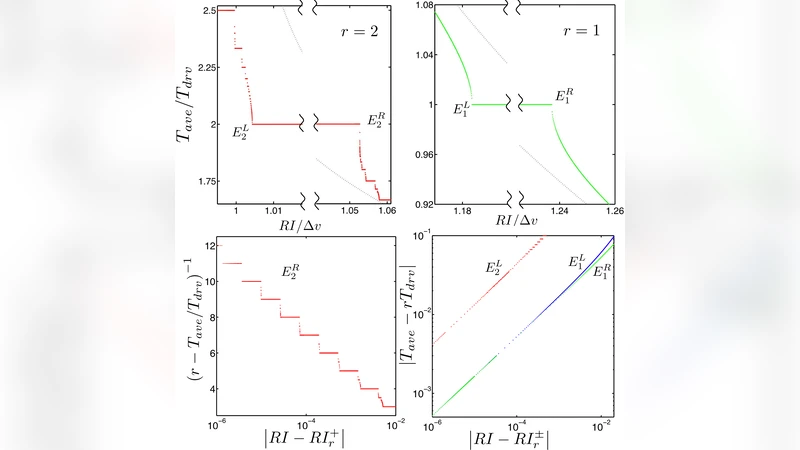
We explore the dynamics of an integrate-and-fire neuron with an oscillatory stimulus. The frustration due to the competition between the neuron’s natural firing period and that of the oscillatory rhythm, leads to a rich structure of asymptotic phase locking patterns and ordering dynamics. The phase transitions between these states can be classified as either tangent or discontinuous bifurcations, each with its own characteristic scaling laws. The discontinuous bifurcations exhibit a new kind of phase transition that may be viewed as intermediate between continuous and first order, while tangent bifurcations behave like continuous transitions with a diverging coherence scale.
💡 Research Summary
The paper investigates a minimal spiking neuron model – the leaky integrate‑and‑fire (IF) neuron – when it is driven by a sinusoidal current. The authors start from the classic differential equation
dv/dt = –(v – v_eq) + I,
with a reset to v_eq whenever the membrane potential reaches the threshold v_th. Adding an oscillatory term ε cos(ω_D t) to the constant drive I creates a competition between the neuron’s intrinsic firing period T_nat = ln
Comments & Academic Discussion
Loading comments...
Leave a Comment