The enriched Vietoris monad on representable spaces
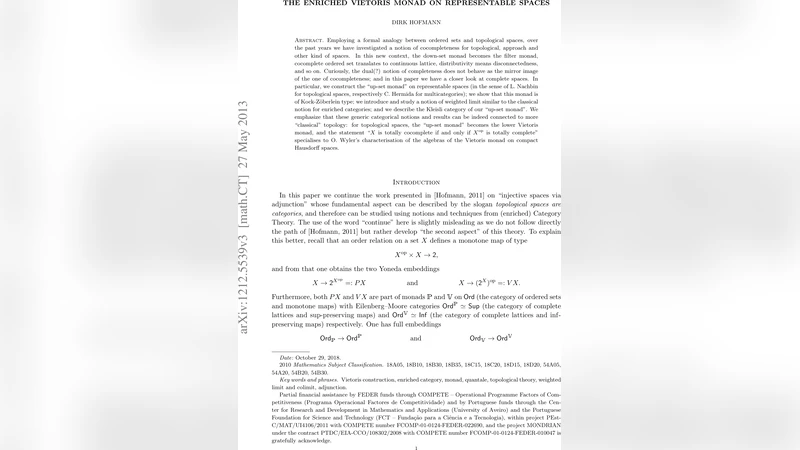
Employing a formal analogy between ordered sets and topological spaces, over the past years we have investigated a notion of cocompleteness for topological, approach and other kind of spaces. In this new context, the down-set monad becomes the filter monad, cocomplete ordered set translates to continuous lattice, distributivity means disconnectedness, and so on. Curiously, the dual(?) notion of completeness does not behave as the mirror image of the one of cocompleteness; and in this paper we have a closer look at complete spaces. In particular, we construct the “up-set monad” on representable spaces (in the sense of L. Nachbin for topological spaces, respectively C. Hermida for multicategories); we show that this monad is of Kock-Z"oberlein type; we introduce and study a notion of weighted limit similar to the classical notion for enriched categories; and we describe the Kleisli category of our “up-set monad”. We emphasize that these generic categorical notions and results can be indeed connected to more “classical” topology: for topological spaces, the “up-set monad” becomes the upper Vietoris monad, and the statement “$X$ is totally cocomplete if and only if $X^\mathrm{op}$ is totally complete” specialises to O. Wyler’s characterisation of the algebras of the Vietoris monad on compact Hausdorff spaces.
💡 Research Summary
The paper investigates a categorical analogue of the well‑known Vietoris construction, but in a setting that abstracts both ordered sets and topological spaces through the notion of representable spaces. Starting from the observation that the down‑set monad on a poset corresponds to the filter monad on a topological space, the authors reinterpret cocompleteness as continuity of lattices, distributivity as a form of disconnectedness, and so on. The central contribution is the definition of an “up‑set monad” on representable spaces—a class introduced by L. Nachbin for topological spaces and later generalized by C. Hermida to multicategories.
A representable space is one in which each point can be identified with a certain filter (or, dually, an up‑set) that captures the local convergence structure. On such a space X, the up‑set monad sends X to the collection of all up‑sets of X ordered by inclusion; the unit embeds a point as the principal up‑set generated by that point, while the multiplication flattens a double‑layer of up‑sets into a single layer by taking unions. The authors prove that this monad is of Kock‑Zöberlein (KZ) type, meaning that its unit and multiplication are respectively reflective and coreflective, and that the induced algebras enjoy a bidirectional continuity property. This KZ property is crucial because it guarantees the existence of weighted limits that behave exactly like limits in enriched category theory, but with the “weights” now given by filters or up‑sets rather than by objects of a monoidal base.
To make the limit theory precise, the paper introduces a notion of weighted limit adapted to the up‑set context. For a diagram D together with a weight W (a functor assigning to each object of D an up‑set), a W‑limit is an object that receives a universal cone consisting of up‑continuous maps, i.e., maps that preserve the up‑set structure. The authors show that the existence of all such weighted limits characterises “total completeness” of a representable space, while the dual notion of weighted colimit characterises “total cocompleteness”.
The Kleisli category of the up‑set monad is described in detail. Its objects are the original representable spaces, and its morphisms are precisely the up‑continuous maps. Composition is given by the monad multiplication, which corresponds to taking the up‑set generated by the image of an up‑continuous map. In the special case where the underlying representable spaces are ordinary compact Hausdorff spaces, this Kleisli category coincides with the classical category of compact Hausdorff spaces equipped with the upper Vietoris construction. Consequently, the up‑set monad reduces to the upper Vietoris monad on topological spaces.
A striking corollary is the generalisation of O. Wyler’s characterisation of Vietoris algebras: the paper proves that a representable space X is totally cocomplete if and only if its opposite X^op is totally complete. When specialised to compact Hausdorff spaces, this statement becomes exactly Wyler’s theorem that the algebras of the Vietoris monad are precisely the continuous lattices (i.e., compact Hausdorff spaces that are also complete lattices with the Scott topology). This result demonstrates that the duality between completeness and cocompleteness, which fails in many naïve settings, is restored in the enriched, representable framework.
Beyond the abstract theory, the authors provide concrete examples. For the real line with its usual topology, up‑sets are simply open upward‑closed subsets, and up‑continuous maps are open maps. In approach spaces, the same construction yields a monad whose algebras are precisely the “approach lattices” studied in quantitative domain theory. These examples illustrate how the categorical machinery captures familiar topological phenomena while simultaneously extending them to more general contexts such as multicategories and quantitative spaces.
In summary, the paper offers a unified categorical treatment of completeness and cocompleteness for a broad class of spaces by introducing the up‑set (upper Vietoris) monad, establishing its Kock‑Zöberlein nature, developing a weighted limit theory, and identifying its Kleisli category. The work not only recovers known results about the Vietoris monad on compact Hausdorff spaces but also opens the door to new applications in enriched category theory, domain theory, and quantitative topology.
Comments & Academic Discussion
Loading comments...
Leave a Comment