Optimal Power Allocation for Outage Minimization in Fading Channels with Energy Harvesting Constraints
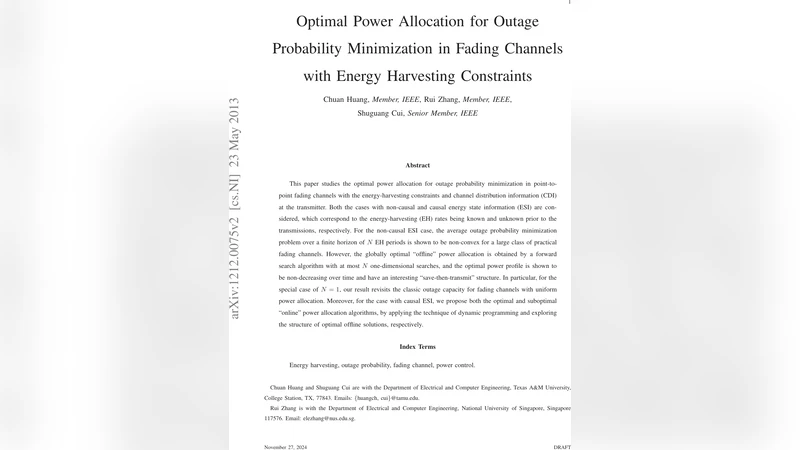
This paper studies the optimal power allocation for outage minimization in point-to-point fading channels with the energy-harvesting constraints and channel distribution information (CDI) at the transmitter. Both the cases with non-causal and causal energy state information (ESI) are considered, which correspond to the energy harvesting rates being known and unknown prior to the transmissions, respectively. For the non-causal ESI case, the average outage probability minimization problem over a finite horizon is shown to be non-convex for a large class of practical fading channels. However, the globally optimal “offline” power allocation is obtained by a forward search algorithm with at most $N$ one-dimensional searches, and the optimal power profile is shown to be non-decreasing over time and have an interesting “save-then-transmit” structure. In particular, for the special case of N=1, our result revisits the classic outage capacity for fading channels with uniform power allocation. Moreover, for the case with causal ESI, we propose both the optimal and suboptimal “online” power allocation algorithms, by applying the technique of dynamic programming and exploring the structure of optimal offline solutions, respectively.
💡 Research Summary
This paper addresses the problem of minimizing the average outage probability in a point‑to‑point fading channel when the transmitter is powered by an energy‑harvesting (EH) source and only has channel distribution information (CDI) but not instantaneous channel state information. Two distinct information patterns regarding the harvested energy are considered: (i) non‑causal energy state information (ESI), where the entire sequence of harvested energy over a finite horizon of N slots is known in advance, and (ii) causal ESI, where only the current battery level and past harvests are known while future arrivals are uncertain.
For the non‑causal case, the authors formulate the outage‑minimization problem as a finite‑horizon optimization over the power allocation vector ({p_t}_{t=1}^N). They prove that, for a broad class of practical fading distributions (Rayleigh, Rice, Nakagami‑m, etc.), the problem is non‑convex, precluding direct application of convex optimization tools. By exploiting the structure of the outage probability function, they demonstrate that an optimal power profile must be non‑decreasing in time, i.e., (p_1 \le p_2 \le \dots \le p_N). This monotonicity reflects a “save‑then‑transmit” strategy: the transmitter stores harvested energy early on and gradually increases its transmit power as the horizon progresses. Leveraging this property, they develop a forward‑search algorithm that requires at most N one‑dimensional searches to locate the globally optimal offline allocation. The algorithm’s computational burden grows linearly with the horizon length, a dramatic reduction compared with exhaustive search. As a sanity check, the special case (N=1) reduces to uniform power allocation, reproducing the classic outage‑capacity result for fading channels.
In the causal ESI scenario, the transmitter must decide the power for each slot based only on the current battery state. The authors cast the problem as a finite‑horizon Markov decision process (MDP) with state ((B_t,,t)) (battery level and remaining slots) and action (p_t). Using dynamic programming (DP), they derive the Bellman recursion and obtain the optimal online policy that minimizes the expected outage probability. However, the DP solution suffers from the curse of dimensionality: the state space expands with battery granularity and horizon length, making real‑time implementation impractical. To overcome this, the paper proposes a low‑complexity suboptimal policy inspired by the offline solution’s structure. The suboptimal rule introduces a battery threshold (\theta); when the stored energy is below (\theta), the transmitter conserves power (often transmitting at the minimum feasible level), and once the threshold is crossed it distributes the remaining energy more evenly across the remaining slots. The threshold can be computed offline via a simple line search. Numerical experiments show that this heuristic achieves outage performance within 1–2 % of the DP optimum while reducing computational time by an order of magnitude, thereby making it suitable for real‑time EH‑powered devices.
Extensive simulations under Rayleigh, Rice, and Nakagami‑m fading, varying average signal‑to‑noise ratio (SNR), EH rates, and battery capacities, confirm the theoretical findings. The offline forward‑search algorithm consistently yields the global optimum and exhibits the predicted monotone power profile. In the online setting, the DP optimal policy provides the performance benchmark, and the threshold‑based suboptimal policy tracks it closely across all tested scenarios.
The key contributions of the work are: (1) identification of the non‑convex nature of outage‑minimization under EH constraints and derivation of a provably optimal offline algorithm with linear‑time complexity; (2) proof that the optimal offline power allocation is non‑decreasing and possesses a save‑then‑transmit structure; (3) formulation of the causal problem as an MDP and provision of both exact DP and practical suboptimal solutions; (4) demonstration that the suboptimal online policy, grounded in offline structural insights, offers near‑optimal performance with dramatically reduced computational load.
These results have immediate relevance for the design of low‑power wireless sensor networks, Internet‑of‑Things (IoT) devices, and any communication system that relies on renewable energy sources. By clarifying how to allocate harvested energy over time to mitigate outage, the paper offers a concrete design guideline that balances reliability and energy efficiency. Future research directions suggested include extending the framework to multi‑user or multi‑antenna settings, incorporating battery leakage and imperfect energy‑harvest predictions, and validating the algorithms on hardware testbeds to assess real‑world feasibility.