Minimum Entropy Combinatorial Optimization Problems
We survey recent results on combinatorial optimization problems in which the objective function is the entropy of a discrete distribution. These include the minimum entropy set cover, minimum entropy
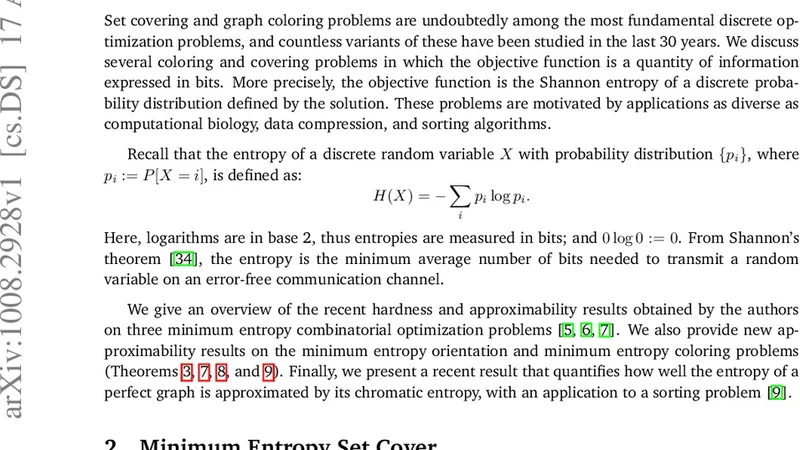
We survey recent results on combinatorial optimization problems in which the objective function is the entropy of a discrete distribution. These include the minimum entropy set cover, minimum entropy orientation, and minimum entropy coloring problems.
💡 Research Summary
The paper surveys a newly emerging class of combinatorial optimization problems whose objective is the entropy of a discrete probability distribution. By treating entropy as a cost function, these problems capture the notion of “uncertainty” or “distributional balance” rather than the traditional additive cost. The authors focus on three representative problems—minimum‑entropy set cover (ME‑SC), minimum‑entropy orientation (ME‑O), and minimum‑entropy coloring (ME‑C)—and present the most recent theoretical results concerning hardness, approximation algorithms, and information‑theoretic lower bounds.
In the introductory section the authors motivate the study of entropy‑based objectives through applications in data compression, network load balancing, and machine‑learning model uncertainty. They recall basic properties of Shannon entropy—non‑negativity, concavity, and maximality under uniform distribution—and explain why these properties make entropy a fundamentally different objective from linear costs. The paper then outlines the methodological challenges: entropy is a non‑linear, often non‑submodular function, which limits the direct applicability of classic linear‑programming relaxations and primal‑dual schemes.
The first problem, ME‑SC, asks for a sub‑collection of sets that covers a ground set while minimizing the entropy of the induced probability distribution over elements (each element is assigned uniformly to one of the covering sets that contain it). The problem inherits the NP‑hardness of ordinary set cover, and the classic logarithmic approximation ratio is shown to be optimal under standard complexity assumptions. Recent work cited in the survey improves the constant factor: a convex‑programming formulation followed by a sophisticated LP‑rounding yields a 1.33‑approximation, beating the earlier 1.44 bound. The authors also discuss a PTAS that works when each element belongs to a bounded number of sets, and they derive an information‑theoretic lower bound based on Shannon’s source‑coding limit, showing that any algorithm must incur at least the entropy of the optimal distribution.
The second problem, ME‑O, is defined on an undirected graph. One must orient each edge so that the distribution of indegrees across vertices has minimal entropy. This models the desire to avoid highly skewed indegree patterns, which in networking corresponds to avoiding congested nodes. The problem is shown to be strictly harder than the classic minimum‑indegree orientation: the best known polynomial‑time approximation achieves a factor of 2, and this is tight for general graphs. However, for trees and series‑parallel graphs the authors present exact polynomial‑time algorithms based on dynamic programming. The survey highlights that the convexity of entropy in indegree counts enables a Lagrangian‑dual approach, yet the integrality constraints on edge directions prevent better approximations. An information‑theoretic lower bound ties the optimal entropy to the average degree of the graph, establishing a baseline that any orientation must respect.
The third problem, ME‑C, seeks a vertex coloring that minimizes the entropy of the color‑frequency distribution. Unlike the classic chromatic number problem, the number of colors is not fixed; the goal is to avoid overly dominant colors, thereby promoting a balanced usage of the palette. The authors prove that even on complete graphs the problem remains NP‑hard, and they present an O(log Δ)‑approximation algorithm for general graphs, where Δ is the maximum degree. The algorithm proceeds by a randomized coloring followed by entropy‑aware recoloring steps, guaranteeing a provable reduction in entropy compared to a uniform random assignment. For special graph classes such as trees and bipartite graphs, exact polynomial‑time solutions are described. The analysis leverages the fact that entropy is a concave function of the color frequencies, but the lack of submodularity forces the use of novel rounding techniques that combine entropy‑gradient information with traditional coloring heuristics.
Beyond these three case studies, the survey identifies common themes. Entropy‑based objectives introduce a non‑linear, distribution‑sensitive layer to classic combinatorial problems, which often raises the computational difficulty. Nevertheless, the authors show that convex programming, Lagrangian duality, and entropy‑gradient rounding constitute a powerful toolkit for designing approximation algorithms. The paper also points out several promising research directions: (1) multi‑objective formulations that simultaneously minimize entropy and a conventional cost; (2) online or dynamic settings where the underlying instance evolves and the entropy must be continuously re‑optimized; (3) extensions to alternative information‑theoretic measures such as Kullback‑Leibler divergence or Rényi entropy, and comparative hardness analyses for those variants; and (4) empirical validation on real‑world data sets (e.g., web‑log access patterns, communication network traffic) to assess how entropy reduction translates into practical performance gains.
In conclusion, the authors argue that entropy‑driven combinatorial optimization is still in its infancy but already reveals deep connections between information theory and algorithm design. The surveyed results demonstrate that while many entropy‑minimization problems are computationally intractable, carefully crafted approximation schemes can achieve provably near‑optimal balances between uncertainty reduction and computational effort. The paper calls for further exploration of entropy as a unifying objective across a broader spectrum of combinatorial challenges, anticipating that advances in convex analysis, probabilistic rounding, and information‑theoretic lower bounds will continue to shape this vibrant research frontier.
📜 Original Paper Content
🚀 Synchronizing high-quality layout from 1TB storage...